

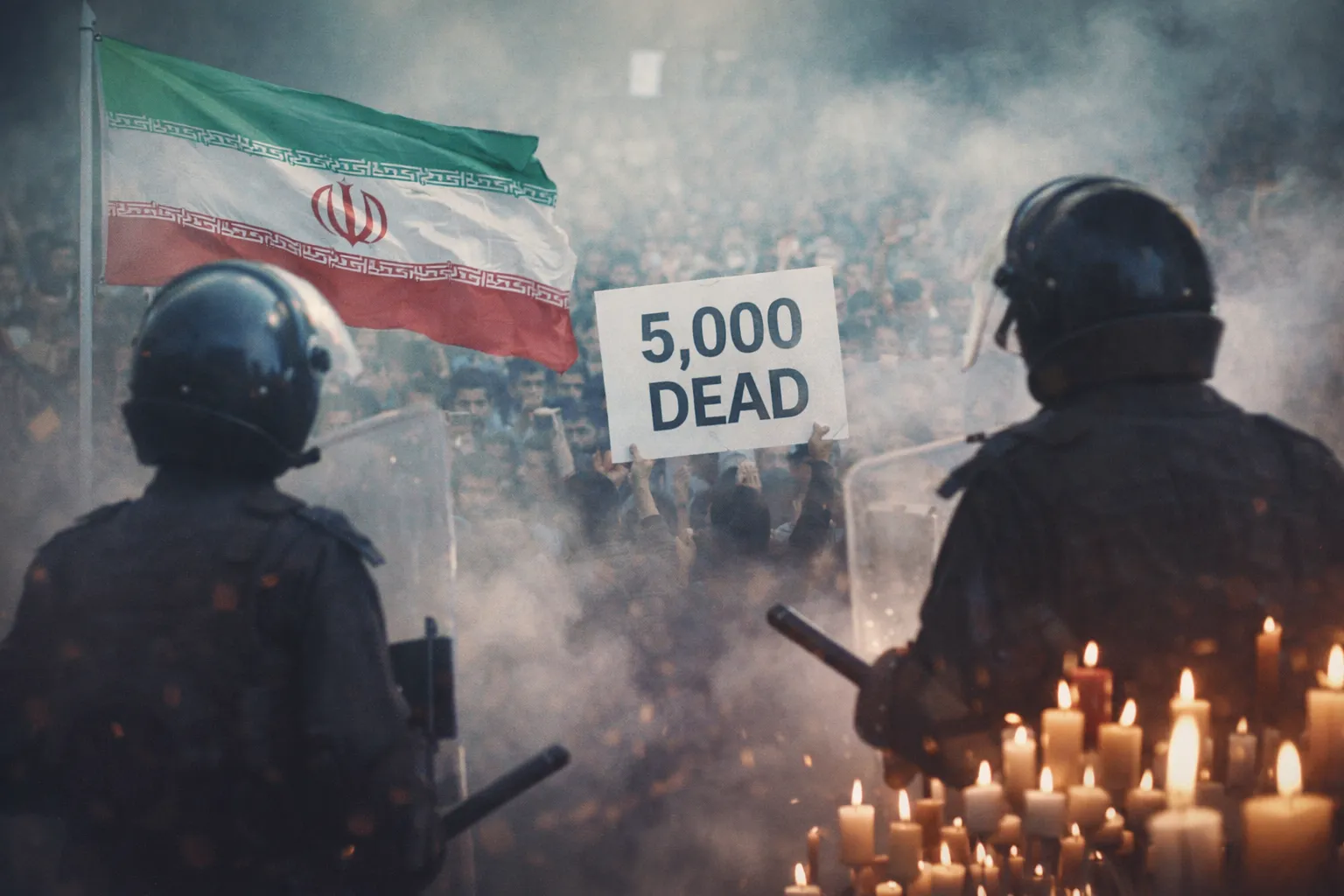
“5,000 Dead in Iran”: What’s Actually Confirmed, What Isn’t, and Why Verification Is So Difficult
Over the last hours (January 18, 2026), a headline-like figure has circulated widely across media and social platforms: “5,000 dead in Iran.” It is the kind of number that instantly shocks—and precisely for that reason, it demands strict discipline in verification.
In situations of intense repression, restricted communications, and polarized narratives, casualty figures can become instruments: sometimes minimized, sometimes inflated, often repeated without methodology. Responsible journalism starts by separating three different categories of information:
-
What is attributed to official or authority-linked sources (including anonymous sourcing).
-
What is documented by organizations using identifiable cases and verification methods.
-
What is estimated but cannot be independently confirmed in real time due to conditions on the ground.
Let’s put the claim into a clear, structured frame.
What is being reported as “confirmed”—and by whom
The “at least 5,000” figure is circulating as a reported claim attributed to a source linked to Iranian authorities, presented as an assertion that authorities have “verified” at least 5,000 deaths during unrest, sometimes alongside mentions that a portion of those deaths includes members of security forces.
This distinction is crucial:
-
A reported authority-linked claim is not the same thing as independent international verification.
-
The wording “verified” can mean “counted internally” according to criteria that are not transparent to outside observers.
-
In restricted environments, outsiders may not have access to primary documentation needed to confirm or refute the figure.
So, the accurate formulation is: the figure is being reported as an authority-linked claim, not as universally and independently confirmed.
Why casualty figures diverge so widely in closed or restricted environments
You may see lower numbers, higher numbers, and dramatically different ranges cited simultaneously. This happens for structural reasons, not only political ones.
1) Restricted information flow
When internet access is limited or disrupted, the chain of evidence becomes fragmented. Verification teams lose direct contact with witnesses, hospitals, and local networks. That slows confirmation, delays cross-checking, and expands the space for rumor.
2) Different methodologies
Numbers that sound similar can be fundamentally different measures:
-
Named, case-by-case confirmed deaths (typically slower but methodologically stronger).
-
Probable deaths based on multiple indirect indicators.
-
Broader estimates based on network reports that may be incomplete or overlapping.
-
Authority-linked counts that may include categories outsiders cannot audit.
These are not interchangeable, even if they appear in the same headline format.
3) Political incentives and narrative pressure
In crises, multiple actors have reasons to shape perception:
-
State narratives may downplay, reclassify, or limit disclosures.
-
Opposition networks and advocacy groups may emphasize maximum possible scale to catalyze international attention.
-
Media ecosystems amplify what is fastest and most emotionally gripping—often before verification catches up.
None of this automatically proves any side “right.” It simply explains why the information environment becomes unstable.
What the “5,000” figure would imply—if it reflects reality even partially
If a death toll on that scale were ultimately substantiated by converging, credible evidence, it would point to an event of extraordinary severity: a major legitimacy crisis, a heavy escalation of state force, and a humanitarian dimension that goes far beyond political framing.
But this is exactly why verification must be strict: human lives cannot be reduced to viral arithmetic. Behind any number are names, families, and specific circumstances—each of which requires documentation to be responsibly reported.
What to watch in the next 48–72 hours
If you want to track the story without getting pulled into noise, watch for four concrete signals:
-
Named, accountable statements (not only anonymous claims).
-
Methodology-backed updates from organizations that publish how they count and verify.
-
Changes in communications restrictions, which frequently determine how quickly independent evidence can emerge.
-
Institutional international responses with specific steps—not only rhetorical condemnation.
These indicators usually tell you whether a figure is stabilizing toward verification or drifting into informational warfare.
Bottom line: Is it confirmed or not?
With strict, professional language:
-
The “5,000 dead” figure is circulating as a reported claim attributed to an authority-linked source.
-
Independent, broadly accepted verification is not clearly established in the public record currently, and other estimates vary depending on the source and method.
-
The most responsible approach is to report the figure as a claim, explain the verification constraints, and update only when multiple credible lines of evidence converge.
In fast-moving crises, speed is not the highest standard. Accuracy is.
FAQs
Why can’t journalists “just confirm” the number quickly?
Because confirmation requires primary evidence: identities, dates, locations, medical or eyewitness documentation, and cross-checks—especially when access is restricted and communications are disrupted.
Why do some sources publish much higher or much lower estimates?
Because they are often counting different things using different methods—confirmed cases versus probable cases versus estimates versus authority-linked figures.
What is the most reliable sign that a number is stabilizing?
When multiple independent sources—using transparent methods—begin to converge on similar ranges over time.