

Table of Contents
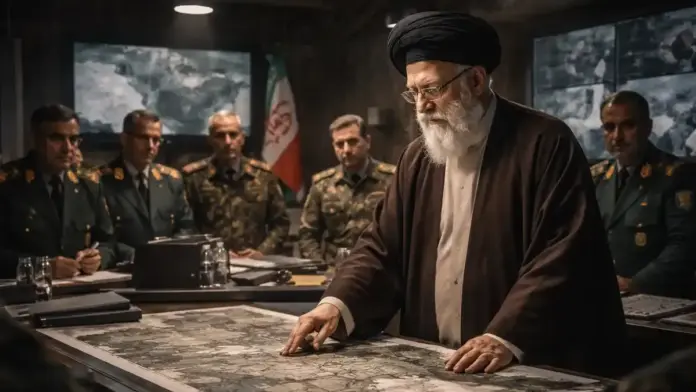
After Khamenei, Who Is Really Giving the Orders in Tehran?
The first point has to be stated clearly. With the strongest publicly available reporting today, the serious conclusion is not that Ali Khamenei may be secretly alive in the shadows. It is that he is being treated as dead. Iranian state media confirmed his death, according to AP, and Reuters now describes him as having been killed in the opening phase of the war. That means the real question is no longer whether he survived.
The real question is who is really giving the orders in Tehran now.
That question matters because Iran is not a simple presidential system where one leader disappears and the next one takes over in a clean, visible line. The Islamic Republic is a layered structure of clerical authority, security institutions, patronage networks, parallel chains of command, and ideological enforcement. Khamenei’s death removed the apex, but it did not erase the system beneath it. It made that system more opaque, more nervous, and potentially more dangerous.
Readers following the wider regional fallout can also move through Newsio’s broader EN Geopolitics coverage, because this power transition cannot be separated from the war that is reshaping the entire region.
The formal successor appears to be Mojtaba Khamenei
Reuters has reported that Mojtaba Khamenei, the son of the late supreme leader, was appointed by the Assembly of Experts as Iran’s new supreme leader. That outcome was not unexpected. For years, Mojtaba had been seen as the strongest succession candidate, with deep ties to hardline circles and especially to the Islamic Revolutionary Guard Corps.
But formal succession is not the same thing as uncontested control. Reuters noted that Mojtaba lacks his father’s senior clerical stature and historic political authority, even if he has long exercised influence behind the scenes.
That distinction is crucial. Ali Khamenei was not just a ruler with a title. He was the figure who held together the competing centers of the Islamic Republic: clerics, Guards, parliament, the presidency, the judiciary, and the coercive state. Mojtaba may have inherited the office, but that does not mean he automatically inherited the same lived authority inside the machinery of power.
For readers who want the larger strategic setting around that transition, Newsio’s analysis of Iran’s wider destabilizing reach helps explain why a wounded but functioning Tehran still matters far beyond its own borders.
The strongest sign of weakness is his absence
The most revealing detail may be less about the title itself and more about how Mojtaba has appeared since taking it. Reuters reported that weeks after his elevation, he had not appeared publicly in photo or video form before the Iranian public and had issued only two written statements.
The same reporting said he had been injured and remained physically absent from the kind of visible leadership performance that systems like Iran’s rely on in moments of crisis.
That is not a trivial detail. In a system built on ceremony, projection, and authority, physical presence matters. A silent leader with no public image does not just raise questions about health. He raises questions about whether he is truly ruling, or whether he is functioning as a formal cover for a deeper collective command structure operating behind him. That possibility is exactly why this story matters so much.
So who is really issuing the orders?
The most serious answer right now is this: probably not one single man in the old sense. Reuters reporting points instead to a more collective, more hardline, and more security-driven power configuration in which the Revolutionary Guards carry even greater real weight than before. The IRGC had reportedly prepared for decapitation scenarios, and Reuters noted that their influence rose further after Khamenei’s death and Mojtaba’s weak public posture.
That means Tehran may have lost the singular authority at the top without losing the ability to function. In fact, systems under extreme stress often shift power toward their hardest, best-organized coercive institutions. In Iran, that does not mean civil society or elected moderates.
It means the Guards and the networks built around them. Reuters had already reported before the strikes that U.S. intelligence assessed hardline IRGC elements could dominate a post-Khamenei scenario. In that sense, the question is no longer just succession. It is securitized succession.
The formal state is still there, but that is not the whole answer
Iran has not run out of state figures. The president, the parliament speaker, the judiciary, and senior IRGC commanders all remain part of the governing structure. But Reuters has also reported that the pool of experienced power brokers has thinned sharply after targeted killings, including the death of Ali Larijani, making Tehran’s decision-making narrower and more fragile. That matters because a thinner ruling circle is not the same thing as a weaker threat. Sometimes it means a harsher one.
This is where the analysis needs precision. Tehran today does not look like a vacuum. It looks more like a tighter, more opaque, more militarized decision center. Orders are still being produced. The issue is whether they are now being produced by a visible leader with full authority or by a smaller and harder survival machine operating behind the official face of succession.
Is there any serious basis for the “he may still be alive” theory?
With the current evidence, no. There is plenty of opacity around how the regime is functioning. There is confusion. There is heavy propaganda. There is deep uncertainty about who holds which levers from one day to the next. But that is not the same thing as a serious evidentiary basis for saying Khamenei is secretly alive. AP and Reuters, the two strongest public reporting lines available here, are aligned on the core point: he is dead.
The strange silence coming out of Tehran does not point most strongly to Khamenei hiding in the dark. It points much more plausibly to a regime trying to buy time, stabilize succession, mask the weakness of the formal heir, and govern through a more collective and less transparent chain of power until it can restore a usable equilibrium or harden further.
What this means for the next phase
If real authority has moved away from the singular religious-political center of the father and into a more distributed but more militarized structure, then the next phase in Iran may become more unpredictable.
Not because nobody is in charge, but because more people may now be in charge, and because the people who matter most may be more security-minded, more survival-driven, and less politically constrained.
That raises the risk of a power system that thinks first about regime survival, then retaliation, and only later about strategic stabilization. It also means that outside observers should stop asking the wrong question. The crucial issue is not whether Khamenei lives on in the shadows. The crucial issue is whether Tehran is now ruled by a weak formal successor or by a harder collective center of power anchored in the Revolutionary Guards.
Right now, the second possibility looks more serious.