

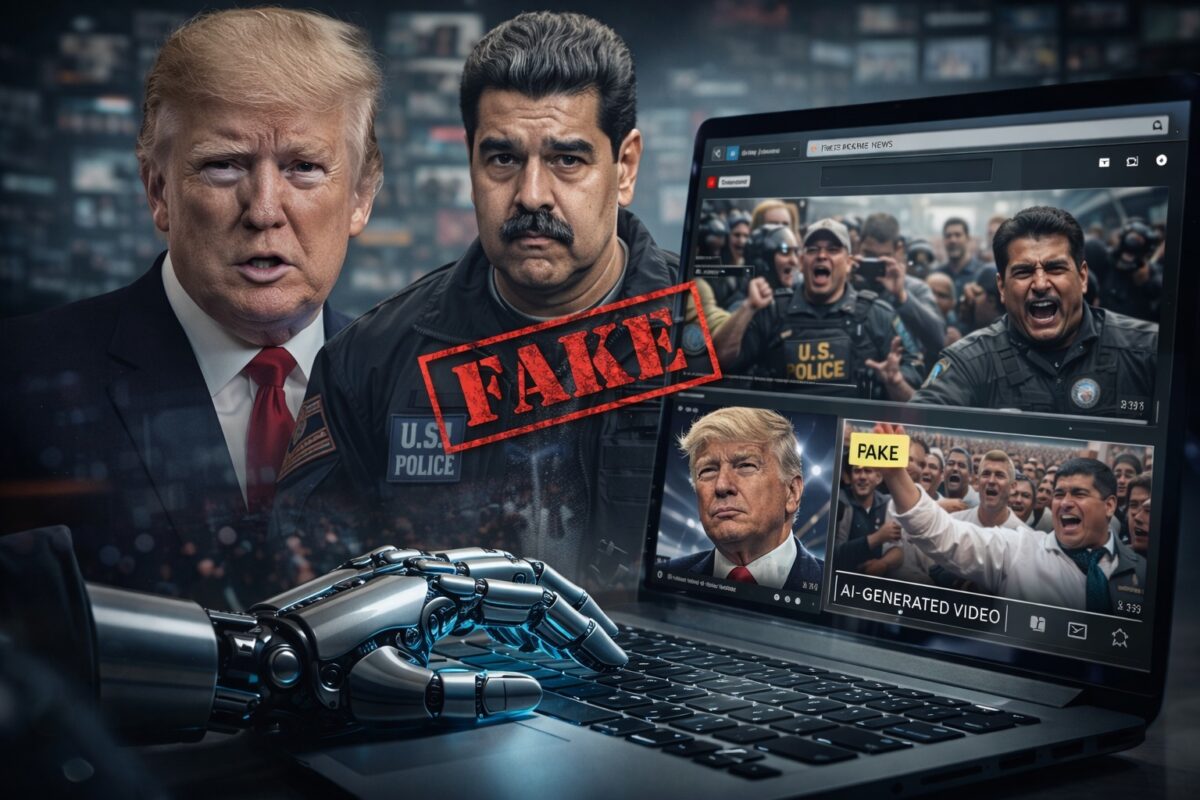
The new “fog of war” is visual
In major geopolitical shocks, the first casualty is often clarity. Yet the modern version of that “fog” is no longer just rumor—it’s high-fidelity video, generated or altered by AI, traveling at platform speed.
In the wake of the Venezuela crisis and the reported capture and transfer of Nicolás Maduro to U.S. custody, multiple outlets documented a rapid wave of AI-generated clips and images claiming to show arrests, celebrations, and dramatic “on-the-ground” scenes—many of which were not authentic. WIRED+2The Daily Beast+2
This piece is not written to amplify any single viral clip. It is designed to do something more useful and more durable: explain what happens during these moments, why AI video thrives in them, and how ordinary readers (and editors) can verify what they’re seeing before it hardens into “truth.”
AI Deepfakes: The 60-Second Verification Checklist (Evergreen)
Before you share any viral clip from a breaking crisis, run this fast check. It prevents most misinformation mistakes in under a minute.
-
Pause: If it triggers instant outrage or triumph, treat it as high-risk.
-
Source: Who posted it first? Is it a verified outlet or a random account?
-
Timestamp: When was it uploaded—does it match the claimed event date?
-
Location: Is there proof of where it was filmed (signs, landmarks, metadata)?
-
Second source: Can you find the same footage confirmed by a reputable newsroom?
-
Context check: Search key frames—has the clip appeared before with a different caption?
-
AI tells: Look for warped text, odd hands, unnatural blinking, inconsistent shadows, or “rubbery” facial motion.
-
Do not amplify: If you can’t verify at least two anchors (source/time/location), label it unverified or don’t post it.
The rest of this article explains why synthetic videos spread during crises and how to verify them step-by-step.
Transparency & methodology: During rapidly evolving news events, manipulated or AI-generated visuals may circulate at scale. This article prioritizes verification practices and relies on reputable reporting when describing confirmed developments.
1) What’s happening online after a major breaking event
When events are fast-moving and emotionally charged, three conditions create perfect oxygen for synthetic media:
A. The information vacuum
In the earliest hours, verified footage is scarce. People still want visuals, so the internet produces them—authentic or not. Wired reported that disinformation surged quickly after Trump’s announcement about Maduro, with synthetic media among the items circulating. WIRED
B. Algorithmic acceleration
Platforms reward engagement, not epistemic caution. Video—especially “shocking” or triumphant video—wins. That incentive invites opportunists: memers, propagandists, scammers, and attention merchants.
C. Identity and tribal interpretation
In polarized contexts, users often share content not because it’s proven, but because it signals belonging. That is why synthetic media doesn’t merely “mislead”—it mobilizes.
A prominent example reported by The Daily Beast described a clearly AI-generated video portraying Venezuelans celebrating and thanking Trump, which spread widely and was later flagged with platform community notes. The Daily Beast
2) Deepfakes vs. “AI-generated video”: what you’re actually seeing
Not all synthetic visuals are equal. In practical terms, you’ll see three common categories:
-
Full AI-generation
Entire scenes created from prompts—faces, crowds, environments, and motion. -
Face swaps / identity impersonation (“deepfakes” in the strict sense)
A real clip where a person’s face is replaced or animated to mimic someone else. -
Contextual manipulation
Authentic footage paired with false captions, wrong locations, old dates, or misleading edits.
In real-world misinformation, #3 is often the most common—and often the most effective—because it requires less technical polish.
3) Why “crisis + politics” is the most dangerous combination
Synthetic media matters most when it can influence:
-
public fear
-
international legitimacy
-
support for escalation
-
perceptions of consent (“people are cheering”)
-
perceptions of atrocity (“look what they did”)
Reuters reporting on the Venezuela crisis shows how high the stakes are—claims about governing arrangements, threats of further action, and geopolitical reverberations can all be intensified by misleading visuals. Reuters+1
And the danger isn’t theoretical. Fact-checkers have repeatedly had to address misleading or manipulated videos circulating in this broader political environment, including cases involving Trump posting or sharing misleading video claims about Maduro. politifact.com
4) How to spot synthetic or misleading video (the practical checklist)
You don’t need a lab. You need a disciplined routine.
Step 1: Pause the emotional impulse
If the clip makes you feel instant outrage or instant victory, assume it’s high-risk.
Step 2: Ask the “four anchors”
-
Who posted it first?
-
When was it posted?
-
Where was it filmed (provable location)?
-
What independent outlet has verified it?
If you can’t answer at least two, do not share.
Step 3: Look for synthetic “tells” (not perfect, but helpful)
-
warped text or signage
-
inconsistent shadows
-
“melting” edges around hands or jewelry
-
unnatural blinking or teeth
-
jittery micro-movements (especially around mouths)
-
mismatched license plates, distorted backgrounds
The Daily Beast’s reporting highlights how obvious artifacts (including distorted backgrounds) can appear in viral synthetic clips—yet they still spread. The Daily Beast
Step 4: Verify with two quick tools
-
Reverse image search (key frames)
-
Cross-platform search (same clip appearing earlier with different context)
Step 5: Demand “second-source video”
If a claim is real and major, it usually appears—quickly—via:
-
reputable wires
-
major broadcasters
-
on-the-record officials
-
multiple independent journalists
When only anonymous accounts have it, treat it as unverified.
5) The platform problem: moderation can’t keep up
Even when platforms add labels or community notes, the correction rarely catches the first wave of views. The clip has already shaped perception.
That dynamic is why disinformation researchers increasingly talk about provenance—systems that show where a piece of media came from and how it was altered. The goal is not censorship; it’s traceability.
Separately, research on Venezuela’s information environment shows that narrative control, messaging apps, and video manipulation can be leveraged as tools of political power. DFRLab+1