

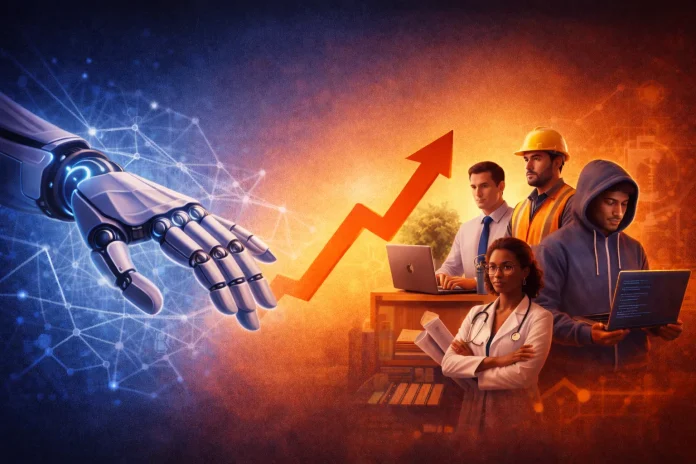
AI is changing work — mostly by changing tasks inside jobs
Artificial intelligence is reshaping the job market less like a “job killer” and more like a force that rewrites what many roles actually do day to day. Routine, repeatable tasks are increasingly automated or partially automated. Work that depends on judgment, accountability, trust, and complex human interaction is harder to replace — but it is also changing fast as AI becomes a standard tool.
This explainer breaks down which careers face higher exposure, which roles are rising, and what skills increasingly separate resilient workers from vulnerable ones. If you want a clear baseline on what AI is (and isn’t) in practical terms, see Newsio’s guide AI for people and businesses: what it is, what it isn’t, and what changes next.
“At risk” doesn’t always mean “disappearing”
When people say a job is “at risk,” they often imagine immediate replacement. In reality, the first wave is usually task substitution:
-
less manual drafting, more reviewing and refining
-
fewer repetitive queries, more exception handling
-
fewer basic reports, more interpretation and decision support
That means many roles won’t vanish — but they may shrink, split, or lose bargaining power unless workers move up the value chain.
Careers most exposed to automation pressure
The highest exposure tends to show up where work is structured, predictable, and rules-based — especially when outcomes can be evaluated quickly. Examples include:
Administrative and back-office routines
Data entry, document processing, scheduling, basic compliance checklists, and standardized reporting are all areas where AI tools can reduce time and staffing needs.
Customer support built on scripts
Where interactions follow predictable flows (FAQs, simple account issues), automation can handle more volume — leaving humans to resolve complex, emotionally sensitive, or high-stakes cases.
Entry-level content tasks without original reporting
AI can produce drafts quickly. The risk rises when the work is mainly rephrasing, templated summaries, or basic copy — and falls when the work requires sourcing, verification, interviews, and accountability.
Basic finance and operations tasks
Reconciliations, invoice workflows, forecasting templates, and routine analytics can be accelerated — shifting roles toward oversight, controls, and decision support.
A key pattern: AI doesn’t need to be “perfect” to change staffing. It just needs to be “good enough” to take the first pass and compress time. For the broader technology context shaping this shift, Newsio breaks down the bigger picture in The next generation of technology: how 5G, AI, and automation are changing our lives.
Careers that are rising
The strongest growth signals cluster around roles that combine technology with responsibility, domain expertise, and human judgment:
-
data and analytics roles tied to real business decisions
-
cybersecurity, fraud detection, and risk management
-
AI operations: testing, monitoring, quality control, bias checks, and safety
-
product, operations, and process redesign (making systems work in the real world)
-
human-centered professions where trust and responsibility matter: health, care, education, and specialized advisory work
In short: jobs that coordinate people + systems + accountability tend to gain value as AI spreads.
The skills that increasingly protect careers
AI-era resilience usually comes from a mix of three capabilities:
1) Verification and critical judgment
Knowing how to check outputs, spot errors, and avoid confident mistakes. This includes basic data literacy, source evaluation, and “trust but verify” workflows.
2) Domain expertise that AI can’t fake
Deep understanding of a field — the constraints, the exceptions, the real-world stakes — turns AI from a shortcut into a productive tool. Without domain skill, AI often produces polished nonsense.
3) Communication and responsibility
Explaining tradeoffs, defending decisions, managing stakeholders, and taking ownership when things go wrong. AI can support these tasks, but it does not carry accountability.
Why regulation matters in the workplace transition
Rules and compliance shape how quickly companies deploy AI in hiring, performance management, customer decisions, and regulated sectors. Newsio’s explainer on the EU AI Act and what it means for business adds useful context on how guardrails are forming.
For a widely cited institutional view on how generative AI changes occupational exposure — with emphasis on task-level disruption rather than instant job deletion — see the International Labour Organization’s brief Generative AI and jobs: A 2025 update.
What this means for readers
-
AI pressure hits routine tasks first — not entire professions overnight.
-
Many roles will shift toward oversight, judgment, and exception handling.
-
Growth concentrates in security, data, operations redesign, and human-centered accountability work.
-
The safest path is not “learning tools,” but combining tools with domain depth and verification habits.