

Table of Contents
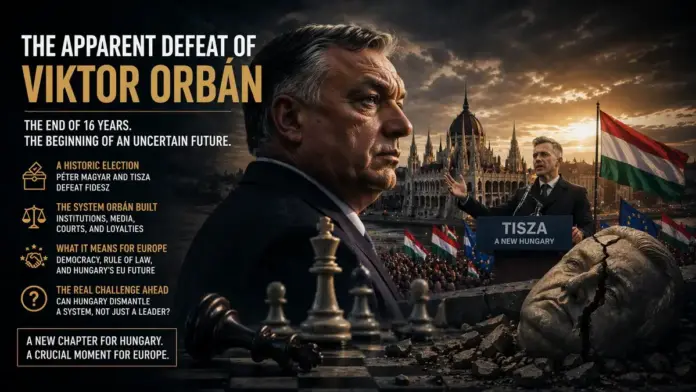
The apparent defeat of Viktor Orbán is not just an election result — it is a historic rupture that will now be tested inside the state itself
Viktor Orbán has been removed from power after 16 years, and the scale of the result is too large to be dismissed as a routine transfer of government. Reuters and AP both describe a historic Hungarian election in which Péter Magyar and the Tisza party not only defeated Orbán’s Fidesz, but did so with record turnout and with a parliamentary supermajority strong enough to attempt deep institutional change. This was not a narrow stumble. It was a decisive political break.
But that is exactly why the harder question starts now, not on election night. Orbán’s defeat is fully real as an electoral fact. It becomes only “apparent” if anyone assumes that removing one leader automatically dismantles the political architecture he built over more than a decade and a half. Governments can fall in one night.
Systems usually do not. Reuters Breakingviews noted that Tisza’s two-thirds majority opens the door to repealing many Orbán-era laws, yet it also underlines the scale of the institutional inheritance Magyar now faces.
That is why Hungary’s vote matters far beyond Budapest. This is not only a national reset. It is a European test case. It asks whether a state that drifted toward what critics called “illiberal democracy” can be pulled back through the ballot box, whether democratic fatigue can still turn into democratic correction, and whether entrenched power can be displaced without the machinery beneath it simply reasserting itself under new conditions.
Reuters says Orbán’s fall followed years of clashes with the EU over media freedom, judicial independence, and democratic standards, while European leaders immediately read the outcome as a major democratic turning point.
What actually happened in Hungary
The result was not symbolic. It was structural. Reuters reported that Tisza won a two-thirds parliamentary majority, while AP described the election as a European political earthquake in which Orbán was plainly ejected after 16 years in office.
That distinction matters because a simple victory changes government; a supermajority can change the legal and institutional framework of the state itself.
The social meaning of the vote is just as important as the numerical one. Reuters traced Orbán’s fall to a combination of economic stagnation, high inflation, weakening public services, corruption concerns, and growing frustration with a government that had spent years presenting itself as a fortress of national strength while daily life became harder for ordinary voters.
In other words, Orbán did not lose only because his opponents became stronger. He also lost because his own governing story stopped explaining people’s real lives.
That is the line that serious readers should keep in view. Orbán’s system remained electorally formidable for years because it combined nationalism, institutional control, message discipline, anti-immigration politics, and permanent confrontation with Brussels into a coherent political machine.
But coherence is not immortality. Once the cost-of-living crisis, public-service decline, and corruption fatigue reached a certain threshold, the system’s rhetorical power no longer compensated for the lived reality beneath it.
Why Péter Magyar succeeded where others failed
Magyar did not defeat Orbán as a standard opposition politician repeating the old anti-Orbán script. AP notes that he emerged from within the broader Fidesz world, understood how the system functioned from the inside, and used that knowledge to speak as both insider and critic.
That gave him a unique political advantage. He could describe the regime’s decay not as a distant opponent, but as someone who had seen the machine from close range.
That background also helped him reach voters who might never have moved toward a conventional liberal opposition. Magyar did not need to persuade all of Hungary to become ideologically different overnight.
He needed to convince a broad coalition that the country had become too stagnant, too corrupt, too isolated, and too locked into one political class. Reuters says his campaign drew heavily on anti-corruption, democratic restoration, and better ties with Europe, while still appealing to patriotism and to voters who did not want Hungary reduced to a permanent East-versus-West political trap.
That is what made his victory socially powerful rather than merely partisan. He did not simply inherit protest energy. He converted systemic fatigue into a governing mandate. And because he did so without presenting himself as a caricature of the old opposition, he broke through in places where Orbán’s narrative had long been resilient. AP reports that his rise accelerated after he publicly broke with Fidesz amid scandal and then transformed that rupture into a broader argument about accountability, state capture, and national renewal.
Why Orbán fell now, and not earlier
For years, Orbán had seemed unusually durable. He had survived European criticism, domestic scandal, international pressure, and repeated accusations that he was hollowing out democratic institutions while keeping the shell of electoral legitimacy intact. Reuters says he had become one of Europe’s most visible nationalist strongmen, with close ties to Russia and China, and a symbolic role for sections of the global right. That image gave him far more than local weight. It gave him myth.
But political myth always depends on political delivery. Once voters stopped feeling that delivery in their own lives, Orbán’s image began to weaken. Reuters identified domestic concerns such as healthcare, inflation, and economic drift as central reasons why the electorate turned. That matters because it reminds us that even highly ideological systems can collapse through practical disappointment. Voters do not live inside slogans. They live inside prices, services, wages, fear, fatigue, and the slow accumulation of mistrust.
There is another reason the timing mattered. Orbán’s permanent struggle with the European Union had once helped him perform sovereignty. Over time, however, that same confrontation increasingly came to look costly rather than heroic.
Reuters says the new political environment may open the way to thawing ties with Brussels and recovering billions in frozen EU funding. That changes the domestic political equation. What Orbán had framed as defiance began, for many voters, to look like strategic self-harm.
The defeat is historic — but the Orbán system does not disappear on command
This is the heart of the analysis. A leader who stays in power for 16 years does not only govern. He appoints, shapes, rewards, pressures, entrenches, and normalizes. He leaves behind legal structures, institutional loyalties, media habits, administrative reflexes, and a political language that survives his own office.
That is why Reuters Breakingviews stressed that Hungary’s voters may have strengthened Europe’s liberal case, but Magyar still inherits a state marked by corruption, legal engineering, and fiscal strain.
So the election settled one question and opened another. Yes, Orbán lost. No, Orbánism as a governing culture will not evaporate because of one ceremony, one parliamentary vote, or one speech in Brussels. The real difficulty lies in what comes next: can a new leadership unwind years of concentrated political influence without reproducing a new form of centralized control in the process?
Can it clean institutions without turning cleansing into vendetta? Can it restore legality without producing instability? Those are not rhetorical questions. They are the next phase of the Hungarian story.
That is also why a reader moving through this article could naturally keep open Newsio’s guide on How to Read the News Without Being Manipulated. Hungary’s transition will now generate propaganda, simplification, selective outrage, and self-serving narratives from every camp. The cleaner the political moment looks on the surface, the more carefully it should be read underneath.
What it means for Europe
Across Europe, the result was immediately understood as more than a domestic upset. AP reported enthusiastic reactions from European leaders, including Emmanuel Macron, Pedro Sánchez, Donald Tusk, and Ursula von der Leyen, who saw Magyar’s victory as a democratic realignment and a chance to bring Hungary closer again to core EU norms. Reuters likewise reported that Poland’s Donald Tusk openly hailed the result as a blow against authoritarian rule in the region.
This matters because Orbán was not merely one difficult leader among many. He had become a persistent internal friction point inside the European project, especially on rule-of-law questions, ties with Russia, and the broader political language of sovereignty-versus-Brussels.
Reuters says his defeat could thaw relations with the EU, improve investor confidence, and revive a path toward funding that had been blocked by governance concerns. That makes the election important not only morally or symbolically, but institutionally and financially.
There is also a geopolitical layer that cannot be ignored. Orbán’s relationship with Moscow had made him a deeply controversial actor inside the European system, especially since Russia’s war against Ukraine.
Reuters reported before the election that the Kremlin openly accused forces within the EU of helping Orbán’s rivals, underscoring just how geopolitically loaded the Hungarian vote had become. This was not just about domestic corruption or culture-war politics. It was also about where Hungary sits in the broader balance between democratic Europe, Russian influence, and the future strategic shape of the continent.
For that wider strategic layer, Newsio’s piece “Would you arrest Putin?” Trump’s remarks, Moscow’s response, and what’s really at stake fits naturally here, because the Hungarian result cannot be understood in isolation from the larger argument over Russia, European resolve, and the politics of strongman alignment.
What it means for the global right
Orbán’s defeat carries meaning well beyond Hungary because he had become a model for parts of the international right. Reuters reported that U.S. Democrats immediately framed the result as a rejection of a style of politics closely associated with Donald Trump and his allies, while AP described the outcome as a global signal against a leader who had become emblematic of anti-liberal statecraft.
Orbán had become proof-of-concept for the idea that a government could centralize power, weaken institutional constraints, maintain electoral legitimacy, and still present itself as the authentic will of the nation.
That is why his fall matters as a political symbol. It does not mean nationalist or populist politics are over. It means one of their most durable governing icons proved vulnerable after all. The mythology of invincibility cracked. And once a long-ruling strongman loses despite deep institutional advantages, the entire ecosystem that treated him as an unbeatable template has to rethink its assumptions.
The relevance extends to the American debate too. Reuters says U.S. Democratic leaders openly read Orbán’s loss as a warning sign for Trump-style politics, while Republicans reacted more unevenly. That does not make Hungary a mirror of the United States. But it does show how closely Orbán had been woven into a broader transatlantic argument about executive power, democratic erosion, and the seduction of “strong leader” politics.
That broader frame also makes room for another internal Newsio reference: Trump’s Post-Maduro Storm: Escalation, Threats to Colombia and Greenland, and an Assertive U.S. Foreign Policy. It belongs here not because Hungary and the United States are the same, but because both debates touch the same deeper question: what happens when political legitimacy begins to merge with a taste for concentrated power and permanent confrontation.
What could still go wrong
Magyar’s victory is large enough to inspire hope. It is also large enough to create dangerous expectations. Societies that vote forcefully for change often expect that change to become visible quickly. But institutional repair is slower than electoral emotion. Restoring legal trust, reversing administrative capture, rebuilding public services, and renegotiating relations with Brussels will take time.
Reuters says markets reacted positively to the result, but analysts and diplomats still want to see real reforms before assuming a clean democratic restoration is underway.
The second risk is political. Orbán may have lost office, but he did not erase his electorate. Reuters and AP both suggest that Hungary remains deeply marked by years of nationalist, anti-immigration, and sovereignty-focused politics.
That means Magyar will govern a country that has clearly chosen change, yet still contains a large constituency shaped by Orbán’s worldview. Managing that without deepening the divide will be one of the first serious tests of the new government.
The third risk is institutional self-preservation. When a long-ruling system loses the top of the pyramid, it often tries to survive through the layers underneath: bureaucracy, legal inertia, political appointments, media influence, and embedded loyalties.
That is why the real measure of this transition will not be the beauty of election night, but the endurance of reform months later. Orbán’s defeat becomes historically complete only if Hungary proves that the state can be reopened without being broken.
This is also where Newsio’s Electronic Voting in Greece: What Citizens Need to Know fits naturally into the larger conversation. It is not about Hungary specifically. It is about the harder democratic truth that elections are not only about counting votes. They are about trust, legitimacy, institutional credibility, and the public’s belief that the system itself remains answerable.
The strongest external line in the piece
The clearest authority link for readers who want the most direct baseline on the election itself remains Reuters’ report on Orbán being ousted after 16 years in power. It is the cleanest starting point for the factual event. But the event is only the first layer. The harder layer is everything that comes after it.
What readers should keep
The first truth is simple: Viktor Orbán suffered a real, heavy, and historic defeat. This was not spin, not ambiguity, and not a survivable scare. Hungary voted him out after 16 years, and it did so decisively.
The second truth is deeper: Hungary did not automatically wake up free of the system Orbán spent years constructing. The legal framework, the institutional reflexes, the political habits, and the influence networks of the Orbán era will continue to shape the next phase.
And the third truth is the one Europe should watch most closely: the Hungarian vote proved that even an entrenched strongman can lose. But whether that loss becomes democratic restoration, or only a dramatic pause in a longer struggle, will depend on what happens inside the state now. That is where the real story begins.