

Table of Contents
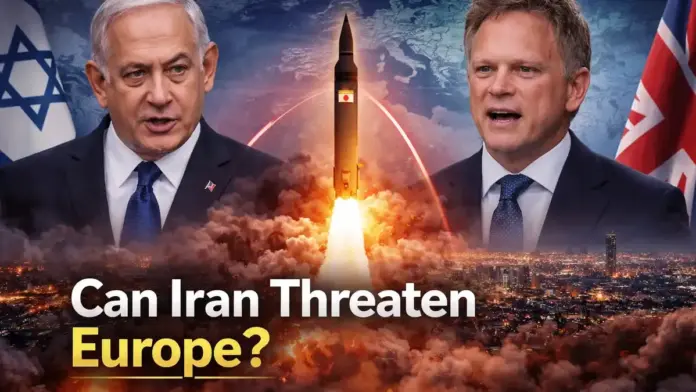
Can Iran Really Threaten Europe? What Israel Says, What Britain Rejects, and What Still Has to Be Proven
The most dangerous mistake in a fast-moving war is to turn a serious warning either into instant certainty or into something easy to dismiss. The current argument over whether Iran can threaten Europe belongs in neither category. Israel is now openly pushing the claim that Iran has demonstrated missile reach broad enough to put deep European targets into a wider threat envelope.
Britain, however, says it has no confirmed assessment that Iran is targeting Europe or has the verified capability being described. That means the issue now sits in the most difficult space of all: between strategic warning and common proof.
Reuters reported that Israeli military officials said Iran had used long-range ballistic missiles with a range of about 4,000 kilometers for the first time, and that such a development could in theory place European capitals within reach.
That argument is not being framed by Israel as a technical curiosity. It is being framed as a strategic warning with implications beyond the Middle East.
But that claim ran into immediate resistance from London. Reuters also reported that British minister Steve Reed said the UK had no evidence suggesting Iran was targeting Europe with ballistic missiles or that it possessed the confirmed capability described in the Israeli warnings.
That response matters because it shows that a major European government is not, at least for now, treating the Israeli assessment as settled operational fact.
Israel is no longer speaking only to its own public
This is the first serious conclusion. When Israeli officials start publicly talking about Iranian range in relation to London, Paris, or Berlin, they are doing more than describing a weapons system. They are widening the political map of the conflict. The message is that Iran should no longer be viewed as only a threat to Israel or to U.S. positions in the region, but as a potential strategic concern for Europe as well.
That matters because wars are not fought only on the battlefield. They are also fought through threat perception, alliance psychology, and the shaping of strategic attention. If Europe begins to see itself as part of the same risk arc, then the conflict stops being understood as a distant regional war and starts being processed as a direct security question with continental implications. This is exactly why the language of range matters even before all the proof is agreed upon.
Britain’s rejection is not a minor detail
The British response is not a diplomatic footnote. It is an important correction to the current narrative. London did not simply decline to comment. It said it did not have the evidence that would support the claim as currently presented. That creates a clear distinction between two levels of discourse: strategic warning on one side and commonly verified capability on the other. Those are not the same thing.
This distinction matters enormously for how serious reporting should be written. It is fair to say Israel is warning that Iran is showing range that could potentially bring Europe into the discussion. It is also fair to say Britain is not endorsing that warning as a confirmed operational assessment. What is not fair is to collapse those two positions into a headline of certainty.
The deeper issue is not only range, but meaning
Even so, the real importance of this debate does not end with the raw number of kilometers. The larger question is what it would mean strategically if Iran is now demonstrating systems capable of pushing the threat conversation far beyond the Middle East. If that capability is real in the way Israel suggests, then the conflict can no longer be read only as a regional confrontation.
It becomes part of a broader European deterrence problem, a missile-defense problem, and a political problem for NATO-aligned capitals that would rather keep the war geographically contained.
That still does not mean Iran intends to strike Europe tomorrow. Capability and intent are not the same thing. Britain’s public position underlines exactly that gap. But in strategic affairs, demonstrated or plausibly demonstrated reach can alter calculations long before intent is proven beyond doubt. A threat does not always need to be used to have consequences. Sometimes it only needs to become credible enough to force new planning.
Europe has already entered the frame, whether it wants to or not
This is why the argument matters even before it is fully settled. Europe is now inside the frame of the conversation. That alone marks an escalation. Once London, Paris, Berlin, or Rome are mentioned as potential endpoints in a missile-range discussion, the conflict has already moved beyond the category of a strictly local war. It has become a wider strategic question, even if the evidence remains contested.
That shift is consistent with a broader pattern in the current war. Reuters has reported Iranian missile activity toward the U.S.-UK base at Diego Garcia, while other reporting has shown how energy security, maritime choke points, and critical infrastructure are increasingly bound up with the conflict’s trajectory. The significance of the Europe debate, then, is not only whether one missile can travel one precise distance. It is that the conflict’s strategic perimeter is visibly widening.
The nuclear and strategic backdrop cannot be separated from this
Another reason the debate cannot be shrugged off is that it exists inside a wider crisis over Iran’s strategic capabilities. The IAEA Director General’s March 2026 statement to the Board of Governors stressed the need to return to diplomacy and negotiations to ensure that Iran does not acquire nuclear weapons.
That institutional backdrop matters because missile-range debates never sit in isolation. They are interpreted through the larger question of what kind of state capability may eventually stand behind them.
This does not prove every worst-case scenario. It does explain why governments and militaries treat long-range capability claims as politically explosive. Missiles are not judged only by engineering. They are judged by the strategic environment in which they appear.
What still has to be proven
The most honest answer right now is the simplest one.
Yes, Israel is warning that Iran is demonstrating missile reach that could potentially place European capitals inside a wider threat envelope. No, Britain has not accepted that claim as a confirmed operational assessment. And yes, the fact that this debate is now happening at all shows that the conflict is already being reinterpreted on a larger strategic scale.
That is where serious reporting has to stay: not in exaggerated certainty, but in disciplined clarity. The issue is no longer whether the war remains only a Middle Eastern question. The issue is that Europe has now been pulled into the logic of the threat debate itself. Once that happens, the conflict has already crossed a threshold, even if the final evidence on capability is still under dispute.