

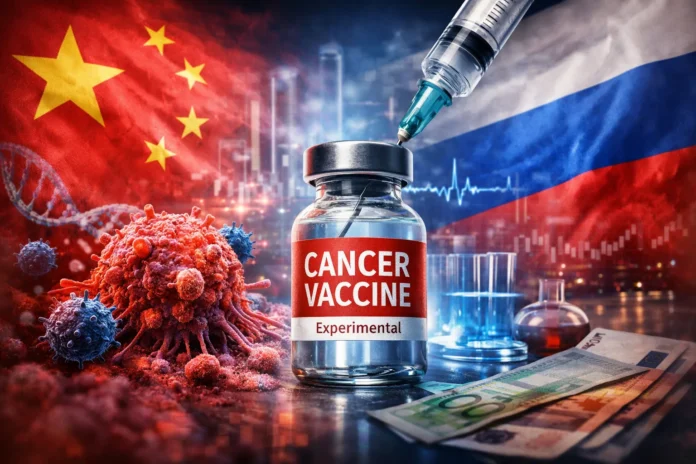
“China is about to approve a Russian ‘cancer vaccine’”? What’s actually known, what isn’t confirmed, and why this story spreads so fast
A claim like this hits people where they live: fear, hope, and the deep human wish for a clear breakthrough. You heard that China plans to approve a Russian cancer vaccine tied to Russian companies, and that it could cause “2.6–3” worth of damage to Europe and the U.S. (often stated without units). Because this is a high-stakes health topic, the only responsible approach is slow, structured verification.
The bottom line (based on available public evidence)
-
I could not find credible, official evidence that China’s regulator has announced an imminent approval of a specific Russian “cancer vaccine” for broad use.
-
The loudest viral “proof” threads often rely on early-stage research claims (especially around “Enteromix/EnteroMix”) that independent fact-checking says are exaggerated—including claims that it is “approved” or a “cure.”
-
China does run many cancer vaccine programs and has a formal pathway (IND acceptance/clinical trials → approval), but that is not the same as approving a Russian product for public rollout.
1) First, a crucial clarification: “cancer vaccine” can mean two different things
When people say “cancer vaccine,” they often mix up two categories:
-
Preventive vaccines that reduce cancer risk indirectly (for example, vaccines that prevent infections linked to cancer).
-
Therapeutic cancer vaccines / immunotherapies given to patients who already have cancer, designed to train the immune system to recognize tumor targets (neoantigens, tumor-associated antigens, dendritic cell vaccines, viral vectors, etc.).
Most Russia-related headlines you’re seeing fit category (2). That matters because therapeutic vaccines:
-
are usually personalized or semi-personalized,
-
require phased clinical trials,
-
and rarely move quickly from announcement to real-world, large-scale use.
So, if a post implies “one vaccine that cures cancer,” treat it as a red flag.
2) What’s driving the rumor: “Enteromix/EnteroMix” and big claims without the matching evidence
A large share of the viral narrative revolves around a Russian program often referred to as Enteromix/EnteroMix, sometimes promoted online as “100% effective,” “already approved,” or “ready for everyone.”
Independent fact-checking has pushed back hard on that framing. AFP Fact Check reports no evidence that Enteromix has been released to the public or approved for general use, and notes that calling it a “cure” is not supported by available evidence.
Some outlets also state they cannot verify the strongest performance claims circulating in media and social posts.
The practical takeaway:
You can have promising preclinical results and still be years away from a proven therapy. Early claims often collapse in larger trials, because real oncology outcomes require:
-
larger numbers,
-
longer follow-up,
-
careful endpoints (overall survival, progression-free survival, response rates),
-
and transparent safety reporting.
3) What Russia has said it is doing (and what that does—and doesn’t—imply)
Russia’s Gamaleya-related ecosystem has been linked in reporting to personalized mRNA therapeutic vaccine approaches, with plans described as moving into or through human trials. (Different reports cite different timing and details.)
But even if Russia runs or plans trials, that fact alone does not establish:
-
international approvals,
-
manufacturing readiness at scale,
-
or that China’s regulator has agreed to adopt/approve a specific Russian therapy.
A trial plan ≠ approval. A press statement ≠ clinical consensus.
4) Where China actually fits: regulation is a paper trail, not a vibe
China’s regulator is the National Medical Products Administration (NMPA). If China were truly “about to approve” a Russian cancer vaccine for broad use, you would normally expect to see a clear regulatory footprint: official notices, trial registry entries tied to that specific product, and later an approval decision. The NMPA maintains official communications and structures for review and oversight.
China does have active cancer vaccine research and trial activity. A peer-reviewed overview in Frontiers in Oncology discusses cancer vaccine trial progress registered in China and references IND acceptance for an mRNA neoantigen vaccine candidate.
That point is important because it highlights the core confusion in viral posts:
IND acceptance is not approval
-
IND acceptance means regulators allow a product to enter clinical testing under defined conditions.
-
Approval means regulators accept evidence of safety/efficacy for a specific indication and population, with labeling, surveillance, and quality requirements.
So even when China “approves something” in early headlines, it often means trial permission, not public rollout.
5) The “2.6–3 damage” claim: why it reads like a number designed to persuade, not to inform
You also mentioned a claim that this would cause “2.6–3” in damage to Europe and the U.S. That number is suspicious for one simple reason:
It usually appears without a unit (billion? trillion? percent? market share?) and without a transparent model. In the materials I reviewed, I did not see a credible, sourced economic analysis that ties a specific imminent Chinese approval of a Russian cancer vaccine to a defined “2.6–3” damage figure.
This is a common misinformation pattern:
-
attach a big, sharp number to a complex story,
-
and let the number do the persuading.
Real market impacts in oncology—if they happen—depend on:
-
the therapy’s true efficacy and safety,
-
the cancer type and eligible population,
-
pricing and reimbursement,
-
manufacturing scalability,
-
and comparative advantage versus existing immunotherapies.
A single early-stage therapy does not “wipe out” Western oncology markets overnight.
6) Why this narrative spreads so fast (and why it’s dangerous if mishandled)
This story spreads because it offers a powerful emotional package:
-
Hope (“a breakthrough is here”),
-
geopolitical drama (“Russia/China vs the West”),
-
economic shock (“the West will lose trillions”),
-
and simplicity (“one vaccine changes everything”).
But cancer medicine is not a single switch. It is a long chain of evidence.
And the danger is not abstract. Overstated “miracle cure” narratives can:
-
create false hope for patients and families,
-
fuel predatory scams,
-
and distract from evidence-based care and legitimate clinical trials.
Important note: This article is informational and not medical advice. Anyone facing a diagnosis should rely on licensed oncology teams and vetted treatment pathways.
7) What would count as real confirmation (a practical checklist)
If you want to track this responsibly, watch for these concrete signals:
-
A named product + named sponsor + trial identifier (not just “a Russian vaccine”).
-
Regulatory status clarity: IND accepted vs full approval (these are not interchangeable).
-
Peer-reviewed data: methodology, endpoints, adverse events, follow-up time.
-
Independent reporting that does not rely on recycled social claims.
-
Official regulator references (NMPA communications or databases) tied to that product.
Until you see those, treat “China is about to approve it” as unproven.
8) What you can publish—without hype, and fully “safe”
Here is the most accurate framing for a serious newsroom today:
-
Russia has promoted several oncology “vaccine” approaches, including therapeutic immunotherapy concepts.
-
Viral posts exaggerate maturity and regulatory status.
-
Independent fact-checking finds no evidence of general approval or public rollout for Enteromix and cautions against “cure” claims.
-
China runs extensive cancer vaccine research and has formal regulatory pathways, but public evidence does not support the claim of an imminent approval of a Russian cancer vaccine for broad use.
Authority source (single, highest value)
AFP Fact Check on Enteromix claims and lack of evidence for approval/public rollout.