

Table of Contents
The Chronicle of a Foretold Expulsion: How the Greeks of Istanbul Were Systematically Driven Out in the 20th Century
The story of the Greeks of Istanbul is often told in fragments: a tax here, a pogrom there, then the expulsions, then the silence. But that fragmented telling can hide the deeper truth. The disappearance of the city’s Greek community was not a random demographic decline and not a tragic accident of history.
It was the cumulative result of a political climate, an economic design, repeated intimidation, and ultimately an administrative push that made continued life in the city increasingly impossible. The Encyclopedia of the Hellenic World and later minority-rights documentation both point to the same pattern: pressure did not arrive in one moment; it arrived in stages.
That matters because the Greeks of Istanbul were not a marginal residue living on borrowed time. They were part of the city’s economic, educational, religious, and social structure well into the 20th century.
They belonged to the urban life of Constantinople not as decoration from a vanished empire, but as an active and rooted community with schools, churches, businesses, associations, and a long civic memory of place.
When that kind of community is reduced to a handful of survivors within a few decades, the right question is not “why did they fade?” The right question is “what pressures made staying impossible?”
This is why the history must be reconstructed with precision. The key is not to write a mournful elegy and stop there. The key is to show the sequence: how a community that survived imperial transition entered the 20th century with visible strength, then moved through ideological suspicion, economic targeting, organized terror, and finally state-backed expulsion.
That sequence is the spine of the story. It is also what gives the history its contemporary weight. A community is rarely erased in one blow. It is usually worn down until departure looks less like exile than like the last remaining option.
Before the rupture: the illusion of durable coexistence
It is tempting to remember pre-catastrophe Istanbul only through the language of cosmopolitan nostalgia: multilingual streets, mixed neighborhoods, elite schools, commercial vitality, a city where Greeks, Armenians, Jews, and Muslims all moved within an urban culture larger than any single identity.
That picture is not false. But by itself it is incomplete. Coexistence existed, yet it was more fragile than later memory sometimes admits. It did not rest on a permanent guarantee of equal belonging. It rested on a balance that could be broken once the state itself began to redefine who truly belonged in the national future.
That fragility is one of the central historical lessons. The Greeks of Istanbul had every reason to believe that their role in commerce, education, and city life gave them a form of long-term security. Their usefulness seemed obvious.
Their rootedness was beyond dispute. But nationalist state-building often does not operate according to the logic of usefulness. It operates according to the logic of redesign. Once the political imagination shifts from plural coexistence to ethnic consolidation, a successful minority can stop being viewed as an asset and begin to be treated as an obstacle.
That is where the real danger began: not with the final decree, and not with the mob in the street, but with the slow conversion of an old community into a problem to be solved. Once that shift occurs inside official thinking and public discourse, every later measure begins to look less exceptional and more “necessary.”
The architecture of exclusion is built long before the final act. It begins in classification, suspicion, and the decision that one group’s presence is incompatible with the national project.
Nationalism, Turkification, and the shrinking space for non-Muslim communities
The decisive turn came with the rise of Turkish nationalism and the weakening of the old imperial logic of multi-communal coexistence. The Young Turk revolution of 1908 did not instantly expel the Greeks of Istanbul, but it marked a new ideological direction.
The state and its elites moved increasingly toward ethnic consolidation, economic nationalization, and the creation of a more distinctly Turkish Muslim bourgeois order. Within that framework, strong non-Muslim communities no longer fit as comfortably into the state’s long-term design.
That shift mattered not only politically, but materially. The economic role of Greeks, Armenians, and Jews became entangled with a broader project of transferring wealth, influence, and opportunity into newly favored national hands. What looks from a distance like “minority decline” often turns out, at closer range, to be a process of selective economic displacement.
For the Greeks of Istanbul, this meant that prosperity itself could become a vulnerability. The more visible the community’s economic role, the easier it became for nationalist policy to frame that role as something to be corrected, diluted, or removed.
That broader state logic is part of why this history should not be reduced to one single event. The 1955 pogrom matters enormously. So do the 1964 expulsions. But neither can be understood fully without the ideological and economic groundwork that came before them.
This is not a story of sudden hatred appearing out of nowhere. It is a story of a state environment in which the space for a historic minority community narrowed over time until the final blows became possible.
The Varlık Vergisi: economic persecution as state method
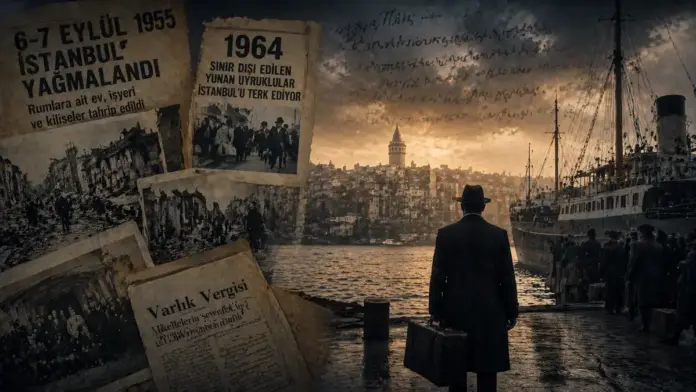
One of the clearest windows into that process was the Varlık Vergisi, or Wealth Tax, imposed in 1942. Formally, it was presented in wartime terms. In practice, it struck non-Muslim citizens with disproportionate force.
Historical summaries and later scholarship consistently describe it as a mechanism that hit minorities—including Greeks—far harder than the Muslim majority, often through arbitrary assessments so severe that payment itself became impossible.
Those who could not pay faced labor camps such as Aşkale. This was not ordinary taxation. It was a state instrument of economic humiliation and transfer.
For the Greek community, the wealth tax was not just a financial wound. It was a political revelation. It demonstrated that the state could convert a family’s accumulated property, work, and standing into an object of punitive policy at will.
Once that line was crossed, security was irreparably damaged. Economic life no longer appeared as a stable basis for survival. It now depended on whether the state still accepted the legitimacy of one’s continued presence.
That is a much deeper form of injury than loss of money alone. It turns the everyday world—business, savings, inheritance, planning—into a zone of uncertainty.
In that sense, the Varlık Vergisi was one of the first major clearings of the ground. It weakened the economic base of the community, transferred wealth outward, and sent a chilling message about the conditional nature of non-Muslim security in republican Turkey.
A community whose material foundations are systematically undermined does not simply become poorer. It becomes easier to dislodge.
September 1955: the night when the city sent its message
If the wealth tax was the message of administrative and economic punishment, the Istanbul pogrom of 6–7 September 1955 was the message of open terror. The attacks targeted the Greek minority above all, while also hitting Armenian and Jewish properties. The destruction was massive: homes, businesses, churches, cemeteries, and schools were attacked, looted, and desecrated.
The standard historical descriptions of the pogrom emphasize that this was not a spontaneous outburst of popular anger, but a state-sponsored or state-enabled anti-Greek attack carried out under cover of orchestrated agitation.
The significance of the pogrom lies in more than the number of broken buildings. It lies in what the violence communicated. It told the Greeks of Istanbul that the city could cease to be home overnight.
It told them that their churches could be violated, their neighborhoods broken open, their dignity stripped in public, and their labor erased in a single coordinated convulsion. Material destruction mattered.
But the deeper injury was existential. The pogrom was a public demonstration that the old assumption of safety was gone.
This is the point after which the possibility of ordinary continuity became much harder to believe in. Trust collapsed. And once a community ceases to trust that the state either can or wants to protect it, departure begins to shift from distant fear to practical calculation. That is why 1955 occupies such a central place in memory. It was not merely another episode of discrimination.
It was the event that shattered the plausibility of normal future life in the city. For a wider internal Newsio frame on how state pressure, rhetoric, and regional tension can shape the Greek-Turkish environment beyond formal diplomacy, readers can also see Greek-Turkish Tensions 2025: the latest threats, the reality behind the rhetoric, and the political stakes.
The 1964 expulsions: the cold efficiency of administrative removal
The expulsions of 1964 brought the final administrative blow. After denouncing the 1930 Greco-Turkish agreement that had protected the status of many Greek nationals living in Istanbul, the Turkish government moved to expel thousands of them.
Documentation gathered by the Hrant Dink Foundation and related minority-rights work underlines the scale of the rupture: thousands of Greek nationals were ordered out, while many more Istanbul Greeks connected to them through family and social life were effectively forced to follow.
Families were split by citizenship category, property was abandoned, institutions were hollowed out, and the community’s social body was broken.
The cruelty of the measure was sharpened by its bureaucratic form. People were forced to leave quickly, with sharply limited belongings and cash, while lives built over generations were effectively stripped away behind them.
This matters because it reveals the final stage of a long process. The state no longer needed a mob.
The prior years of intimidation, dispossession, and fear had done much of the work already. Now administrative power could finish what ideology, economics, and violence had prepared.
This is one of the coldest truths in the whole history: the end did not arrive only through street terror. It arrived through paperwork, decrees, categories, and deadlines. Once a state has damaged a community’s security, wealth, and dignity, administrative expulsion can appear almost procedural. That is precisely what makes it so devastating. It turns uprooting into something that looks like governance.
The city that remained was no longer the same city
With the removal of the Greeks of Istanbul, the city lost more than a population count. It lost part of its social texture, memory, and civic plurality. The disappearance of a historic community from a great city is never only demographic.
It changes the sound of the streets, the institutional life of neighborhoods, the educational ecosystem, the commercial culture, and the moral imagination of place. The Greeks of Istanbul had been embedded in schools, parishes, associations, trade, and urban routines. Their absence created emptiness that property transfer alone could not fill.
Istanbul remained a giant city, of course. But it was no longer the same urban world. The reduction of Greeks, along with the broader pressure on other non-Muslim communities, narrowed the city’s older cosmopolitan breadth. That does not mean one should romanticize the past into perfection.
It means something more precise: exclusion reshapes a city from within. When a state chooses homogeneity over plural civic depth, the target community is not the only loser. The city itself becomes smaller in spirit, memory, and inherited complexity.
That is why this history speaks beyond bilateral grievance. It is a lesson in what happens when state-building treats old rooted communities not as part of a nation’s richness, but as residues to be pushed aside. The result is not only injustice to the expelled. It is also permanent impoverishment of the place that expelled them.
Why this memory matters now
The easiest way to misuse this history would be to turn it into fuel for fresh hatred. That would betray the past rather than honor it. The point of remembering what happened to the Greeks of Istanbul is not to produce new broad-brush suspicions. It is to restore clarity about how systematic exclusion actually works.
A historic community is rarely erased by one speech or one riot alone. Erasure usually happens when ideology, administrative power, economic pressure, tolerated violence, and international indifference begin to align.
That is also why the history carries wider value for international readers. It shows how persecution can wear the face of legality. It shows how property confiscation can be justified as policy, how violence can be disguised as crowd emotion, and how expulsion can arrive through bureaucratic form after public terror has already done its work.
Memory matters because euphemism is one of the last shelters of injustice. If a community was uprooted, it should not be said merely to have “faded.”
For readers who want a broader Newsio verification frame on how serious historical and political questions should be read without surrendering to emotional manipulation, one useful internal companion is How to Read the News Without Being Manipulated: A Complete Guide to Fact-Checking, Sources, and Propaganda. That matters here because memory deserves precision, not mythmaking.
The international dimension: silence, caution, and the limits of outside protection
Another hard truth sits in the background of this entire story. The Greeks of Istanbul were not uprooted in a world without observers. The wider international environment knew enough, saw enough, and still failed to reverse the trajectory.
This is not unique to this case; history repeatedly shows that minority communities are often most exposed precisely when their fate is treated as regrettable but strategically secondary.
That is one reason the 1964 expulsions still matter so much in rights discussions today: they remind us that diplomatic visibility does not always equal effective protection.
This is also why a strong external anchor belongs naturally inside the article. The Hrant Dink Foundation’s material on the 1964 expulsions and the Istanbul Greeks is especially valuable because it treats the issue not as a sentimental afterthought, but as a minority-rights and historical-justice question with enduring relevance. Likewise, the broader historical framing preserved in the Encyclopedia of the Hellenic World helps keep the story tied to documented patterns rather than inherited slogans.
Closing: memory as restoration, not rhetoric
The Greeks of Istanbul were not removed by one isolated incident. They were steadily pushed toward disappearance through a sequence that now stands out with painful clarity: first suspicion, then economic punishment, then orchestrated terror, then administrative expulsion. That sequence is what gives the history its moral and analytical force. It reveals a process, not a sudden rupture.
To remember that process accurately is not an act of revenge. It is an act of restoration. It restores reality against euphemism. It restores the scale of what was lost. And it restores the central truth that a community thousands of years old did not simply drift away from Istanbul on its own.
It was driven out. The more clearly that is said, the harder it becomes for history to hide behind softer words.