

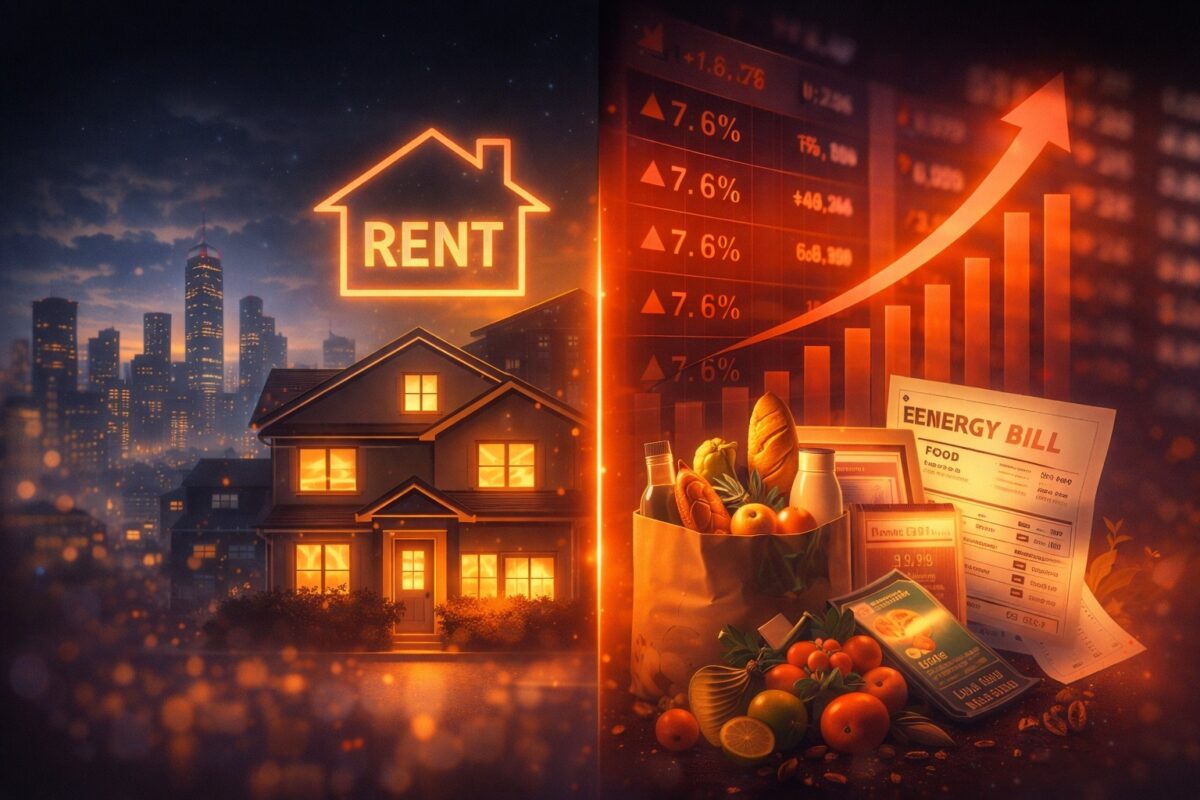
Part A — The cost of living isn’t a feeling. It’s the architecture of everyday life.
“Cost of living” is where macroeconomics turns into kitchen math. It’s not one index—it’s a relationship: what you pay versus what you earn. When essentials rise faster than incomes, households don’t merely complain; they reorganize their lives: fewer choices, delayed plans, lower quality, thinner margins.
That shift becomes political because it changes something deeper than spending: it changes trust. People don’t revolt over spreadsheets. They revolt over the daily experience of unfairness—when effort no longer maps to stability.
The first rule you must internalize
“Inflation is down” rarely means prices go down. It usually means prices rise more slowly. The public lives at the new price level, not at the rate of change. That gap between official messaging and lived reality is where cynicism grows.
Cost of living is a system, not a single cause
Energy costs move through supply chains. Higher interest rates change housing dynamics. Housing pressure reshapes labor mobility. Food prices hit hardest because substitution is limited. Treat it as a system, or you’ll prescribe slogans.
Part B — The three engines: housing, food, and energy
If you want to explain most cost-of-living pressure, watch these three.
1) Housing: when the city becomes a product
Rents rise when supply can’t meet demand, when financing and construction costs climb, when short-term rentals tighten the long-term market, and when higher borrowing costs push would-be buyers into renting.
Housing is a basic good that also functions as an asset. When those two roles collide, the social costs are severe: delayed family formation, reduced mobility, worse health outcomes, and chronic stress.
2) Food: the inflation you can’t opt out of
Food gets squeezed by energy and fertilizer costs, logistics, climate shocks, and—in many markets—concentration that creates pricing power. The result is brutal because households don’t “reduce food”; they reduce nutrition, variety, and dignity.
3) Energy: the multiplier
Energy is not just a bill. It’s an input into transport, production, storage, heating/cooling, and services. When energy rises, everything absorbs it—with delay and persistence. When energy falls, pressure eases—but prices don’t automatically rewind.
Part C — Why averages don’t save you: baskets, inequality, and real wages
Official inflation is an average basket. Your household is a different basket. Renters experience inflation differently than homeowners. Families experience it differently than retirees. Low-income households feel it most because essentials dominate their spending.
The core concept: real wages
Nominal wage growth means little if purchasing power falls. When real wages decline, households bridge the gap with debt, skipped payments, reduced quality, or reduced participation—and social fatigue spreads.
A calm truth: markets aren’t evil, but they aren’t neutral
Where competition is weak, “adjustments” tend to stick upward. That’s not conspiracy; it’s structure. Structure is policy, whether policymakers admit it or not.
Part D — What works (and what’s theater)
Relief that lasts usually hits four targets: supply, competition, resilience, and targeted protection.
Housing: supply + smart rules + protection
Increase supply, speed permitting transparently, unlock vacant stock, expand renovation capacity, build targeted social housing, regulate short-term rentals where they crush neighborhoods, and strengthen tenant protections without freezing the market.
Food: competition + transparency + targeted support
Improve price transparency, enforce competition rules, audit supply chains, and support vulnerable households with targeted tools rather than broad measures that burn budgets and miss the pain points.
Energy: efficiency is the cheapest energy
Invest in efficiency, grids, diversified supply, and resilience. Protect vulnerable households with mechanisms that avoid long-term market distortion.
Income: the durable path is productivity
Emergency support matters. But the long-run solution is productivity, skills, and a functioning state. Everything else buys time.
Part E — Five myths that poison the debate
-
Inflation down = prices down.
-
One villain explains everything.
-
One subsidy fixes a system.
-
Markets self-correct automatically.
-
People are “just emotional.” (They’re responding to bills.)
Part F: cost of living is where policy gets judged
Cost of living is the core of the social contract: shelter, food, energy, dignity. If those become unstable, everything else becomes unstable—trust, cohesion, and democracy itself.
Serious policy doesn’t promise miracles. It promises the harder work: reduce structural pressures, raise real incomes, and protect the vulnerable without breaking the engine that produces prosperity.
Sources & Tools
-
OECD — Data & methodology (inflation, household spending)
https://data.oecd.org/ -
U.S. Bureau of Labor Statistics — Consumer Price Index (CPI)
https://www.bls.gov/cpi/ -
Federal Reserve Economic Data (FRED) — St. Louis Fed
https://fred.stlouisfed.org/ -
IMF — World Economic Outlook (WEO)
https://www.imf.org/en/Publications/WEO -
World Bank Data
https://data.worldbank.org/ -
Eurostat — Inflation and price indices (HICP)
https://ec.europa.eu/eurostat/web/hicp -
European Central Bank (ECB) — Statistics
https://www.ecb.europa.eu/stats/html/index.en.html -
UK Office for National Statistics (ONS) — Inflation and price indices
https://www.ons.gov.uk/economy/inflationandpriceindices -
U.S. Energy Information Administration (EIA) — Energy prices & data
https://www.eia.gov/ -
Our World in Data — Inflation / prices / living standards data
https://ourworldindata.org/