

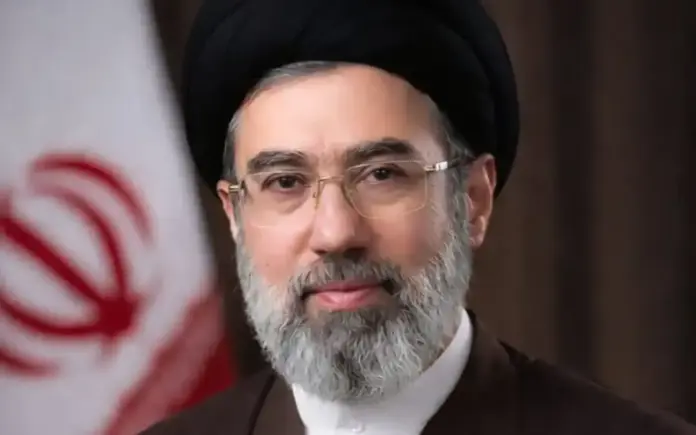
A country is not a family estate, not a private possession, and not a hereditary transfer of power
Some developments stop being only news events and become a test of political sanity. Mojtaba Khamenei’s elevation after the killing of his father, Ali Khamenei, is one of those moments. This is not just a succession story. It is a question about whether a country of millions can be treated as if it were a private chain of inheritance, especially when the ruling system carries a long record of repression, executions, and regional destabilization. Reuters reported that Mojtaba Khamenei was elevated rapidly under wartime pressure and remained publicly silent afterward, with the Revolutionary Guards described as the decisive force behind the transition.
That is where the first fact-check matters. The issue is not “family guilt” in some vague moral sense. The issue is political continuity through a ruling structure that has been heavily criticized and sanctioned internationally for repression at home and destabilizing conduct abroad. The U.S. Treasury said in 2019 that Mojtaba Khamenei was being sanctioned for acting on behalf of the supreme leader despite not holding any elected office, as part of what it described as the supreme leader’s inner circle.
So the real extension of the earlier article is this: the problem is not merely that a son followed a father. The problem is that supreme power is being passed onward inside a system that has already accumulated a grave historical burden. In that setting, succession is not just administrative. It becomes a test of whether the state still sees itself as accountable to a people, or only to the survival logic of its own ruling core.
As Reuters reported, Mojtaba Khamenei remained publicly silent after his elevation while the Revolutionary Guards were portrayed as the driving force behind the succession. That is not a cosmetic detail. It is the clearest clue to the kind of Iran now taking shape.
What the Khamenei name now carries
The next phase in Iran does not begin on a blank page. It begins on top of Ali Khamenei’s legacy. That legacy is not only ideological. It is measurable in state violence, punitive governance, and confrontation with the outside world. When the U.S. Treasury sanctioned Mojtaba Khamenei and other figures in the supreme leader’s circle in 2019, it described that network as one that had oppressed the Iranian people for decades while exporting destabilizing policies. Whatever one’s political perspective, that shows how deeply the name was already tied to the machinery of hard power.
Reuters also described Mojtaba Khamenei long before this succession as a hardline backroom figure with strong ties to the Revolutionary Guards and significant influence through his father’s office. That matters because it means he is not entering power as a public reformer, a neutral administrator, or an outsider to the system. He is entering power as a continuation figure from within the same structure.
That is why the argument here is not emotional excess. It is structural. If a name is already tied to repression, closed power, and coercive influence, and that same name becomes the vehicle for a father-to-son transfer at the top of the state, then the question becomes unavoidable: is the country being governed as a nation, or preserved as a regime lineage?
The regime is not accused only of authoritarianism, but of severe and escalating repression
Anyone trying to understand why this succession feels heavier than a normal elite transition has to look at the recent human rights record attached to the system. Human Rights Watch said in February 2026 that Iranian authorities in 2025 carried out executions on a scale unseen since the late 1980s, alongside mass and arbitrary arrests and deeper repression under the language of national security.
Amnesty International reported in September 2025 that Iranian authorities had executed more than 1,000 people so far that year, the highest number the organization had recorded in at least 15 years. That is not a marginal human rights concern. It is evidence of a punitive governing model built around fear and finality.
The U.N. Human Rights Council also moved in January 2026 to extend mechanisms examining abuses in Iran, amid grave concerns over repression and protest crackdowns. Taken together, these are not random criticisms from one ideological camp. They form a pattern: the system behind the succession is widely seen as one with a deep record of coercion and violent control.
That broader context also connects with Newsio’s existing English file, including Khamenei: repression and executions under his rule (fact-checked), which helps readers place the current succession inside the regime’s longer record rather than treating it as a standalone palace event.
This is why father-to-son transfer is not a technical matter. It is a challenge to political legitimacy itself.
A state is not a house. It is not a family property. It is not a title deed to be passed on because the previous holder died. That sounds obvious, but history keeps proving that it is not obvious enough. Systems that blur the line between state authority and dynastic continuity eventually force their societies into the same question: are citizens participants in political life, or subjects trapped inside the continuity needs of a ruling core?
That is what makes the Khamenei succession so politically consequential. The issue is not only that a son followed a father. The issue is that this happened inside a system already burdened by repression, executions, militarized control, and regional confrontation. When power moves onward under those conditions, what hardens is not just continuity. What hardens is the sense that the country itself is being subordinated to the survival of a ruling chain.
Reuters’ reporting reinforces that concern because it does not describe a broad, calm, consensual process. It describes wartime pressure, Guard dominance, and visible unease even among insiders. That is not the picture of a confident political transition. It is the picture of a system trying to keep control first and explain itself later.
Mojtaba Khamenei’s silence makes the entire picture darker, not clearer
If the new leader had immediately stepped forward, addressed the country, projected an independent political voice, and shown a clear public style of authority, there would at least be room for a serious argument that this was the start of a visibly new phase. That did not happen. Reuters reported that Mojtaba Khamenei remained silent after his elevation, and another Reuters report said Israeli officials believed he had been lightly wounded, which may explain part of his absence.
But even if injury explains the lack of appearance, it does not settle the deeper issue. The larger problem remains that the new supreme leader has not yet emerged as a publicly defined leader in his own right. That leaves the Guards, and the apparatus around them, more visible than the man they elevated. In political terms, that matters enormously. It suggests a transition in which the coercive core is easier to see than the formal top.
That is why the silence cannot be dismissed as a communications quirk. It may be the first visible sign that Iran is entering an even more securitized phase in which clerical symbolism remains intact while operational power sits more clearly with armed institutions. Reuters explicitly warned of fears among insiders that Iran could move toward harsher repression at home and a more confrontational line abroad.
The true extension of this story is simple: no family can be allowed to hold a nation’s future hostage
This is the point where the article has to say something plain. No country belongs to a surname. No population exists so that a ruling family can preserve continuity over it as if it were inheritance. No state with tens of millions of people should be expected to accept, as normal, the idea that the answer to a dead father is simply the son, especially when the father’s system left behind such a heavy record.
That is not a call for emotional overreaction. It is a call for political clarity. When power begins to resemble family continuity rather than public legitimacy, the society beneath it pays the price. And when that same power structure retains the capacity to threaten shipping lanes, energy flows, and regional stability, the price is no longer only domestic. It becomes international.
This is one reason the current moment should be read as more than a succession headline. It is a warning about what happens when a regime treats continuity as more important than legitimacy and treats a state as something to preserve for itself rather than something to answer to.
Hormuz is where this internal crisis becomes everyone else’s problem
The wider danger is not abstract. It runs directly through the Strait of Hormuz. Reuters reported that U.S. forces destroyed 16 Iranian mine-laying vessels, and another Reuters report described a cargo ship being hit by a projectile in the Strait, underscoring how volatile the route has become.
The International Energy Agency has stressed how critical Hormuz remains for global oil and LNG flows. When instability there rises, the consequences are not confined to military balance. They spill into shipping risk, insurance, energy prices, inflation pressure, and wider market fear.
That means the succession question cannot be separated from the external leverage Iran still holds. A regime can be wounded internally and still remain dangerous externally. In fact, regimes under intense pressure often become more likely to use asymmetric tools precisely because they cannot compete cleanly in a conventional contest. The danger is not that one family “owns the world.” The danger is that a closed power structure under dynastic-style continuity can still make the world more unstable.
That wider geoeconomic line also matches Newsio’s existing English coverage, including Strait of Hormuz: what a “closure” claim means (data-driven impact guide), which places the risk to global trade and energy inside a fact-based framework.
This is where the most dangerous public distortion begins
The public distortion usually moves in two easy directions. One says that because the regime is wounded, it is finished. The other says that because a successor was named, continuity has already been secured. Both claims are too simple.
The evidence supports neither collapse nor calm. It supports a much harsher middle reality: the regime has prevented an immediate vacuum, but it has done so through a rushed, militarized, low-transparency transition driven heavily by the Revolutionary Guards. At the same time, its human rights record and regional behavior make it impossible to treat this succession as a neutral continuation.
That is why the strongest reading is also the most disciplined one. The danger is not theatrical fantasy about one family destroying civilization on its own. The danger is the very real capacity of a regime lineage with a record of repression and confrontation to keep dragging a region, and the world economy with it, into higher-risk territory.
The most realistic answer is not rage. It is clarity.
The realistic answer is not to pretend that the world can be solved with one slogan or one emotional reaction. It is to insist on a few clear truths at once.
Human tragedy does not erase political responsibility.
Succession does not equal legitimacy.
Continuity does not equal stability.
And a country is never the inheritance of a ruling family.
Those truths matter because they allow readers to hold two things together without confusion: people can die, and that can still be tragic; a regime can suffer loss, and that can still leave its structural danger intact. Mature analysis has to be able to carry both facts at once.
That is also why Newsio’s role matters here. The point is not to intensify noise. The point is to draw a sharper line between grief and legitimacy, between succession and moral reset, between continuity and public right. A wounded ruling family does not become a harmless one simply because it is wounded.
What readers should keep
The core issue is no longer only who rose in Tehran after Ali Khamenei. The deeper issue is whether a country can continue to be governed under a dynastic-style logic by a system already marked by repression, executions, and the growing dominance of security institutions. On the evidence available, that is exactly the danger this succession now represents.
A country is not a house. It is not an inheritance. And when a regime with such a heavy record tries to preserve itself through family continuity while still threatening major energy routes and regional stability, the problem is no longer merely Iranian. It becomes a warning about what happens when public life is reduced to the survival of a ruling core. That is the real extension of this story, and it is the one readers should carry forward.