

Table of Contents
Cuba protests in recent days: what is happening, why the pressure is building, and what comes next
The protests seen in Cuba over the last several days are not a random burst of anger and they should not be reduced to a single, easy slogan. What is unfolding is more serious than that. The island is facing a deepening mix of rolling blackouts, food and medicine shortages, transportation failures, internet disruptions, and an economy that is struggling to provide even basic normality. In that environment, public frustration is no longer staying private.
It is moving into streets, campuses, and neighborhoods in ways that are becoming harder for the state to contain.
The most important point for readers is this: Cuba is not simply having a “bad week.” It is moving through a period in which the daily social contract is fraying. When electricity becomes unreliable for long stretches, when public services keep failing, and when shortages stop feeling temporary, protests stop looking exceptional.
They start to look like symptoms of a deeper structural breakdown. That is why the events of the past few days matter beyond the number of people visible in any one protest video.
This also helps explain why the story should be read with more care than social media usually allows. Cuba’s current unrest is not just about ideology or opposition politics. It is about whether ordinary life still feels livable.
Readers who want a wider regional frame for how political strain and economic crisis can feed each other can also see Newsio’s coverage of post-Maduro escalation and U.S. pressure in the region and our analysis of how crisis narratives and misinformation spread after geopolitical shocks. Those pieces are not about Cuba itself, but they help show the wider regional atmosphere in which this story is developing.
What happened in recent days
The first clear warning sign came from Havana. Reuters reported on March 9 that more than 20 students at the University of Havana staged a rare sit-in protest over energy shortages, internet disruptions, and the way those failures were wrecking their studies. In Cuba, open student protest is politically sensitive, so the significance of the event was bigger than the crowd size alone.
A vice minister eventually met the students and said there would be no punitive action, which itself suggested the government understood how charged the moment had become.
A few days later, the situation became more explosive in Morón, in Ciego de Ávila province. Reuters and AP reported that a protest over blackouts and shortages escalated into a rare riot in which demonstrators attacked the local Communist Party office, threw furniture into the street, and set some of it on fire.
At least five people were arrested, according to officials. That matters because in Cuba this is not just another public disturbance. It is an attack on one of the regime’s most protected political symbols.
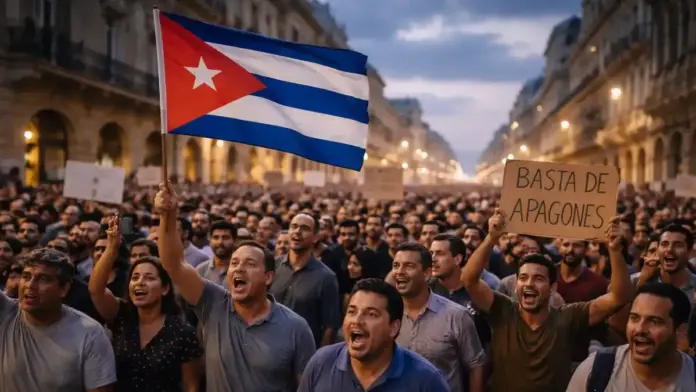
The Wall Street Journal added another layer to the picture: recent protests have also taken the form of nighttime pot-banging and neighborhood demonstrations, with the darkness of prolonged blackouts giving some protesters both cover and urgency. That detail is important because it shows that the unrest is not limited to one city, one social group, or one format. It is becoming more diffuse, and diffuse frustration is often harder for authorities to predict and manage.
Why people are protesting now
The immediate trigger is the energy crisis. Large parts of Cuba have been facing repeated power outages, in some areas lasting many hours a day. Reuters, AP, and the Guardian all describe a situation in which the country has gone months without steady oil deliveries, while aging infrastructure and fuel shortages have pushed the grid close to breaking point. When electricity disappears for that long, the damage goes far beyond inconvenience. It affects food storage, transport, work, healthcare, communications, and the basic rhythm of daily life.
But electricity is only the visible front edge of a broader collapse in living conditions. Food shortages, medicine scarcity, and declining purchasing power have been grinding down Cuban households for a long time. The protests are happening now because these pressures are no longer appearing one by one.
They are hitting at the same time. When a country faces fuel shortages, blackouts, service disruption, and weakened access to essentials all at once, protest becomes less about one grievance and more about a generalized sense that normal life is slipping away.
That is why the current unrest should not be misread as purely spontaneous or purely political theater. It is rooted in material deterioration. In that sense, Cuba’s recent protests belong to a wider pattern in which economic breakdown translates into political risk.
Newsio’s English readers who follow Latin America will recognize a similar logic in our explainer on the broader Venezuela crisis and regional instability, where economic fragility, political pressure, and external confrontation also fed each other rather than operating separately.
What the government is saying
President Miguel Díaz-Canel has publicly acknowledged the seriousness of the crisis and has linked the energy emergency to what Havana describes as an intensified U.S. blockade or oil squeeze. Reuters reported that Cuba says it has gone three months without oil shipments and that this has worsened blackouts and transportation problems across the island.
The government has also confirmed that it has opened talks with Washington, which is a notable sign that the crisis has reached a level where even limited diplomatic channels may now be seen as necessary.
That does not mean the government is conceding political weakness in a straightforward way. It is still condemning violent acts, defending the system, and warning of legal consequences. But the fact that talks with the United States are now being acknowledged at the same moment protests are spreading is revealing. It suggests that Havana is looking for some form of pressure relief, even if only partial and even if it continues to frame the crisis in anti-sanctions terms.
What the authorities fear most
What any tightly controlled system fears is not one protest by itself. It fears linkage. A student sit-in can be contained. A neighborhood protest can be contained. A single riot in Morón can be contained.
What becomes dangerous is the joining of these forms of anger into a broader national pattern: students, workers, families, and local communities all reaching the same conclusion that everyday life is no longer sustainable. The recent pattern in Cuba hints at that possibility, even if it has not yet reached the scale of a generalized national uprising.
The Wall Street Journal’s reporting that protests have intensified after sundown is also important in this respect. Nighttime demonstrations, pot-banging, and blackouts create a different protest environment from daytime marches.
They can spread faster through neighborhoods, they are harder to monitor in full, and they give ordinary frustration a more contagious form. That does not mean the government is on the verge of collapse. It does mean the social temperature is rising in ways that deserve careful attention.
What readers should and should not conclude
Readers should conclude that the recent protests in Cuba are real, serious, and tied directly to worsening living conditions. They should also conclude that the crisis is entering a more dangerous phase because the unrest is now appearing in multiple forms: student protest, local riot, neighborhood nighttime dissent, and public acknowledgment from the government that the situation is severe enough to require new talks with Washington.
Readers should not conclude, at least not yet, that Cuba is on the immediate edge of regime change just because dramatic images are circulating online. That is a different claim, and the evidence cited here does not support making it. What it does support is something more precise: Cuba is under intensifying internal pressure, its energy and supply crisis is worsening, and the state is facing a level of public frustration that is becoming harder to keep invisible.
That is the clearest and most accurate way to describe the moment. The issue is not just whether people are protesting. The issue is that more and more Cubans appear to feel that basic life on the island is becoming unmanageable. And when that feeling starts to spread across campuses, towns, and nighttime streets, the real story is no longer a single protest. It is the erosion of daily governability itself.