

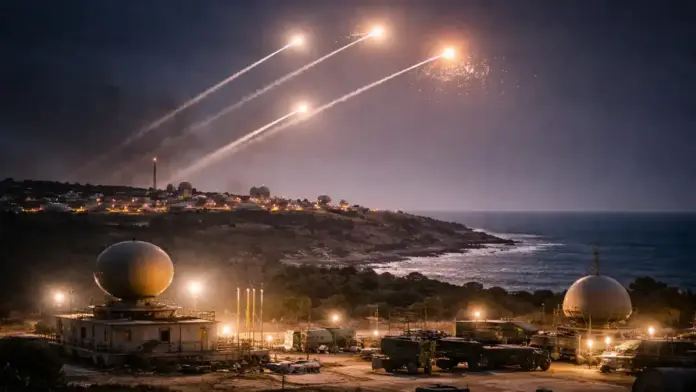
Missiles launched toward Cyprus were intercepted: what we know so far
The key fact that is solid enough to publish without hesitation is narrow and specific: missiles were launched toward Cyprus and were intercepted, as described in verified reporting tied to an official UK defense statement. That is the confirmed baseline—serious on its own, without adding assumptions.
The clearest public reference for this confirmed first layer is here: Ekathimerini.
From there, professional coverage has to draw a bright line between direction and intent:
-
“Toward Cyprus” does not automatically mean “Cyprus was the intended target.”
-
Reporting has also indicated it was not clear whether the intent was to hit British facilities on the island.
Those two sentences are not hedging. They are the difference between verified reporting and narrative-building. In fast-moving regional crises, that difference is what keeps a newsroom accurate—and legally safe.
For readers trying to keep perspective when information spreads faster than confirmation, the wider context is that modern conflicts run two tracks: operational reality and an information war that quickly amplifies fear and certainty. A grounded, evergreen lens on that dynamic is here: The information war (2025): how it works and why it affects all of us.
Why bases enter the picture
Cyprus sits at the edge of the Eastern Mediterranean’s security architecture. The island hosts UK Sovereign Base Areas, and in periods of heightened regional tension that fact alone can pull Cyprus into broader risk discussions—especially around air defense, flight routing, and force posture.
That does not mean Cyprus “became a target” as a matter of confirmed intent. It means the region operates as an interconnected risk environment when escalation accelerates.
What we know so far
Here is the verified record in a clean, publishable form—no speculation, no rhetorical framing:
-
Confirmed: Missiles were launched toward Cyprus and were intercepted, according to verified reporting tied to an official UK defense reference.
-
Confirmed (as uncertainty): Public reporting indicates it was not clear whether the missiles were intended to strike UK bases on the island.
-
Not confirmed as intent: There is no locked, official confirmation in the record that “Cyprus as a country” was the deliberate target.
-
Not confirmed for Greece: As of publication, there is no equivalent verified record showing missiles were launched toward Greek territory or intercepted over Greece.
That last point matters because rumors often spread geographically—“if it happened there, it must have happened here.” Responsible reporting does not make that leap without hard confirmation.
What “interception” actually signals—without technical overload
Interception is not a cinematic detail. It is a security signal. It tells readers that:
-
an object was treated as a threat,
-
air-defense procedures were activated,
-
and the incident reached an operational threshold worth public mention.
It also tells you something else: the situation is not confined to rhetoric. It is producing measurable security actions in real time.
About “movement” of people: the accurate, non-alarmist language
In moments like this, it can be normal to see small, local shifts—people avoiding a specific location for a period, changing routes, or temporarily stepping away from a site after alerts or visible security activity. That is not “population displacement,” and it should not be written as such unless verified sources document formal evacuations at scale.
What this means for you
1) If you live in Cyprus—or have people there
The safest way to follow developments is to keep two filters on:
-
Verification before sharing. Viral clips and mislabeled footage move faster than official updates.
-
Local scale first. If there is disruption, it often concentrates around specific places and procedures, not a generalized collapse of daily life.
Small, local precautionary moves can happen—people stepping away from a location, avoiding crowds for a few hours, or choosing quieter routes. That is a normal safety response in tense conditions.
2) If you are in Greece and asking “are we in the same line of fire?”
The professional answer is calm and simple:
-
There is no confirmed equivalent record of missiles launched toward Greece or intercepted over Greek territory in the verified reporting layer referenced above.
-
At the same time, a broader escalation can raise alert levels across the Eastern Mediterranean as a connected security space.
That translates into vigilance, not panic—and a higher standard for what we accept as “news.”
3) The bottom line
This is serious because it involves missile activity and air-defense activation in a strategically sensitive region. But the responsible way to publish it is measured:
-
State the confirmed interception toward Cyprus.
-
Preserve the confirmed uncertainty about intent.
-
Do not expand the story to Greece or other countries without confirmed evidence.
• Summary: Verified reporting says missiles were launched toward Cyprus and intercepted, while intent—particularly regarding UK bases—has not been confirmed as a locked fact. No equivalent verified record has been established for Greece.