

What we know so far
Reports of “explosions in Dubai” travel fast, and they can mean very different things depending on what actually happened. In a Gulf security incident, the word “explosion” might describe an air-defense intercept overhead, debris reaching the ground, a localized fire, or a direct impact. In the first hours of any crisis, the responsible approach is to distinguish what reputable sources have confirmed from what is still being clarified.
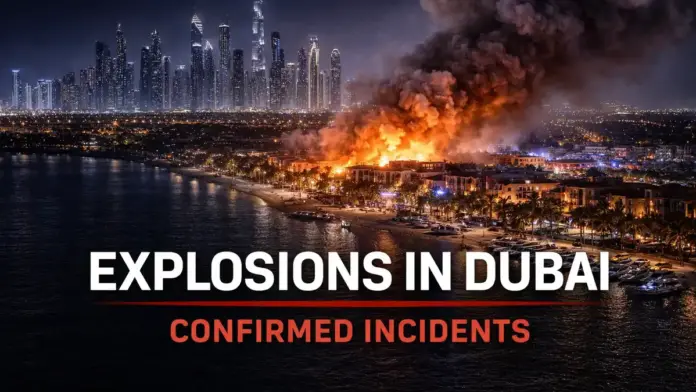
At this point, credible reporting indicates the wider Gulf region saw missile activity and air-defense responses, and that incidents described as explosions and fires were reported in Dubai, including references linked to the Palm area. What is still not locked in—because it must be confirmed site by site—is the precise cause of each incident and the final accounting of damage and casualties.
Dubai matters because it is not just a city; it is a global aviation and business hub and a symbol of regional stability. When a security incident touches that ecosystem, the ripple effects often arrive before the full facts: flight disruptions, rerouted air corridors, logistical delays, and a surge of rumor-driven content that can distort public understanding. That broader regional context is also shaped by longer-running pressure dynamics, which we’ve covered in depth in Iran 360: what’s happening now, what people are demanding, and the realistic outlook for 2026.
What appears confirmed vs what remains unclear
Based on major reporting, the high-confidence picture is that the region experienced missile and air-defense activity, and that Dubai was referenced in relation to reported incidents during that escalation. The lower-confidence, still-developing questions are more specific: whether each reported incident in Dubai was caused by debris from an intercept or by a direct impact, and what the complete, verified damage and casualty figures will be once authorities finalize checks.
The first practical impact of a regional security shock is usually not political commentary—it’s what systems do. Airspace changes. Airlines reroute. Flight schedules shift with little notice. Passengers get stranded or rebooked. Costs rise. That’s why “breaking news” becomes real life quickly in a place like Dubai, where aviation connectivity is part of the city’s identity.
At the same time, this is the exact moment when misinformation spreads most easily. Screenshots of departure boards, cropped flight maps, recycled clips, and confident claims without verification can flood timelines. The safest rule for readers is boring but effective: trust information that is consistent across reputable outlets, treat viral clips as unverified until proven, and resist claims that jump straight to conclusions. We’ve laid out practical verification habits for this kind of situation in How to read the news without being manipulated: fact-check habits, sources, and propaganda signals.
One detail that might sound technical but matters a lot is the difference between “intercept debris” and “direct impact.” If an incident is linked to debris falling after an intercept, it suggests intense air-defense engagement overhead and a real risk of secondary damage even when the incoming threat is neutralized. If an incident is a direct impact, the risk profile changes: attention shifts to intended targets, geographic spread, and whether other locations could be affected. Right now, the only honest framing is that missile and air-defense activity has been reported and that incidents in Dubai have been referenced, while the specific cause at each site still requires careful confirmation.
Diplomacy also matters here more than people think. In high-risk cycles, two tracks run at once: what happens in the air and on the ground, and what happens through backchannels to prevent escalation from becoming uncontrolled. Those “time window” signals and messaging patterns often shape decisions in ways the public sees only later—a dynamic we’ve examined in Trump–Iran: the “10–15 day window” and strike claims — what it means and what changes the game.
For readers who want a single, high-authority baseline on the reported missile activity in the Gulf and the incidents linked to Dubai, the most widely cited reference in major coverage is this Reuters report.
What this means for you
If you’re in the UAE—or you have friends and family there—the most helpful thing you can do is reduce noise. Don’t treat viral clips as proof. Follow official guidance if alerts are issued. In situations involving intercepts, even when the intended threat is neutralized, debris can still pose risk. Keep communication simple: agree on one check-in time and one short “status” message so people don’t panic when information gaps appear.
If you’re traveling or connecting through Dubai, expect fast changes. Confirm updates directly with your airline and airport channels. Avoid planning around “it will be fine in a few hours” assumptions. In regional incidents, disruptions can last longer than the initial wave of headlines because airspace decisions and routing changes often remain cautious until risk clarity returns.
If you’re watching the economic ripple effects, the key concept is uncertainty pricing. Insurance premiums can rise. Logistics costs can increase. Markets may react to risk perception as much as to confirmed physical disruption. The deciding factor is whether escalation stays bounded—or spreads into wider airspace, shipping corridors, or critical infrastructure.
What to watch next is straightforward: official clarification of what happened in Dubai, consistent confirmation across major agencies on damage and casualties, and signals—public or quiet—that the escalation has limits. In breaking events, the strongest indicator of stability isn’t the loudest statement. It’s the first reliable, repeated confirmation of facts that don’t change every hour.
• Summary: Credible reporting links Dubai to incidents during wider Gulf missile and air-defense activity, while the precise cause at each site and the final verified impact remain subject to careful confirmation.