

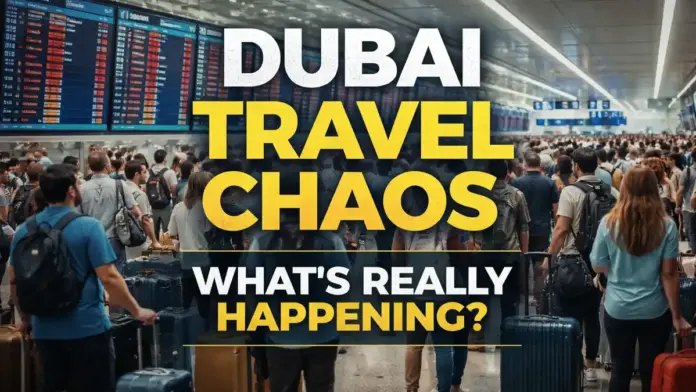
What is really happening in Dubai
When reports about Dubai began spreading across the internet, the first reaction was immediate panic. Videos appeared on social media. Screenshots of airport boards circulated everywhere. Dramatic captions started describing the situation as if the city had collapsed overnight and the airport system had simply stopped existing.
But reality is rarely that simple.
Yes, flights were disrupted. Yes, travelers were stranded. Yes, the wider regional tension created real uncertainty for airlines, airports, crews, and passengers across the Gulf. Those things are serious. They are real. They deserve sober coverage.
But the difference between a serious disruption and a complete collapse is enormous. And that difference is exactly where truth must be protected.
Because once exaggeration takes over, people stop understanding what is actually happening. They stop reading carefully. They stop asking the right questions. They stop distinguishing between a transportation crisis, a regional security shock, and the fantasy version of events that social media prefers because it is louder, darker, and more clickable.
This is the real starting point of the story. Dubai is not a city that has “fallen.” It is a city under pressure because it sits at the center of one of the most interconnected travel systems in the world.
Why Dubai matters more than most cities
Dubai is not just another airport city. It is one of the most important international aviation hubs on the planet.
Every day, people pass through Dubai on routes that connect Europe, Asia, Africa, and Australia. Business travelers, migrant workers, families, students, tourists, cargo operators, and global airlines all depend on that system working with speed and precision.
That is exactly why disruption in Dubai travels far beyond Dubai.
When regional airspace becomes uncertain, airlines do not simply deal with one delayed departure. They deal with an entire chain reaction. Routes are reassessed. Crews go out of position. Aircraft arrive late. Connections collapse. Ground handling slows down. Rebookings pile up. Travelers who were supposed to stay in transit for two hours suddenly find themselves trapped for a day or more.
This is what makes the Dubai story so important. It is not just about one city. It is about what happens when one of the world’s great movement hubs is forced to operate under geopolitical pressure.
That broader regional pressure does not come out of nowhere. It belongs to a wider Gulf security environment that has already made travelers and readers more anxious about what can happen when military tension spills into aviation. For readers who want that larger picture,
[Iran 360: what’s happening now, what people are demanding, and the realistic outlook for 2026] helps explain why even a city built on order can be shaken by instability around it.
The human reality behind the headlines
The strongest version of this story is not the loudest one. It is the most human one.
Behind every dramatic post about Dubai there are ordinary people trying to solve ordinary problems under extraordinary pressure.
There is the family with children who thought they were only connecting through the airport for a few hours and are now trying to figure out where they will sleep. There is the worker traveling on a tight budget who cannot simply book a new ticket at a higher price. There is the business traveler missing meetings across continents. There is the student trying to get home and no longer sure which route still works.
This is what a real travel crisis looks like. It does not always look cinematic. It looks exhausting.
It looks like long lines at counters. It looks like people refreshing airline apps every few minutes. It looks like no one giving a fully clear answer because the system itself is still adjusting.
And that is why exaggeration is so dangerous. It turns living human stress into performance. It replaces real confusion with internet theater.
The difference between disruption and collapse
This is where the article must be absolutely clear.
Dubai is experiencing disruption. That is not in doubt.
But disruption is not collapse.
An airport under pressure is not the same thing as an airport that has stopped existing. A city coping with airline delays and operational instability is not the same thing as a city that has become uninhabitable. A major transportation shock is not the same thing as the total breakdown of urban life.
These distinctions matter because words shape public understanding.
If you say “collapse,” readers imagine the basic structure is gone. If you say “severe disruption,” readers understand the structure still exists but is struggling under pressure. These are not stylistic choices. They are different realities.
The internet tends to choose the darker version because it spreads faster. Serious journalism must do the opposite. It must choose the more accurate version, even when that version is less dramatic.
Why the internet keeps getting this story wrong
The internet rewards emotional certainty, not disciplined clarity.
A short clip showing crowds at an airport becomes “Dubai is shut down.” A photo of a delayed board becomes “all flights are canceled.” A regional security event becomes “the whole city is collapsing.” This is how digital panic works. It compresses a complex situation into one extreme sentence.
But the real world does not move that way.
Airports under pressure usually do not stop all at once. They slow down. They restrict. They reroute. They absorb shock unevenly. Some flights move. Others do not. Some passengers get out. Others wait. Some airlines adapt quickly. Others take longer.
This unevenness is exactly what makes the experience so frustrating for travelers. It is also what makes the online story so misleading. Because the truth is rarely neat enough for a viral slogan.
Readers who want to stay grounded in moments like this need one habit above all others: they have to separate verified reporting from recycled panic. That is why [How to read the news without being manipulated: fact-check habits, sources, and propaganda signals] matters in a moment like this. When the emotional temperature rises, media discipline becomes practical self-protection.
What this means for travelers right now
For travelers, the most important shift is psychological.
Normal travel depends on predictability. You expect the route to hold. You expect the connection to work. You expect the gate, the aircraft, the crew, and the schedule to remain inside a manageable range of change.
- That assumption breaks first in a crisis.
- So the most useful mindset is not panic. It is disciplined flexibility.
Passengers need to rely on direct airline updates, airport announcements, and verified notifications. They should assume that schedules can change faster than social media can explain why. They should also understand that even after the immediate danger appears to ease, recovery is not instant. Aircraft need to be repositioned. Crews need legal rest. Routes need approval. Backlogs need to be absorbed.
In other words, even when the headlines calm down, the disruption may continue.
This is why so many travelers describe these moments not as dramatic but as draining. The uncertainty lasts longer than the noise.
Why a city like Dubai is especially vulnerable
There is a deeper reason this story feels so big.
Dubai’s greatest strength is also its greatest exposure.
Because it is such a central node in the global system, it reacts immediately to instability around it. Smaller places can be bypassed. Global hubs cannot. They are too connected, too busy, too structurally important.
That means Dubai does not need to become a battlefield to feel the force of conflict. It only needs to sit inside a region where security calculations suddenly change.
This is the real lesson of the story.
The world often speaks about infrastructure as if it were invincible. Airports, logistics chains, airline networks, digital booking systems, synchronized timetables. All of it feels permanent when it works.
But modern systems are not invincible. They are only stable as long as the political environment around them allows them to be stable.
When that environment shifts, even the most efficient hub in the world can begin to wobble.
The economic truth behind the travel crisis
There is also an economic layer to this story that should not be ignored.
When a hub like Dubai is disrupted, the cost is not only emotional. It becomes financial immediately.
Travelers pay for extra nights, new tickets, missed bookings, and delayed plans. Airlines absorb routing costs, schedule repair costs, and compensation pressure. Cargo networks lose time. Insurance logic shifts. Business schedules fail.
And because Dubai is so central, those costs do not stay local. They spread across the wider network.
This is why a travel disruption in Dubai is never just a travel disruption. It is also a logistics story, a confidence story, and a global systems story.
What serious reporting should say now
A serious article should not try to compete with panic. It should do something harder and more useful.
It should tell the reader this:
Dubai is under pressure, not erased.
Travelers are stranded, not imaginary.
The disruption is real, but the exaggeration is also real.
The airport system is stressed, not dead.
The city is functioning, but the certainty people normally rely on has been badly shaken.
That is the truthful center of the story.
For readers who want one clean external reference for the broader verified framework behind the regional aviation disruption, the strongest authority link remains this [Reuters report].
The real lesson after the noise
The biggest mistake in moments like this is to think the loudest version is the truest one.
It usually is not.
The truest version is often the one that sounds less theatrical and more human. The one that pays attention to the stranded passenger instead of the viral slogan. The one that understands that a city can be deeply affected without being destroyed. The one that treats uncertainty as something to explain, not to exploit.
That is the real story in Dubai.
Not fantasy.
Not internet apocalypse.
Not the cheap thrill of saying a city has fallen.
The real story is harder and more honest than that.
It is the story of what happens when one of the world’s most connected travel hubs runs into the hard edge of geopolitics, and ordinary human beings are left to absorb the shock first.