
Part A — The economy isn’t “a thing.” It’s a system of contracts, prices, and power.
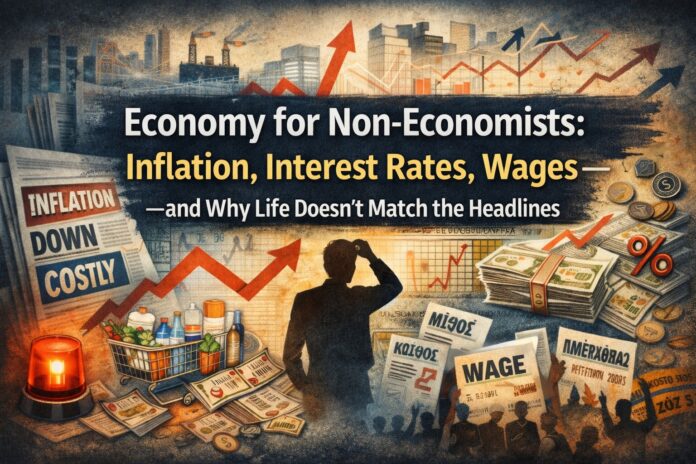
Most people imagine the economy as a scoreboard: GDP up, inflation down, markets calm. In reality, the economy is a living system of contracts (wages, rent, loans), prices (what you pay), and power (who can pass costs onto whom).
That’s why two statements can be true at once:
-
“Inflation is falling.”
-
“My life is getting more expensive.”
Because “inflation falling” often means prices are rising more slowly, not that prices are going back down.
A simple map: four forces behind most economic headlines
-
Prices (inflation)
-
Money (interest rates & credit)
-
Income (wages)
-
Output (growth & productivity)
Headlines bounce among them. Your life is where they collide.
The first literacy rule: “Compared to what?”
-
“Wages are rising.” Compared to inflation or just nominally?
-
“The economy is growing.” Per person or overall?
-
“Inflation is lower.” Lower than the peak or lower than the target?
If you don’t control the comparison, you don’t control the meaning.
Part B — Inflation: the most-used word, the least-understood concept
Inflation is not “high prices.” It is the rate at which the overall price level rises. Prices can be high while inflation is low. Prices can keep rising while inflation falls.
Three truths about inflation
-
It has multiple causes. Demand, energy, supply chains, exchange rates, margins, expectations—often a mix.
-
Your inflation isn’t the CPI. Your household basket differs from the average basket.
-
Inflation is distribution. It hits people unevenly; it’s social as much as economic.
Why prices don’t “go back down”
Prices typically fall only when productivity jumps, shocks reverse, demand collapses (recession), or technology slashes costs. So “inflation down” can still feel like “no relief.” That gap fuels political anger.
The quiet factor: pricing power
In concentrated markets, firms can protect margins more easily. This isn’t moral preaching—it’s structure. And structure is policy.
Part C — Interest rates: the lever that moves everything, slowly and unevenly
Interest rates are the price of money. When rates rise:
-
borrowing gets harder,
-
demand cools,
-
investment slows,
-
hiring softens,
-
inflation pressure usually eases.
But with a lag. Policy is steering a ship: you turn now, the ship turns later.
Why raise rates when people are already squeezed?
Because if people expect permanently rising prices, behavior shifts: purchases get front-loaded, wages are demanded faster, prices are set defensively. Expectations can become self-fulfilling.
Bonds aren’t trivia—they’re the plumbing
Bond yields shape government borrowing, corporate credit, mortgages, and investment decisions. When rates move, the future gets repriced.
Same rates, different pain
Renters, variable-rate borrowers, fixed-rate owners, and small businesses feel the same policy through different channels.
Part D — GDP and productivity: headlines you can’t spend
GDP measures total output. It doesn’t automatically mean higher median wages or better living standards. Growth can be captured.
The long-term engine of prosperity: productivity
Productivity isn’t “working harder.” It’s producing more value per hour. When productivity stalls, wages struggle, politics becomes zero-sum, and society polarizes.
Deficits and debt: neither sin nor free money
Deficits can stabilize crises or finance investment—or become waste. The real questions:
-
What is the deficit buying?
-
Does it increase future productive capacity?
-
Who pays, and when?
-
What happens when rates rise?
Editorial close: economic literacy is civic self-defense
Without a basic economic map, you become easy prey for slogans. Every “just” hides trade-offs: costs, timing, and distribution. The economy isn’t magic. It’s choices—about real life: rent, work, security, dignity.