

Table of Contents
The crisis is no longer about threats alone — it is now hitting energy and shipping directly
The latest developments in the Gulf point to a clear shift. This is no longer just a crisis of warnings, deterrence, or military signaling. It is increasingly a crisis that is landing directly on energy infrastructure and commercial shipping. Reports of strikes affecting oil-related facilities, combined with the confirmed case of a vessel hit in the Strait of Hormuz and a crew forced to abandon ship, show a conflict moving into a more dangerous operational phase with global consequences.
That also means this is exactly the kind of story that can get distorted fast. Some headlines and social posts rush to present every new incident as proof of total maritime collapse. Others downplay the danger because not every tactical detail is publicly visible yet. Neither approach is serious enough.
The more accurate reading is stricter: there are confirmed incidents involving ships in and around Hormuz, there are verified disruptions tied to the energy sector, and there is already enough evidence to say that the crisis is materially affecting both shipping confidence and energy risk.
For an English-language companion article built in full hreflang logic with the Greek original, the key is not to copy wording line by line. It is to preserve the same editorial core: what is confirmed, what remains less clear, where the misinformation risk sits, and why readers outside the Middle East should care right now. That framing is especially important in a story where fear can outrun proof in a matter of minutes.
What is actually confirmed about the ship hit in the Strait of Hormuz
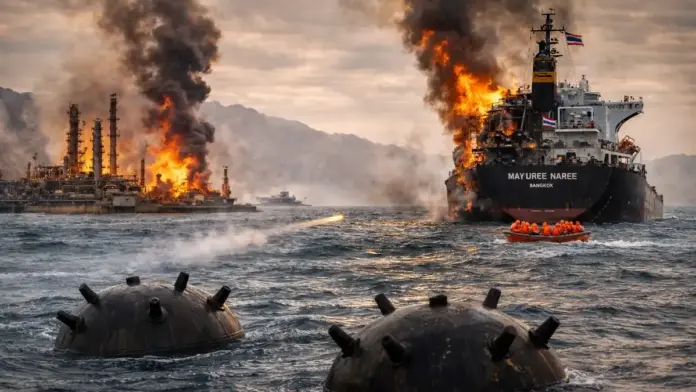
The clearest verified case matching the latest reporting involves the Thailand-flagged bulk carrier Mayuree Naree. Reuters reported that the vessel was hit by projectiles in the Strait of Hormuz, caught fire, and that crew members abandoned the ship, with Thailand later saying three crew were missing. Reuters also separately summarized the vessel among the ships attacked since the start of the current Gulf war phase.
That point matters because precision matters. The strongest confirmed layer is the outcome: the ship was hit, a fire broke out, and the crew had to evacuate. What remains more difficult to state with absolute confidence in public reporting is the complete technical profile of the strike in every detail at the moment of publication. In crisis coverage, responsible writing avoids overstating a tactical description beyond what the available reporting firmly supports.
This is the line that protects credibility. The disciplined formulation is not to inflate every report into a cinematic certainty. The disciplined formulation is that a commercial ship in the Strait of Hormuz was struck by projectiles, suffered a fire, and forced a crew abandonment. That is already severe enough without editorial exaggeration.
The strikes on energy infrastructure are not a side story
The second major layer is energy. Reuters reported that the broader conflict has already affected oil and energy operations in the Gulf, including damage and shutdowns that have disrupted refining capacity and wider market expectations. In one report, Reuters cited roughly 1.9 million barrels per day of refining capacity in the Gulf as shut due to the war. That is not a symbolic development. It is a structural one.
Once strikes begin hitting energy infrastructure, the crisis changes character. It stops being only a military story and becomes an energy security story, a shipping story, an insurance story, and an inflation story. Supply risk is no longer discussed in abstract terms. It becomes part of how traders, shipowners, governments, and insurers recalculate exposure in real time.
That is also where a strong authority external reference matters. As the U.S. Energy Information Administration explains in its analysis of global oil transit chokepoints, the Strait of Hormuz remains one of the most critical energy corridors in the world, with a major share of global oil and LNG trade moving through it. That is why a strike on a vessel or disruption linked to oil infrastructure in this region is never just a local incident. It is a global risk signal.
Why Hormuz matters far beyond the Gulf
The strategic importance of Hormuz is not media inflation. It is geography and economics. A corridor this central does not have to be formally declared “closed” in order to send shockwaves across world markets. If shipowners, charterers, insurers, and governments begin treating it as unsafe at scale, then disruption becomes real even before a legal blockade exists on paper.
That is why readers should avoid a false binary. The wrong question is “Is Hormuz fully shut, yes or no?” The better question is “Has the security environment deteriorated enough to disrupt commercial behavior, raise costs, and threaten energy flows?” The available reporting strongly suggests that the answer to that second question is already yes.
For additional Newsio context in English, this article sits naturally beside Strait of Hormuz: would a seizure or blockade help the global economy or the United States?, which explored why disruption in this waterway would be destabilizing rather than strategically beneficial, and Gulf strikes: What’s confirmed about incidents in Dubai and Qatar, and what hasn’t been verified, which already established the newsroom logic of separating verified facts from viral overreach in a fast-moving Gulf crisis.
Where the misinformation risk really sits
The first distortion is overstatement. The phrase “everything has stopped” may generate urgency, but it can still oversimplify reality. The public record supports serious maritime and energy disruption. It does not automatically justify every maximalist claim circulating online about total collapse in every lane, every terminal, or every shipment.
The second distortion is the opposite one: because the full tactical map is not visible to the public in real time, some claim there is no real crisis at all. That is just as misleading. A crew abandonment, vessel fires, and measurable energy disruption are not theoretical. They are concrete warning signs that the crisis has already crossed into material damage territory.
The third distortion is timeline compression. In conflicts like this, early reports, official claims, ship-tracking signals, and later confirmations do not arrive all at once. They come in layers. Serious reporting has to show readers where certainty ends, where claims begin, and where caution is still necessary. That is not hesitation. It is editorial discipline.
Why this matters to readers outside the region
For readers in the United States, Europe, and beyond, the relevance is immediate. Hormuz is one of the places where a regional conflict can rapidly become a global economic story. If energy infrastructure is being hit and if commercial vessels are being struck badly enough to force evacuations, then the fallout can extend into fuel costs, freight pricing, inflation pressure, and wider market instability.
That is why this piece should be read not as a narrow war update but as a systems story. It is about the overlap between conflict, energy, maritime trade, and information integrity. The battlefield matters, but so does the wider chain reaction it can trigger across shipping routes, supply expectations, and public understanding.
Readers who want that broader escalation frame can also connect this article with Newsio’s Trump–Iran: The 10–15 Day Window, Strike Claims, and What We Actually Know, which helped explain how official claims, military signaling, and incomplete early information can shape perceptions before a fuller picture emerges.
What readers should take away
The safest conclusion today is a three-part one. First, there are confirmed attacks affecting commercial shipping in and around the Strait of Hormuz, including a vessel hit by projectiles and abandoned by much of its crew.
Second, the conflict is hitting energy infrastructure hard enough to create real production and market consequences. Third, the crisis is no longer meaningfully regional in its implications because Hormuz sits at the heart of a globally important oil and LNG corridor.
The second conclusion is just as important: not every viral claim about the crisis has been independently confirmed in full detail. But that lack of perfect public visibility does not cancel the danger. It simply means the story has to be written with precision rather than panic.
And the final conclusion is the one that ties this English article properly to its Greek counterpart in hreflang logic: this is the same core event, the same editorial mission, and the same fact-based discipline, adapted naturally for an international English-speaking audience without losing the seriousness of the original.