

Table of Contents
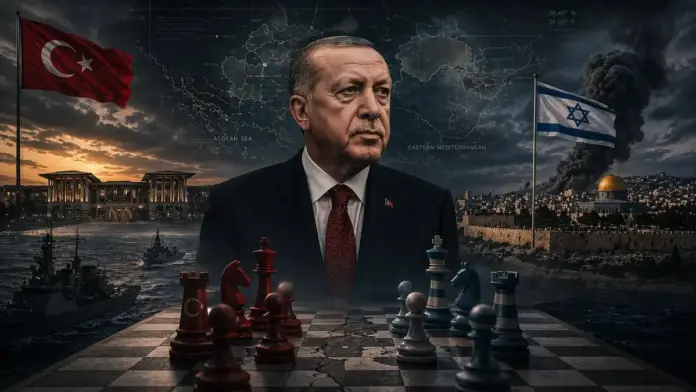
Erdogan is raising his voice more aggressively against Israel, but Greece remains inside Turkey’s strategic frame
There are periods when Ankara speaks in one register to everyone. And there are periods when it grades its fronts differently. This phase looks much closer to the second. Recep Tayyip Erdogan has not abandoned, even in the slightest, the revisionist structure of Turkey’s long-running claims toward Greece.
The Aegean, maritime zones, research activity, demilitarization, Cyprus, and the broader logic of “Blue Homeland” remain embedded in Turkey’s strategic vocabulary. But if one looks at where Erdogan himself has raised the rhetorical temperature most visibly in recent months, the answer is primarily Israel, not Greece.
Reuters reported in February that Erdogan and Greek Prime Minister Kyriakos Mitsotakis met in Ankara and voiced a willingness to keep improving ties even as the core maritime disputes remained unresolved.
That does not mean Athens is outside the danger zone or that Turkish pressure has disappeared. It means Ankara appears to be distributing intensity selectively.
Toward Israel, Erdogan is investing in a more openly ideological, regional, and political narrative — one built around Gaza, leadership in the Muslim world, denunciation of Israeli policy, and a broader attempt to position Turkey as a moral and geopolitical counterweight.
Toward Greece, by contrast, Turkey is keeping a dual track alive: a publicly managed diplomatic channel at the top level, while never withdrawing the strategic substance of its claims on the ground. Reuters’ February and January reporting, taken together, captures exactly that split posture.
Why Israel is climbing higher in Erdogan’s rhetoric
The escalation toward Israel is not only foreign policy. It is also domestic political theater with regional ambition behind it. The Israel-Palestinian file gives Erdogan room to present himself as a leader with moral and geopolitical weight in the Muslim world, to distance himself from the West, and to cultivate a public image of defending Palestinians and, more broadly, Muslim populations under pressure.
Reuters reported in February that Erdogan again attacked Israel over its recognition of Somaliland, folding that move into a wider denunciation of Israeli conduct and outside intervention in the region. The same Reuters reporting also pointed back to Turkey’s continued condemnation of Israel over Gaza, the collapse of trade ties, and the broad deterioration in the relationship.
That matters because Turkish rhetoric toward Israel is now serving several goals at once: external projection, domestic mobilization, ideological positioning, and geopolitical autonomy.
It is a front on which Erdogan can raise his voice dramatically while paying a lower immediate bilateral price than he might if he tried to launch a parallel all-front rhetorical explosion against Greece and the European Union at the same moment. That is why the Israeli track looks louder right now. Not because Greece ceased to matter, but because Israel currently offers Ankara a more profitable stage for escalation.
Why Greece is not leaving the frame
The fact that Turkish rhetoric is now sharper toward Israel does not mean Greece has stopped being a structural target of Turkish strategy. On the contrary, Athens remains inside the hard core of the issues Ankara considers unresolved.
Reuters reported in late January that Turkey’s defense ministry issued a navigation notice insisting Greece must coordinate research activities in Aegean waters that Turkey sees as part of its own continental shelf. The continuation of this pressure, even during a period of political dialogue, shows that the strategic core has not moved.
A few weeks earlier, Reuters had also reported that Greece planned to extend its territorial waters further, potentially in the Aegean, despite Turkey’s long-standing threat of war if Athens moves beyond six nautical miles there. That point matters enormously. It shows that the deep dispute structure is fully alive.
So the current picture is not “calm” in Greek-Turkish relations. It is more complex: fewer spectacular personal outbursts from Erdogan toward Greece at this exact moment, but a stable architecture of challenge, pressure, and revisionist positioning still in place.
That is also why this article connects naturally with Newsio’s earlier English analysis, Greece-Turkey tensions: threats over the islands, “casus belli,” and what the latest rhetoric really means in the eastern Mediterranean. The broader dispute did not disappear. It simply entered another phase of emphasis and tone.
Ankara is trying to keep two faces at once
This may be the most important point for readers. Erdogan’s Turkey has learned to operate with two languages at the same time. It can appear conciliatory at the summit level, hold meetings with Mitsotakis, and speak of maintaining the rapprochement, while simultaneously keeping its machinery of contestation, pressure, and strategic signaling fully active in practice.
Reuters captured exactly that in February: both leaders spoke in Ankara about their desire to keep improving relations, but the longstanding disputes over maritime boundaries, rights in the Aegean, and strategic space in the eastern Mediterranean remained fully open.
That dual language serves Ankara well. It reduces diplomatic cost toward the West and NATO without requiring Turkey to abandon the substance of its claims. At the same time, it allows Erdogan to raise the rhetorical temperature elsewhere — in this phase, most clearly toward Israel — without opening a fully synchronized confrontation with every front at once.
What this means for Greece
For Athens, the biggest mistake would be to read the current picture as evidence that Turkey has somehow “moved past” Greece as a strategic front. The record does not support that conclusion.
The correct reading is narrower and more serious: Turkey is shouting more loudly toward Israel right now, but it has not softened in any real strategic sense toward Greece. It is simply distributing pressure more selectively and more tactically.
That means Greece needs a double awareness. First, it must not confuse the absence of a new headline-grabbing personal outburst from Erdogan with any underlying change in Turkish strategy.
Second, it must understand that the shift in rhetorical intensity toward Israel does not exclude parallel pressure in the Aegean — especially in areas such as research notices, territorial waters, maritime jurisdiction, and questions of sovereign rights. The dispute remains live even when it is not the loudest show on the stage.
Readers who want a broader framework for separating real escalation from emotionally overloaded framing can also see Newsio’s English explainer, How to Read the News Without Being Manipulated: A Complete Guide to Fact-Checking, Sources, and Propaganda. This matters especially in stories where rhetoric, media amplification, and strategic pressure begin to blur together.
The real conclusion
So the picture is not symmetrical. It is not accurate to say that Erdogan is escalating against Greece and Israel in the same way, at the same level, and with the same intensity right now.
The international record shows something more precise:
Erdogan is maintaining steady revisionist pressure toward Greece.
But at this moment, his most openly aggressive, ideologically charged rhetorical escalation is directed primarily at Israel.
That does not make Greece less important to Ankara.
It shows that Turkey does not open every front in the same tone at the same time.
And that is exactly what makes Turkish strategy more dangerous:
it does not give up its claims, but it knows how to modulate its volume according to where it believes the return will be higher.