

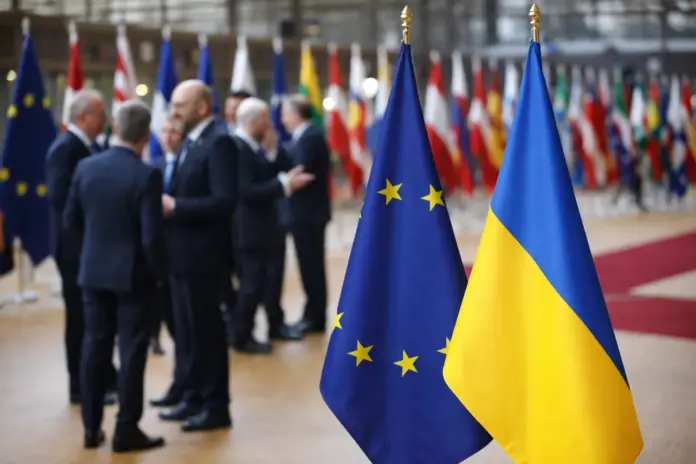
EU Enlargement: Why Accession Criteria Are Back Under Review After Ukraine
EU enlargement has returned to the center of Europe’s strategic debate. The reason is not procedural fatigue. It is security pressure.
Ukraine’s war has changed how European policymakers talk about enlargement: less as a long, purely technical pathway, and more as a geopolitical instrument that can anchor stability and deter further destabilization. That does not mean the EU is abandoning standards. It means Brussels is reconsidering how the accession framework is applied, paced, and sequenced—especially for countries facing extraordinary conditions.
The EU’s baseline remains clear: membership requires meeting established conditions, including democratic institutions, rule of law, and the ability to implement the EU acquis. The European Commission outlines these principles in its official overview of the conditions for EU membership.
What “revisiting criteria” actually means
When EU officials discuss “revisiting” enlargement criteria, they typically are not talking about lowering the bar. They are talking about:
-
Sequencing: which reforms must come first, and which can be phased in
-
Measurement: more concrete benchmarks and clearer progress indicators
-
Incentives: earlier access to selected EU programs or funding tied to verified reforms
-
Reversibility: faster safeguards if rule-of-law backsliding occurs
In practice, the debate is about credibility on both sides: credibility of candidate reforms, and credibility of the EU’s promise that progress produces tangible results.
The Ukraine factor: security logic meets institutional logic
Ukraine’s case is structurally different from most past enlargements. It is pursuing integration while facing a major war and a heavy security burden. That reality creates policy tension.
Security logic
A faster, more visible pathway can signal political commitment and reduce strategic uncertainty. For the EU, enlargement is increasingly discussed alongside resilience, defense coordination, and long-term stability on the continent’s eastern flank.
Institutional logic
At the same time, the EU’s institutions are built on enforceable rules. Rule of law and governance standards are not symbolic requirements; they protect the Union’s legal order and budget integrity. Any impression of “political shortcuts” risks eroding trust—both among member states and among citizens.
This tension mirrors a broader EU challenge: keeping democratic legitimacy strong while modernizing governance in a fast-changing environment. A useful parallel, from a different policy domain, appears in the explainer on <a href=”https://newsio.org/electronic-voting-in-greece-whats-changing-whats-not-and-what-citizens-should-watch-for/”>what changes in electronic voting and what citizens should watch for</a>, where standards, safeguards, and trust mechanisms sit at the center of institutional change.
What could change without changing the “core” standards
Three ideas appear repeatedly in enlargement discussions. None guarantee membership. They aim to make the pathway more structured, more motivating, and more resilient to political shocks.
1) Gradual integration with verified milestones
Candidate countries could enter selected EU policies earlier—only after meeting clearly defined benchmarks—so that reforms produce visible gains before full membership. The principle is simple: reward verified progress, and keep the final decision tied to full compliance.
2) More measurable rule-of-law benchmarks
Instead of broad political assessments, the process can rely more heavily on concrete indicators: judicial independence safeguards, anti-corruption capacity, procurement transparency, and enforcement track records.
3) Stronger conditionality and reversibility
The EU can tighten the “earned and retained” logic: if backsliding appears, funds or chapters can pause quickly. This protects the Union’s internal cohesion and makes commitments enforceable.
The larger point is that Europe is trying to reconcile speed with credibility. That same balancing act shows up across EU-adjacent debates about systems that must remain stable under pressure—another example is the analysis of how AI feeds reshape access to information and institutional trust.
What to watch next: signals, timelines, and EU capacity
The next phase of this debate will likely focus on two tracks running in parallel:
-
Candidate-track adjustments: clearer milestones, earlier incentives, stricter monitoring
-
EU-track readiness: how the Union adapts decision-making and budget structures to remain functional with more members
Enlargement is not only about whether candidates are ready. It is also about whether the EU can remain effective, coherent, and accountable as it grows. That makes the issue inherently political and deeply institutional at the same time.
It also connects to wider discussions about how large systems adapt without losing stability—an angle explored in the explainer on how digital currencies pressure traditional banking structures, where rules, sequencing, and safeguards determine whether change strengthens or weakens a system.
Summary
EU enlargement is back under intense review because Ukraine’s war has reshaped Europe’s security priorities. The EU is not expected to discard core accession standards, but it may adjust how progress is measured, rewarded, and protected—through gradual integration, clearer benchmarks, and stronger reversibility tools.