

Table of Contents
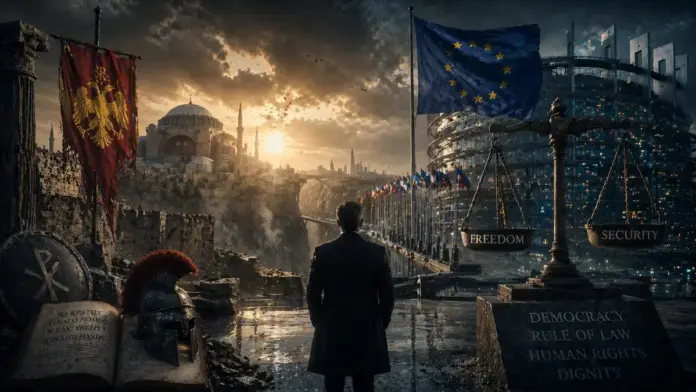
Europe at Its Own Test: Historical Memory, Democratic Self-Defense, and the 21st-Century Crisis of Cohesion
Europe is not facing a single crisis. It is not only under pressure from migration, not only under pressure from war on its eastern flank, not only under pressure from domestic polarization, and not only under pressure from extremism, economic fatigue, or declining trust in institutions.
The real strain comes from the way all of these pressures now overlap and reinforce one another. The European Union is trying to guard its external borders, uphold fundamental rights, integrate diverse populations, reduce irregular arrivals, contain radicalization, and preserve democratic legitimacy at the same time.
That is why the deeper issue is not simply whether Europe is “coping.” It is whether it still knows what it is defending, and by what means. The European Commission’s own migration framework now openly treats border management, asylum procedures, returns, solidarity, and integration as part of one connected policy challenge rather than isolated debates.
That matters because democracy is not a passive condition. It is not an open field without limits. European legal and political thought has long recognized that free societies may need to defend themselves against forces that use democratic freedoms in order to erode democracy itself.
That is the underlying logic behind the idea sometimes described as defensive or militant democracy: not hostility to religion, speech, or pluralism, but a recognition that constitutional systems are not obliged to grant unlimited room to projects that seek to dismantle constitutional order.
The European human-rights tradition protects freedom of religion and conscience, but it does not erase the state’s obligation to preserve public order, rights, and democratic legality.
The real difficulty begins where slogans end. Europe has to find a way to remain open without becoming naïve, rights-based without becoming paralyzed, and serious about security without collapsing into collective suspicion.
It cannot answer every legitimate concern about social cohesion or extremism by dismissing it as prejudice. But it also cannot turn every migration wave, every visible religious symbol, or every urban tension into evidence of a civilizational siege. Both reactions are distortions.
The harder task is cleaner: to distinguish the lawful from the unlawful, the difficult from the dangerous, and the extremist from the merely unfamiliar. That distinction is not rhetorical polish. It is the difference between democratic seriousness and political panic.
Historical memory is not a machine for panic, but it is a warning against complacency
Whenever Europe feels strategically insecure, it returns to its own history. It returns to stories of internal division, imperial decline, collapsing confidence, and political communities that discovered their weakness too late.
These analogies are powerful because they contain one enduring truth: complex political orders usually do not fall in a single dramatic moment. They weaken internally first. They lose clarity, discipline, and confidence before they lose stability.
But history requires discipline too. It is not a machine that turns the present into a reenactment of the past.
Modern Europe is not Byzantium, migration is not medieval siege warfare, and every symbolic conflict is not a prelude to civilizational collapse. Serious writing has to keep that line visible. History can illuminate patterns. It cannot justify lazy equivalence. The useful lesson is not that “Europe will fall the way others fell.”
The useful lesson is that any political community that loses the ability to enforce its own rules, integrate newcomers into a shared civic order, and speak honestly about social strain creates openings for deeper instability.
That is also why Europe’s current problem is larger than migration by itself. The Union is living through a crisis of political self-confidence. It still speaks fluently about values. It is far less convincing when it has to prove that those values can survive pressure.
That tension already runs through Newsio’s own English analysis Migration: What’s Changing in the EU and Why It Shapes Relations With Neighboring Countries, which shows that the migration debate is really a wider argument about governance, responsibility, burden-sharing, deterrence, and state capacity.
Migration is not “the whole problem,” but it is a hard test of state seriousness
Migration has become the screen onto which Europe projects almost all of its anxieties: identity, labor, borders, security, welfare pressure, administrative weakness, and the limits of solidarity. That is exactly what makes the subject so vulnerable to manipulation. One side downplays or obscures real failures of enforcement, processing, and integration. The other turns every arrival into a prepackaged threat. Both responses lose the truth.
The European Commission’s Pact on Migration and Asylum is important precisely because it reflects a more explicit institutional admission that Europe can no longer sustain a politics of denial.
The pact is framed around faster border procedures, stronger returns where legally applicable, more predictable responsibility-sharing, and common rules that try to combine control with legal guarantees.
That does not solve the political conflict. But it does show that the EU itself now treats migration as a structural stress test for democratic governance, not as a temporary communications issue.
For countries like Greece, this is especially concrete. Greece is not debating migration in the abstract. It is dealing with the operational burden that comes with being an external border of the Union.
That means reception systems, registration, asylum processing, enforcement, local social pressure, diplomatic tension with neighboring states, and the constant mismatch between national exposure and European rhetoric.
Newsio’s English explainer Electronic Voting in Greece: What’s Changing, What’s Not, and What Citizens Should Watch For is not about migration directly, but it is useful here for one reason: it shows the same deeper point.
Democratic systems do not survive on principles alone. They survive on trusted procedures, credible administration, and public confidence that rules are actually being applied.
The serious democratic position, then, is neither “everything is fine” nor “everything is invasion.” The serious position is that a European state has both the right and the duty to say something straightforward: anyone who lives under its legal and political order has rights, but also obligations to the common law, to equality before that law, to women’s equal status, to others’ religious freedom, and to the secular authority of democratic institutions.
That is not hostility to diversity. It is the minimum condition of shared civic life. The EU’s own integration policy reflects exactly that premise by treating education, labor-market participation, social inclusion, and civic integration as active policy work rather than automatic outcomes.
Integration failed wherever it was treated as automatic
One of Europe’s most expensive illusions was the belief that integration would happen almost by itself so long as rights existed and time passed. The reality has been much more demanding. The Commission’s action plans on integration and inclusion make clear that integration is not passive coexistence.
It requires institutional effort across schools, housing, employment, health, language, and participation in public life. That alone tells us something important: the problem is not that Europe is too diverse. The problem is that too often it expected diversity to organize itself into cohesion without the hard work of civic integration and state capacity.
That point matters because it allows a much cleaner conversation. The issue is not that people of different backgrounds live in Europe. The issue begins when states lose either the confidence or the tools to insist on real incorporation into common rules, common institutions, and a shared public space.
That is where parallel realities emerge—not as grand conspiracies, but as the result of weak administration, political hesitation, and social postponement. The answer is not cultural paranoia. It is stronger democratic governance.
This is where Newsio’s English piece Enforcement on Unlicensed Places of Worship in Athens also fits naturally. Its value is not that it dramatizes religion. It does the opposite. It helps separate lawful religious freedom from licensing, regulatory oversight, and the ordinary requirement that institutions operate inside the law. That is the kind of distinction Europe needs more often: rights protected, rules enforced, hysteria avoided.
Religious freedom is not the same thing as political immunity for extremism
This is one of the places where public discussion most often breaks down. When radical slogans, extremist projects, or anti-democratic mobilization appear inside open societies, many people hesitate to speak clearly because they fear being accused of attacking a faith or an entire community. That is a mistake. Freedom of religion is fundamental. The use of religion or ideology to justify violence, coercion, or democratic subversion is something else.
That is why the distinction drawn in Newsio’s English analysis Islam, Jihad, and Extremism: What They Really Mean is so important. The article insists on accuracy over panic: the real issue is not Islam as a faith, but extremism, ideological manipulation, and the misuse of religious language in support of political domination or violence. That is exactly the framework serious democratic analysis should adopt.
The same principle appears in European security reporting. Europol’s annual terrorism situation and trend reporting continues to show that the EU faces threats from multiple ideological directions, while wars and geopolitical shocks influence radicalization dynamics across the continent.
The key institutional lesson is not that Europe should become suspicious of entire populations. It is that democratic systems must be able to identify violent extremism precisely, enforce the law consistently, and resist both denial and sensationalism.
Europol’s European Union Terrorism Situation and Trend Report 2025 is one of the strongest authority baselines for that part of the argument because it grounds the issue in threat assessment rather than in ideological theater.
The bigger problem may not be the threat itself, but Europe’s inability to describe it accurately
European public life has developed a damaging paradox. In some circles, the fear of exaggeration has become so strong that real tensions are minimized or blurred. In other circles, fear itself has grown so large that analysis collapses into collective suspicion. The result is a double distortion: denial on one side, panic on the other.
That is where manipulation enters. Not only through fake images or fabricated claims, but through framing. A society can be misled by falsehood, but it can also be misled by selective silence, by euphemism, or by the refusal to classify a problem clearly.
The European Commission now openly frames protection of democracy as a matter of resilience against extremism, information manipulation, and institutional subversion. Its democracy-protection agenda and related work on foreign information manipulation and interference show that public trust, civic stability, and democratic security now have to be defended together.
This is also why readers need a reliable internal method, not just hotter headlines. Newsio’s fact-check framework How to Read the News Without Being Manipulated belongs naturally in this reading chain because Europe’s cohesion debate is exactly the kind of issue where selective clips, emotionally charged images, and ideological shortcuts can overwhelm careful judgment.
A serious publication cannot fight manipulation by becoming manipulative in a more polished tone.
Greece as an external border needs strategy, not mythology
The Greek experience has a particular sharpness. Greece sees earlier than many Western European societies how pressure at the external border turns into an internal political fact. That does not mean Greece should adopt fantasies of civilizational doom. It does mean Greece is entitled to demand a European policy that is neither indifferent nor hypocritical.
For Greece, migration is not a studio debate. It is about administrative endurance, border management, EU burden-sharing, local social balance, and legal credibility. The right national line is not to speak in the language of siege.
It is to say clearly that the EU’s external borders require serious enforcement, that asylum procedures must be fast and lawful, that returns where legally applicable must be implemented, and that integration for those who remain lawfully cannot be outsourced to wishful thinking.
That is democratic seriousness, not ideological aggression. The Commission’s migration framework and the continuing EU-level argument about solidarity versus deterrence make clear that this is now a central structural problem for the Union, not a peripheral Greek complaint.
Europe’s hardest challenge is political self-confidence
Beneath all of this lies a larger question than migration or any single security file. Does Europe still believe in itself as a political project strongly enough to require compliance with its rules without apologizing for doing so?
Does it believe enough in democratic order to protect rights without surrendering the public sphere to intimidation, fanaticism, or permanent state hesitation?
If the answer is no, then the problem is not only what comes from outside. It is what has weakened inside. Political communities do not lose cohesion only through external pressure.
They also lose it when elites can no longer speak clearly, when institutions act too slowly, when administration appears fearful, and when citizens begin to feel that rules are enforced selectively. That is where deeper erosion begins, because the political order stops commanding respect.
The response, though, cannot be hardness for its own sake. It cannot be suspicion as a new political religion. It cannot be broad-brush hostility. The response is more demanding than that: a state that functions, an integration model that expects participation, a legal order that is enforced, a public debate that does not fear reality, and a democracy capable of defending itself without becoming what it fears. That is the only serious European line.
For readers who want the broader geopolitical dimension of Europe’s confidence problem, Newsio’s analysis Trump, Netanyahu, Europe, and Iran: Why the West Is Splitting Over War, Regime Change, and the Future of the Middle East also fits here. It is a different file, but it touches the same deeper issue: Europe’s difficulty in acting as a self-confident strategic center when pressure, risk, and moral argument all arrive at once.
The real European question is not whether Europe will change, but in which direction
Europe is already changing. The question is whether that change will produce a more mature democratic realism or a permanent oscillation between denial and alarm. The new migration framework, EU work against extremism, integration policy, and the growing emphasis on democratic resilience all suggest that European institutions now recognize the scale of the test.
That does not guarantee success. It does show that the old posture of rhetorical comfort is no longer enough.
The more serious European answer will not be complacent drift, and it will not be civilizational panic. It will be a firmer, more honest, more capable rule-of-law model: one that protects belief while blocking fanaticism, one that recognizes the need for border protection without turning human beings into abstractions, and one that understands that integration is not a sentimental word but a hard public-policy task. That is what democratic self-defense looks like in practice.
If Europe can recover that balance, then it will have answered its own historical test in the only way that matters: not by denying pressure, and not by mythologizing it, but by proving that freedom can still be organized into durable order. If it fails, the reason will not only be the scale of the pressures it faced. It will also be its own inability to turn values into governing strength. That is the real cohesion crisis of the 21st century.