

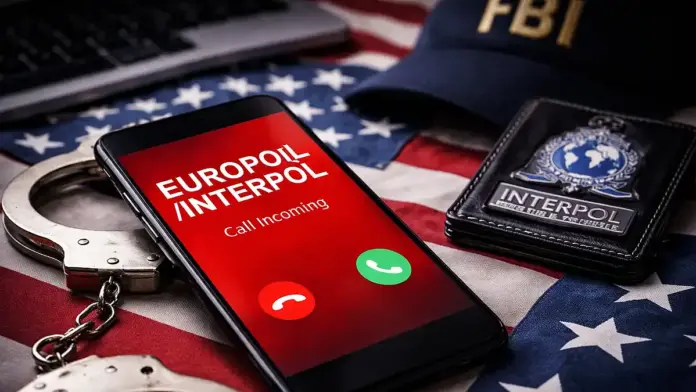
Europol/Interpol “Under Investigation” phone scam: what’s happening and why it works
The call is designed to hit hard and fast: you’re told you’re “under investigation,” an “urgent file is open,” or an “arrest warrant is being prepared.” The name dropped is typically Europol, Interpol, or a vague “European law enforcement unit.” The point is not to inform you. It’s to push you into panic and keep you talking.
This is classic vishing (voice phishing): pressure, authority, and a short clock. Once you’re emotionally off-balance, the scam pivots to what the caller actually wants—personal data, account access, or money.
A practical rule that holds up: legitimate authorities don’t resolve criminal cases through surprise calls, and they don’t ask for one-time codes (OTPs), PINs, banking credentials, gift cards, crypto transfers, or remote access to your device.
The playbook, step by step
1) They use a “serious case” to freeze your judgment.
The allegation doesn’t need to be plausible. It just needs to be scary—financial crime, identity theft, or other high-stakes accusations.
2) They block verification and isolate you.
You’ll hear lines like “do not discuss this with anyone,” “this call is recorded,” or “if you hang up, procedures will escalate.” That’s not procedure. That’s control.
3) They move to “verification.”
They ask for date of birth, address, ID numbers, email—then the dangerous ask: read back an OTP “just sent for confirmation.” That’s how accounts get taken over.
4) They monetize the panic.
It ends in a transfer, “administrative fee,” prepaid cards, crypto, or a request to install an app so they can “help you secure your device.” Remote access is the fastest way to lose an account.
What’s confirmed vs what isn’t
Confirmed: Europol has publicly warned about scams that impersonate the organization through fake correspondence and related tactics. See: Europol warning on fake correspondence scams.
Not reliable on its own: the number you see on your screen. Caller ID can be spoofed. Treat it as a clue, not proof.
Red flags you can trust (and the response that actually protects you)
Eight signals it’s a scam
-
A surprise call claiming you’re “under investigation.”
-
A time squeeze: “now,” “today,” “in minutes.”
-
Threats of immediate arrest or a warrant.
-
Demands for secrecy—especially “don’t talk to a lawyer.”
-
Requests for OTPs, PINs, card details, or banking logins.
-
Instructions to press a key to “reach an officer.”
-
Requests to install an app or share your screen.
-
Scripted delivery: rigid wording, robotic pacing, repeated lines.
What to do during the call
Hang up. Don’t negotiate.
Scammers win by keeping you on the line long enough to steer you into a mistake.
Don’t press keys. Don’t “confirm” anything.
Those prompts are designed to move you to the next stage of the funnel.
Don’t give “harmless” details.
A date of birth plus an email can be enough to start account recovery attempts elsewhere.
Write down what matters.
Time, the displayed number, the exact claim, and whether an SMS or email followed. That’s useful if you report the incident.
If you shared info or paid, move fast
1) Call your bank using official contact channels.
Ask about freezing access, reversing transfers where possible, and monitoring new activity.
2) Reset passwords in the right order.
Start with your email account, then financial services, then everything else. Turn on 2FA where available.
3) Check active sessions and logged-in devices.
Log out unknown sessions and revoke access you don’t recognize.
4) If you installed a “support” app, remove it immediately.
Then run a full device security check. If remote access was granted, assume compromise until proven otherwise.
Related reads on Newsio (EN internal links)
-
AI-powered banking scams: immediate steps to protect yourself
-
New wave of online scams: tricks that fool even experienced users
What this means for you
If you get one of these calls, you don’t need to “prove” anything to a stranger on the phone. Your job is simpler: protect your identity, your accounts, and your decision-making.
Use three quick filters:
-
If they ask for money or codes, it’s a scam.
-
If they demand secrecy and speed, it’s a scam.
-
If they want remote access to your device, it’s a scam.
A calm move beats a clever one. End the call, verify independently, and act through official channels only.
When it’s time to treat it as urgent
If you shared an OTP, card details, or screen access, don’t downplay it. These scams are engineered to get exactly that. Speed matters more than embarrassment: bank, password resets, device check.
Editor’s note: The “serious allegation” is often chosen for shock value, not relevance. The safest response is the least dramatic one—hang up, verify, document, report.
Summary
The “you’re under investigation” Europol/Interpol scam runs on panic: a scary claim, a time limit, isolation, then a request for codes, money, or device access. Hang up, share nothing, document the attempt, and secure your accounts if you interacted.