

Table of Contents
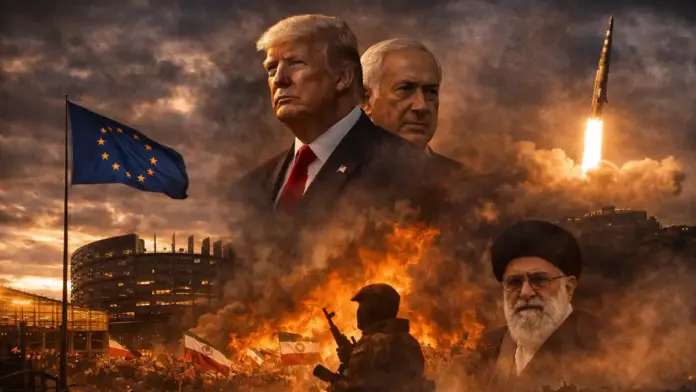
The Free World, Iran, and Europe’s Strategic Evasion: Why Trump and Netanyahu See More Clearly Than a Europe Still Delaying the Inevitable
The real question is not whether Europe disagrees. It is whether Europe understands what is already at stake.
There are moments when neutrality stops looking like wisdom and starts looking like refusal. Much of Europe’s current posture toward Iran increasingly falls into that category. The United States and Israel are treating the Iranian regime as what it is in strategic terms: a source of regional destabilization tied to proxy violence, attacks on critical infrastructure, pressure on shipping routes, and recurring threats to the world’s energy arteries.
Much of Europe, by contrast, still behaves as though it can remain outside the final bill. The problem is that the bill is already arriving — in energy prices, inflation pressure, alliance cohesion, and Europe’s own strategic credibility. Reuters has reported growing European resistance to some U.S. military operations tied to the Iran war, while the same conflict continues to disrupt oil expectations and maritime security.
That does not mean every American or Israeli move is automatically correct, or that every escalation is prudent. It does mean that the central argument made by Trump and, from a different angle, Netanyahu rests on something real: Europe wants the benefits of stability without confronting the source of instability.
When France blocks certain military overflights, when Italy limits base use, and when Spain closes its airspace to U.S. aircraft tied to operations against Iran, the message is not only caution. It is also strategic withdrawal from responsibility. Reuters has documented each of those moves and the diplomatic anger they triggered in Washington.
The deeper problem is that this European hesitation is often presented as sophistication, restraint, or maturity. In practice, it is starting to resemble late-stage illusion. Iran is not a distant abstract issue. It is a regime whose actions and aligned networks have already raised the cost of energy, threatened regional infrastructure, complicated shipping, and reinforced a wider architecture of intimidation.
AP reports that Iran remains capable of striking Israel and Gulf states, and of using drones and infrastructure pressure to impose economic pain beyond its borders. If Europe still cannot recognize that the conflict already touches its own strategic space, then this is no longer moral refinement. It is strategic blindness.
For readers who want the Newsio English background on why the Strait of Hormuz is not a side issue but a core part of the economic fallout, Strait of Hormuz: What a “closure” claim really means and Fuel Prices Surge: How wars move oil markets and what the data says about what comes next fit directly into this framework.
The Iranian regime is not merely authoritarian. It is a regime that exports danger.
This is the first foundation of the argument. If the issue were only internal repression inside Iran, the European debate would look very different. But Tehran is not merely a domestic tyranny. It is a regime that projects instability outward. Reuters and AP reporting describe an Iran that, even under pressure, continues to sustain attacks, threaten strategic corridors, activate partners such as the Houthis, and impose economic and political stress beyond its borders.
Israel says it is prepared for weeks more of strikes because the confrontation is not a narrow episode; it is part of a wider regional contest over who gets to impose cost and who absorbs it.
That is why a harder moral argument for a clearer Western posture cannot simply be dismissed as warmongering. When a ruling system represses its own population and at the same time funds, arms, or politically empowers wider networks of violence and coercion, confronting it is not automatically imperial obsession. It can also be strategic self-defense. That does not make every instrument wise.
It does make Europe’s habitual “keep our distance and watch” approach look increasingly like delayed exposure to a threat that will return later at a higher price. AP’s reporting on Iran’s ongoing ability to inflict damage on regional infrastructure and shipping underscores that point.
For the deeper internal Newsio angle on how Tehran turns external war into a survival strategy for the regime itself, this piece pairs naturally with When a Regime Fears Its Own End: Why Tehran Exports Crisis, Hardens Diplomacy, and Turns War into a Survival Narrative.
Trump is blunt, but on the core point he is touching a reality Europe does not want to face.
Trump does not speak in the language of subtlety. He speaks in pressure, humiliation, and public coercion. But behind that style there is a hard kernel that is not easy to dismiss. Reuters reported that France refused certain U.S. military overflights related to the war, that Italy denied access to Sigonella for some operations, and that Spain shut its airspace to U.S. aircraft tied to the attacks. Those are not symbolic disagreements. They are real operational refusals.
One may dislike everything about Trump’s tone and still struggle to dismiss the substance entirely. It is difficult to claim that Iran is none of Europe’s business when Europe is already facing rising energy uncertainty and broader economic exposure linked to the conflict. Reuters reported steep oil forecast revisions tied to the Iran war and to continued instability around Hormuz. That means Europe is not choosing between involvement and insulation. It is choosing between two kinds of involvement: strategic participation now, or economic and security consequences later.
From that perspective, Europe’s distance can be described not only as caution but also as a kind of convenient hypocrisy: condemning war while hoping someone else neutralizes the threat; defending stability while refusing to carry part of the burden required to secure it; speaking of values while outsourcing the hardest strategic choices to others. That is an interpretation, not a proven official motive. But it is one rooted in facts already on the table.
Netanyahu is not pressing only for war. He is pressing for a historic confrontation with the regime.
From Israel’s side, the war is no longer framed merely as reciprocal violence. Reuters reported that Israel says it is prepared to keep striking Iran for weeks, and Netanyahu has spoken in ways that imply the conflict could shape the future of the regime itself.
That is exactly what unsettles Europe, and exactly what reinforces, for supporters of the harder line, the sense that this is a historic opening: if the West will not stand clearly against a source of regional intimidation now, when exactly will it?
The argument for a more decisive position says something simple and severe: the point is not only to punish an adversary, but to limit its ability to kill, repress, arm proxies, and hold an entire region hostage. If one accepts that premise, Netanyahu looks less like a leader seeking mere military advantage and more like one insisting that the confrontation with Tehran cannot remain half-finished.
Europe, however, fears precisely that transition — from deterrence into a de facto logic of regime pressure or regime change. Reuters reported German Chancellor Friedrich Merz openly voicing doubts about the war’s aims, which is telling because it shows that key European actors are not merely worried about tactics. They are worried about the political horizon itself.
The question is not whether Europeans have reasons to worry about what follows. They do. The question is whether those worries have now become so politically paralyzing that Europe can no longer say the most basic thing clearly: the Iranian regime is not a normal interlocutor behaving inside normal rules.
It is a violent, coercive system whose internal repression and external projection of pressure are inseparable. At that point, Europe starts losing both moral clarity and strategic seriousness.
For Newsio’s internal English frame on how strategic timelines and wartime pressure campaigns should be read without illusion, Trump–Iran: The 10–15 Day Window and What We Actually Know belongs directly in this discussion.
Europe says it serves diplomacy. Too often, it serves delay.
The gentlest defense of Europe is familiar: Europe did not start this war, wants to preserve space for diplomacy, and fears that military escalation may end in something worse than the present danger. Reuters has indeed reported that EU foreign-policy chief Kaja Kallas sees Europe’s main role in diplomacy and potentially later in helping secure navigation in Hormuz, not in joining a war it did not initiate. France has also explored a future maritime mission focused on shipping security rather than combat participation.
That position has logic. It is not unserious. But there is also a harsher reading: Europe invokes diplomacy in a field where diplomacy has repeatedly failed to alter the regime’s core behavior. If diplomacy becomes only a time-buying device for a regime that keeps repressing internally while pressuring externally, then diplomacy ceases to function as a peace alternative and starts functioning as a way to prolong the illness.
That is not reckless to say. It is simply more candid than Europe’s preferred rhetoric. Reuters’ coverage of Europe’s pushback against military operations shows not just prudence, but a deep unwillingness to own the coercive dimension of the crisis.
This is why Europe often appears eager to act as the moral conscience of the international order while behaving, in practice, like a consumer of security hoping others will do the hardest work. That works only as long as others remain willing to carry the burden. If those others are currently the United States and Israel, Europe cannot plausibly pretend that the outcome will not bind its own future.
For Newsio’s internal English perspective on how Gulf flashpoints become information warfare and strategic signaling at once, Dubai: reports of explosions amid Gulf alert — what’s confirmed and what isn’t is a useful companion.
Europe’s hesitation does not remain neutral. It becomes an indirect gain for the regime in Tehran.
This is one of the most uncomfortable and most important truths in the entire debate. Europe often presents its hesitation as responsibility, composure, or fidelity to diplomacy. In geopolitics, however, delay is never empty. It produces consequences. And in the present case, those consequences flow in a direction Tehran can exploit.
When Europe refuses to describe the threat in clear strategic language, when it avoids cost, and when it translates hard reality into procedural caution, the regime does not read “peaceful wisdom.” It reads room. It reads weakness. It reads permission to continue testing the threshold. Reuters’ reporting on Europe’s resistance to participation, and AP’s reporting on Iran’s continuing ability to impose regional pain, make that mechanism hard to ignore.
That has practical meaning. A regime that uses regional escalation, infrastructure attacks, shipping disruption, and energy shock as tools of coercion does not need a clean battlefield victory to succeed politically. It only needs to prove that the other side cannot bear the cost of confrontation.
The more Europe signals that it prefers withdrawal from operational responsibility, closed airspace, and procedural distance, the more it reinforces the political usefulness of the very attacks and threats Tehran and its aligned actors deploy: not only as instruments of damage, but as instruments of intimidation and coercive proof.
Measured this way, Europe is not merely “staying out.” It is also sending a dangerous message to a murderous regime: that enough pressure, enough energy risk, enough maritime fear, and enough regional instability can still push parts of the West into self-deterrence. At that point hesitation stops looking like moral elevation and starts resembling indirect concession. Not because Europe wants to strengthen the regime, but because regimes of this kind read every delay as a reward for the method.
For the clearest external authority baseline, watch the energy shock.
For the clearest external authority baseline on why Europe cannot treat the Iran war as someone else’s problem, the strongest reference is Reuters Energy, because Reuters’ energy coverage shows how conflict around Iran and the Strait of Hormuz moves directly into oil forecasts, inflation pressure, and wider economic risk for Europe and the global economy. Reuters has specifically reported steep upward revisions in oil-price expectations tied to the war and to instability around Hormuz.
Hormuz, oil, and terrorism prove that Europe is not a spectator. It is already implicated.
This is where Europe’s last excuse begins to collapse. Anyone who still imagines Iran is only a Middle Eastern problem is not reading the strategic and economic footprint of the crisis itself. Roughly a fifth of global oil and LNG moves through Hormuz, and Reuters has reported that war-related disruption around Iran has already driven major revisions in oil expectations and sharpened Europe’s economic vulnerability. Europe’s concern is therefore not abstract. It is already being translated into fuel, inflation, and industrial cost.
Add to that the long record of Iranian backing for aligned armed actors and the repeated use of instability as leverage, and the picture becomes even clearer. Europe is not facing a simple moral dilemma between war and peace. It is facing a strategic dilemma between early recognition of a threat and the comforting fiction that the threat will fade if Europe keeps speaking about it gently.
That is why the case for a firmer posture continues to grow — not because it worships war, but because it is exhausted by illusion. AP’s reporting on Iran’s continued ability to pressure the region makes that hard reality impossible to ignore.
For the direct economic bridge between Gulf instability and everyday pressure, Newsio’s English explainer Fuel Prices Surge: How wars move oil markets and what the data says about what comes next belongs naturally here.
The free world is not built by slogans. It is built when it recognizes its enemy without embarrassment.
This may be the hardest conclusion in the piece, but it is also the most necessary. The phrase “free world” becomes empty if it cannot name what it is confronting. If a regime kills its own citizens, jails dissidents, exports coercion, threatens energy arteries, and turns instability into a bargaining tool, then it is not merely another actor with a different worldview.
It is an opposing model of power. And when confronted with such a model, blurred neutrality is often not higher morality. It is refusal to face reality. AP’s reporting on Iran’s persistent attacks and on the costs imposed across the region underlines that the threat is not theoretical.
That does not mean a blank check for any military campaign. It does not mean criticism of American or Israeli excess should disappear. It does mean Europe, if it still wants to speak credibly about principles, cannot continue speaking as though it is unsure about the nature of the threat represented by the current Iranian regime.
It cannot want security, lower energy prices, stable shipping, and a region free of terrorized transit routes while still calling endless avoidance “responsibility.” That is where restraint stops being prudence and starts becoming complicity through inaction. That is a judgment. But it is a judgment built on consequences, not on hysteria.
The clearest reading of the day
The story is not merely that Trump and Netanyahu want more participation. The story is that they see the Iranian regime as a problem that cannot be dissolved through procedural European language, and they believe Europe still underestimates its own exposure. Trump says that aggressively.
Netanyahu says it strategically. Europe answers with reservations, legal caution, and moral distinctions. But as the war continues, as oil forecasts surge, as Hormuz remains under pressure, and as regional networks of intimidation stay active, the question becomes harsher: how much longer can Europe pretend this is not already its own war of consequences?
That is where the stronger case for decisiveness gets its force. Not in hatred. Not in theatrical rage. But in clarity: if the free world cannot recognize early enough when it is facing a regime of killers and exporters of instability, then it will recognize it later, when the cost is much larger and the strategic room is much smaller.
What readers should keep
First, Europe’s distance from the war is not theoretical. It has already taken the form of real refusals involving airspace, bases, and operational support for U.S. and Israeli actions.
Second, the Iranian regime is not only internally repressive. It remains a source of regional instability, energy risk, and wider strategic coercion.
Third, Europe is not outside the consequences. It is already paying in energy uncertainty, inflation pressure, and geopolitical exposure.
Fourth, the strongest case for a clearer Western posture is this: Europe may debate the means used by the U.S. and Israel, but it can no longer seriously pretend uncertainty about the nature of the threat posed by the current Iranian regime. That is where Europe will be judged — as a geopolitical adult, or as a commentator on choices made by others.