

What we know so far
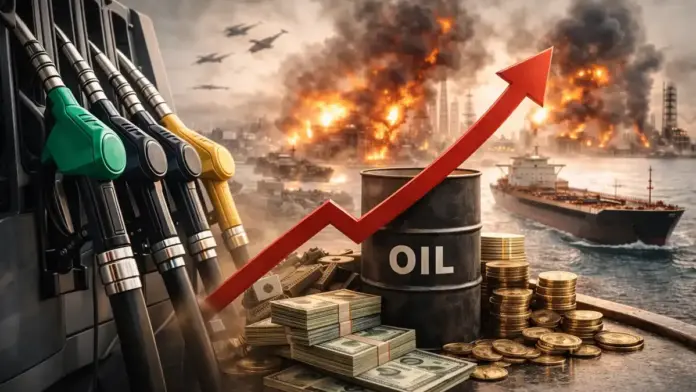
Fuel prices don’t jump “because someone said so.” They jump when markets believe the energy supply chain is at risk: production, shipping lanes, refining, inventories, and the cost of insuring all of it. When military conflict escalates, traders immediately price in uncertainty. That uncertainty becomes money—an added premium on crude oil first, then on refined products like gasoline and diesel, and finally at the pump with a lag of days or weeks.
Recent reporting shows sharp moves higher in oil prices as markets reacted to escalation and to fears about disruption along critical shipping routes, including the Strait of Hormuz—one of the world’s most important energy chokepoints. The immediate, verifiable baseline for the market move and the risk discussion is in Reuters’ energy coverage: Reuters.
What matters for everyday people is not just “did oil rise today,” but:
-
how long that pressure could last,
-
how quickly it reaches the pump,
-
what could bring prices down,
-
and what signals actually tell you whether the spike is temporary or structural.
If you want this to be truly 360° and useful, you have to explain the mechanics in plain English: benchmark prices (Brent/WTI), the risk premium, refining margins, shipping and insurance, and three realistic scenarios that decide whether prices stay high.
For readers who want a broader “how to read crisis news” toolkit—so they don’t get pulled into panic headlines—this internal guide fits naturally: How to read the news without being manipulated: fact-check signals, sources, propaganda.
How conflict moves oil markets before anything physically “runs out”
1) Oil is a global market, not a local product
Crude oil is priced globally. Even if a country is far from the battlefield, markets connect the price through trade routes, insurance costs, and expectations about supply. Prices reflect:
-
supply (production + spare capacity),
-
demand (transport, industry, seasonality),
-
logistics (shipping availability, detours),
-
and, in crises, the risk premium.
2) The “risk premium” in one sentence
A risk premium is the extra price the market pays for the possibility that something goes wrong. In conflict periods, it rises when there is fear of:
-
damage to energy infrastructure,
-
sanctions or retaliation,
-
tighter shipping security,
-
or sudden bottlenecks.
This can unwind quickly if tension eases. It can also persist if risk becomes the “new normal.”
3) Why everyone watches the Strait of Hormuz
The Strait of Hormuz is a narrow passage that funnels a large share of global oil and LNG flows. Even without a full closure, higher risk there can raise:
-
insurance premiums,
-
freight costs,
-
delays and rerouting,
-
and market anxiety.
Bottom line: you don’t need a total shutdown to see higher prices. Markets move on probability and fear—then settle only when risk becomes clearer.
From Brent to the pump: the chain that explains your price
Think of your fuel price as four layers stacked together:
Layer A: Crude oil benchmarks (Brent/WTI)
-
Brent is widely used as a reference for Europe and many global contracts.
-
WTI is the main US benchmark.
When crude rises, refineries pay more for the input.
Layer B: Refined products (gasoline/diesel/jet fuel)
Crude is refined into products. In conflict spikes, refined products can rise more than crude because:
-
refineries may face operational constraints,
-
traders anticipate stronger demand for certain products,
-
and refining margins (spreads) widen.
Layer C: Wholesale → retail
Retail prices don’t move tick-for-tick with oil. Inventory and timing matter. Stations and suppliers cycle through stock purchased at different costs.
Layer D: Taxes and local market structure
In many countries, taxes and fees are a large share of pump prices, which can amplify moves (and also slow down the “feel” of price declines).
How fast does it hit consumers?
Usually:
-
crude moves first (minutes/hours),
-
wholesale follows (hours/days),
-
retail follows with a lag (days/weeks).
That’s why headlines often appear before you see the full effect—and why pump prices can feel “sticky” on the way down.
Let’s analyze the real scenarios
The three scenarios that decide whether prices stay high
In energy markets, a spike can be:
-
a fear shock (risk premium),
-
a supply shock (real disruption),
-
or a duration shock (long-running uncertainty that keeps costs elevated).
Here are the three practical scenarios to keep in mind.
Scenario 1: De-escalation (risk premium fades fast)
What it looks like:
-
fewer incidents around shipping routes,
-
calmer rhetoric and clearer signals,
-
more predictable flows.
What it means:
-
crude may drop quickly,
-
but pump prices often decline more slowly.
Scenario 2: Prolonged tension without major disruption
What it looks like:
-
no major shutdown, but constant elevated risk,
-
higher insurance, detours, and “just in case” costs.
What it means:
-
prices can stay elevated for weeks,
-
volatility remains, and businesses pay for uncertainty.
Scenario 3: Serious disruption to flows or infrastructure
What it looks like:
-
real reductions in exports,
-
attacks or outages affecting production/refining,
-
significant shipping constraints.
What it means:
-
sharper spikes,
-
stronger policy responses (strategic reserves, coordinated statements, supply moves).
Why gasoline rises like an elevator and falls like stairs
Consumers notice this everywhere. There are reasons:
-
Inventory timing
New stock arrives at higher cost quickly; price hikes pass through faster. Price drops can lag because retailers sell through existing inventory. -
Logistics and insurance
Conflict raises shipping and insurance costs—those “hidden” costs can linger after crude cools. -
Taxes and fees
Where taxes are a large share, a move in the base price still lifts the final number meaningfully. -
Uncertainty pricing
When tomorrow is unclear, sellers are cautious about cutting prices aggressively.
Where the pain spreads: beyond your fuel tank
High fuel prices ripple through the economy:
1) Transportation and logistics
-
trucking and deliveries get more expensive,
-
shipping and air travel costs rise,
-
public transport operators face cost pressure.
2) Food prices
Energy is embedded in food:
-
farm machinery,
-
transportation,
-
refrigeration and storage,
-
packaging.
A fuel shock often shows up later in grocery prices.
3) Inflation and interest rates
Central banks worry about energy shocks because they:
-
lift headline inflation,
-
feed inflation expectations,
-
and can force tougher policy choices.
4) Small businesses
Businesses see margins compress:
-
delivery costs rise,
-
suppliers adjust prices,
-
consumers pull back spending.
This is where “a spike in oil” becomes “a squeeze in everyday life.”
One authority external link (embedded naturally, clean URL)
To keep your baseline grounded in what’s confirmed about the market move and the risk drivers, Reuters’ energy coverage is the clearest high-credibility reference: Reuters.
What this means for you
The goal isn’t to scare people. It’s to help them understand what’s happening so they can plan.
1) How to read fuel headlines without panic
When you see “prices are surging,” ask three questions:
-
Is this a one-day move or a multi-week trend?
-
Is there a real disruption—or mostly risk premium?
-
What do shipping/insurance and chokepoint news say?
2) Practical steps for households (simple, non-preachy)
-
Avoid panic-buying at peak moments.
-
Combine errands and reduce “empty” miles.
-
Basic vehicle efficiency matters: tire pressure, smooth driving, less unnecessary weight.
-
Compare stations consistently—small differences compound over a month.
3) Practical steps for small businesses
-
Know your cost per delivery route now.
-
Optimize routing and consolidate deliveries.
-
If you must adjust prices, explain it cleanly as cost pass-through, not opportunism.
4) What to watch in the next few days
The direction from here depends on:
-
escalation vs de-escalation signals,
-
shipping security and insurance premiums,
-
producer signals (OPEC+ and spare capacity),
-
government tools (strategic reserves, policy messaging).
The clean conclusion
In conflict-driven spikes, fuel prices rise first because markets price risk. Whether that risk becomes a long-lived cost depends on whether disruption becomes real—or whether the premium fades. The most useful thing you can do as a reader is track the mechanism, not the emotion: benchmarks, shipping risk, refining margins, taxes, and timing.
• Summary: Conflict shocks lift oil via risk premiums, then raise refined products and pump prices with a lag, spilling into transport, food and inflation. What happens next depends on shipping risk and whether disruption becomes real.