

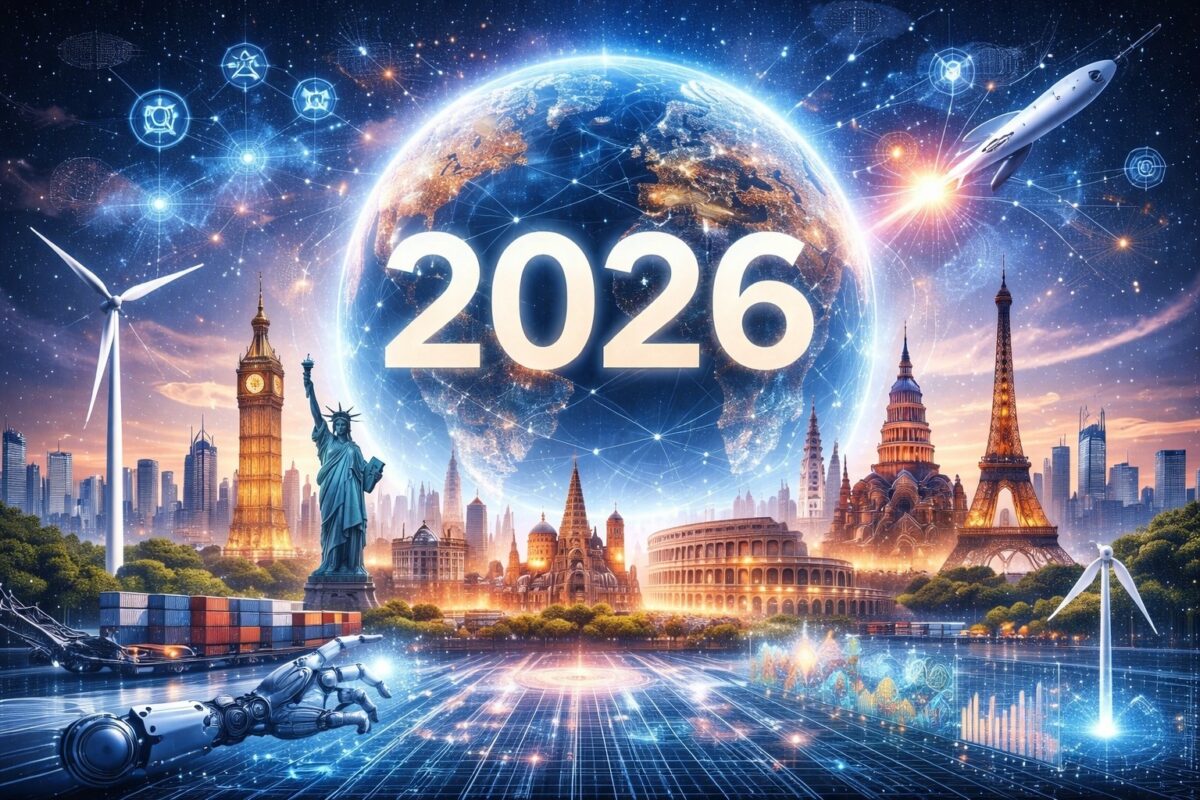
PART A — 2026 as a Year of “Architecture”: Less Surprise, More Design
If 2024–2025 were years of crisis management, 2026 looks more like a year of reordering. Governments, markets, institutions, and societies are no longer operating only in reactive mode. They’re trying to rewrite rules—about how risk is priced in the economy, how trade is managed (tariffs, industrial policy, supply-chain redesign), how security is organized (defense-tech integration), how climate commitments are delivered (COP31), and how artificial intelligence is governed (regulation that stops being an “intention” and becomes a requirement).
The defining feature of 2026 is that it compresses multiple transitions at once:
-
a new set of macro forecasts and policy choices,
-
regulatory milestones that move from drafting to enforcement (especially in AI),
-
major global forums (G20),
-
and mega-events that function as stress tests (World Cup, Winter Olympics)—testing infrastructure, public trust, security capacity, and the legitimacy of “big government” in public space.
PART B — The Global Economy in 2026: “Soft Resilience” and the Price of Friction
Most major international outlooks describe 2026 as a year of moderate growth with persistent downside risks.
-
The IMF’s updated World Economic Outlook places global growth around 3.1% for 2026.
-
The World Bank’s Global Economic Prospects emphasizes headwinds from trade tension and policy uncertainty, projecting that global growth in 2026–27 may improve but remains subdued, around 2.5%.
-
The OECD sits broadly in the “resilience under pressure” frame for 2025–2026: growth continues, but vulnerabilities accumulate.
What does that mean politically?
-
Governments will keep talking about growth—yet they will increasingly govern with a vocabulary of security: energy security, technological sovereignty, defense readiness, supply-chain control.
-
Social pressure will not evaporate. Even if inflation cools, the “memory” of cost-of-living shocks stays in households—and turns into votes, strikes, polarization, or withdrawal.
-
Trade frictions are not a temporary storm; they’re becoming weather. The language of tariffs, strategic industries, and “trusted supply chains” is likely to remain a central policy dialect in 2026.
PART C — China in 2026: The Launch of a New Planning Cycle as a Global Signal
For China, 2026 carries special weight because it marks the opening horizon of the 15th Five-Year Plan (2026–2030)—not merely as a technocratic document, but as a public declaration of priorities in a more contested world.
In political terms, this typically translates into three strong directional currents:
-
tech autonomy and strategic supply chains,
-
industrial policy (AI, semiconductors, advanced materials, next-generation manufacturing),
-
and resilience against external constraints (export controls, sanctions risk, market access uncertainty).
China’s “plan” for 2026 is not a single event. It is the start of a multi-year cycle that will influence trade flows, technology rules, commodity demand, and the geometry of partnerships and rivalries.
PART D — Russia in 2026: Growth Under Constraints and the Gravity of National Projects
For Russia, “plans” for 2026 are read through the mechanism of national projects / national priorities—a governance style where the state acts as organizer, allocator, and accelerator of targeted programs across infrastructure, technology, demographics, and social policy.
Regardless of political interpretation, the institutional logic is clear: 2026 sits inside a model of the state as coordinator-investor, operating under geopolitical constraints and sanctions architecture. In such an environment, the “plan” is not only about GDP—it is about coherence, capacity, and the durability of governance under pressure.
PART E — Climate in 2026: COP31 and the Shift From Promises to “Implementation Accounting”
On climate, 2026’s central milestone will be COP31, hosted in Turkey (Antalya), with Australia leading negotiations and a heightened focus on Pacific priorities.
The political meaning of climate in 2026 is this: the era of grand declarations is giving way to the era of delivery.
-
What gets implemented—and how fast?
-
Who pays—and through what instruments?
-
Who gains competitive advantage from the transition?
-
Who absorbs the cost of adaptation and loss?
In 2026, the climate argument becomes less about the moral necessity of action (broadly accepted) and more about the contested mechanics of financing, burden-sharing, and industrial competitiveness.
PART F — Artificial Intelligence and the Regulatory Year: The Threshold That Rewrites the Market
2026 is a regulatory turning point for the EU, because the EU AI Act reaches its general application date on August 2, 2026 (with certain provisions phasing in earlier).
That changes the AI conversation from “we should” to we must:
-
compliance programs and risk management,
-
documentation and transparency requirements,
-
procurement standards in public and private sectors,
-
and likely a domino effect: organizations outside the EU adjusting practices to keep access to the EU market.
In short: AI will keep accelerating in 2026, but institutions will try to catch it—without suffocating it.
PART G — Mega-Events as Infrastructure Plans: World Cup 2026 and Milano Cortina 2026
Mega-events are not only culture or sport. They are state-scale projects: logistics, transit, crowd management, digital capacity, counterterror planning, public trust, and operational competence.
-
The FIFA World Cup 2026 will take place across Canada, Mexico, and the United States, spread across multiple host cities and requiring an unprecedented coordination footprint.
-
The Milano Cortina Winter Olympics 2026 runs in February 2026, a large and complex test of mobility, security, and alpine infrastructure.
In 2026, these events become global mirrors:
-
If they run smoothly, they reinforce a narrative of capability.
-
If they fail, they manufacture cynicism—fast.
PART H — G20 and “Big Politics” in 2026: Governance in an Age of Friction
The G20 agenda remains one of the key platforms where the year’s pressures converge: growth vs. inflation, trade rules vs. industrial policy, climate vs. competitiveness, technology governance vs. national security.
In a world described as resilient but strained by policy uncertainty and trade tension, multilateral forums become less places of harmony and more arenas of managed power negotiation. 2026 won’t be defined by the absence of dialogue—but by the limits of consensus.
PART I — Space and the Return of Symbolic Power: Artemis II and the Politics of Prestige
2026 also carries a space-driven form of geopolitical symbolism. NASA’s Artemis II allows a major step in the renewed human lunar trajectory—testing capabilities, systems, and readiness.
Beyond engineering, space is narrative and industry:
-
it signals innovation capacity,
-
it shapes industrial ecosystems,
-
and it reintroduces prestige competition in a domain where technological leadership translates into strategic influence.
Closing — 2026 as a Contract Between Expectation and Constraint
2026 does not promise a calm world. It promises a world trying to organize itself:
-
with moderate growth, but harder policy focused on security, supply chains, and technology governance;
-
with COP31 pressing for implementation, not only pledges;
-
with AI moving from aspiration to enforceable rules in major markets;
-
and with mega-projects and mega-events (World Cup, Milano-Cortina, Artemis II) functioning as competence tests.
If we had to deliver the “lecture + editorial” conclusion in one line:
2026 will feel less like a lightning strike and more like a blueprint—built with materials that creak.