
Table of Contents
What changes in Greece’s minimum wage and Fuel Pass from April 1—and why the pressure still does not disappear
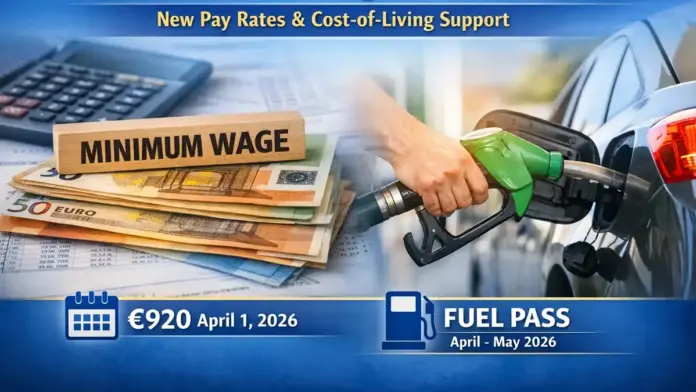
Greece is entering April 2026 with two concrete moves at the center of the cost-of-living debate: a higher statutory minimum wage and a new round of Fuel Pass support. The wage increase is not rumor or political noise. It is a real change scheduled to take effect on April 1, lifting the gross monthly minimum wage to €920. At the same time, the government has announced a new fuel subsidy for April and May.
That matters because public discussion around household pressure often breaks down into two equally misleading extremes. One side treats every new measure as proof that the problem is being solved. The other dismisses everything as cosmetic theater. Neither reading captures the full picture. These measures are real. They do offer relief. But they do not erase the deeper cost-of-living squeeze that still shapes daily life for many workers and families in Greece.
This is where the conversation needs more discipline and less slogan-making. A wage increase matters. A fuel subsidy matters. But the right question is not whether they exist. The right question is whether they are large enough, broad enough, and durable enough to change how households actually feel at the end of the month.
The minimum wage increase is real—and it starts on April 1
The minimum wage in Greece is set to rise to €920 gross per month from April 1, 2026, up from €880. Reuters reported the move as a 4.5% increase, while Taxheaven’s reporting on the new wage framework also reflects the same starting point and timing.
That increase is not trivial. For lower-income workers, even a moderate rise in monthly pay can affect budgeting, bill timing, and the ability to absorb routine expenses. It also matters beyond workers paid exactly at the minimum, because the minimum wage often acts as a reference point in the wider income and benefits system. Taxheaven’s coverage notes the increase as the sixth consecutive raise, while Reuters frames it as part of the government’s broader effort to restore living standards after years of crisis and inflation pressure.
Still, readers should be careful not to confuse a nominal increase with a full recovery in purchasing power. A higher paycheck on paper does not automatically mean the same improvement in real-life financial breathing room, especially when food, housing, transportation, and daily essentials remain under pressure. Reuters explicitly noted that Greek purchasing power still trails the European average and continues to feel the effects of inflation.
For readers who want a broader English-language frame around household pressure and why pay often feels smaller than it looks, this topic connects naturally with Newsio’s explainer on 8 Invisible Fees That Shrink Your Paycheck Without You Noticing and the local economic reporting in Pepper Prices in Thessaloniki: Field Report From €4.49 to €7.22.
Fuel Pass 2026 is also real—but it is targeted, temporary relief
The new Fuel Pass is not just speculation. Greece’s Ministry of National Economy and Finance has announced a new fuel subsidy for the April-May period, structured as targeted support rather than a permanent change in fuel costs. Public reporting around the measure also aligns with the government’s effort to cushion households from renewed energy-related pressure.
That distinction matters. Fuel Pass does not lower the structural price of fuel across the economy. It does not permanently reduce transportation costs. It operates as a temporary buffer: a measure designed to soften a specific pressure point for a limited period. In political communication, those two things are often blurred. In real life, they are not the same.
This is exactly where misinformation and false certainty tend to spread. People hear that a subsidy is “back,” and the claim quickly mutates online into a simplified, distorted message: that everyone qualifies, that the process is already open everywhere, or that applicants should follow links received by message. That is not a harmless misunderstanding. Greece’s National Cybersecurity Authority issued a warning on March 26, 2026, about phishing SMS messages falsely claiming to concern Fuel Pass 2026 and directing citizens to fraudulent links.
The safest conclusion for readers is straightforward: the measure exists, but citizens should rely only on official state information when checking eligibility or application procedures. If a text message creates urgency and asks for data through a link, that is already a red flag. For the official public-facing framework, the most reliable reference point remains the Ministry of National Economy and Finance.
Where the public conversation goes wrong
The distortion usually appears in two opposite forms.
The first is political overstatement. A higher minimum wage and a fuel subsidy are presented as if they settle the cost-of-living problem. They do not. They may ease part of the pressure, but they do not reverse years of accumulated strain in rent, food, utilities, and transport. That kind of framing can make households feel that official language is cleaner than lived reality.
The second is blanket cynicism. In that version, every support measure is dismissed as meaningless or fake. That also misses the truth. A worker earning near the wage floor will see an actual change from April 1. A household dependent on car travel may see some temporary relief through Fuel Pass. The more responsible reading is not “everything is fixed” and not “nothing matters.” It is that partial relief remains partial relief.
Good economic reporting has to resist both temptations. It has to separate what is confirmed from what is exaggerated, and what helps from what transforms. Those are not the same category.
Why households may still feel squeezed even after the announcements
Cost-of-living pressure is not one bill. It is a stack of recurring obligations that interact with each other. A worker may gain from a higher minimum wage and still feel trapped by rent, groceries, and transport costs. A driver may benefit from a temporary fuel subsidy and still face pressure from the wider monthly budget. That is why many public debates sound disconnected from household psychology: they isolate one measure while families live inside the total sum of everything.
Newsio’s English-language coverage already reflects this broader pattern. The disposable-income angle is visible in 8 Invisible Fees That Shrink Your Paycheck Without You Noticing. The rent-pressure side appears in Greece Rent Payments Go Digital: What Changes for Tenants and Landlords. And the everyday food-price reality is visible in the shelf-level reporting from Thessaloniki. Together, those pieces show why the cost-of-living story cannot be reduced to one number, one press conference, or one support measure.
That is also why the wage debate cannot be treated as purely arithmetic. The deeper issue is confidence. Do households feel that they are moving into a safer zone, or do they feel that every gain is already being chased down by another expense? That answer shapes consumer behavior, personal stress, and the political meaning of economic announcements long after the headline fades.
What readers should actually keep
First, the minimum wage increase is real. Greece is moving to a €920 gross monthly minimum wage from April 1, 2026.
Second, Fuel Pass is also back in a new 2026 form, aimed at the April-May period as targeted support rather than broad, permanent restructuring of fuel costs.
Third, neither measure should be overstated. They matter, but they do not eliminate the broader cost-of-living squeeze. That is the central truth readers should hold onto when public messaging becomes either triumphalist or nihilistic.
And fourth, the Fuel Pass conversation already carries a clear misinformation risk. Fraudulent SMS campaigns are exploiting public interest in the measure. Readers should treat unofficial links, rushed “you qualify now” messages, and suspicious application prompts as security risks, not as information.
Bottom line
Greece’s latest wage and subsidy announcements are best understood as pressure-management tools. They are not imaginary. They are not irrelevant. But they are also not a full answer to the financial stress many households continue to feel.
A serious reading of the moment requires balance: acknowledge the real policy change, reject the lazy exaggerations, and keep focus on what families actually experience in the grocery aisle, at the gas station, and when the monthly bills arrive. That is where the truth of the economy becomes visible—far more clearly than in slogans.
For readers who want a wider structural lens on how money systems, policy shifts, and household stress interact over time, this piece also connects with Newsio’s explainer on The Rise of Digital Currencies and Their Impact on Traditional Banking.