

Table of Contents
Greece’s New Wage and Relief Measures: Real Help for Households or Political Comfort Before the Pressure Boils Over?
The real question is not whether the measures exist. It is whether they reach real life.
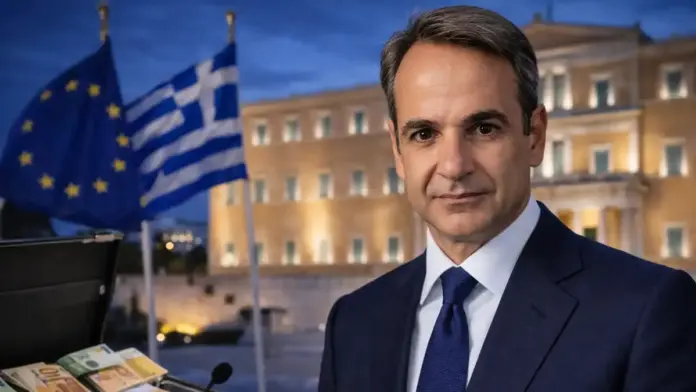
Prime Minister Kyriakos Mitsotakis has announced a new round of support measures built around three core messages: a higher minimum wage, targeted relief for fuel and transport costs, and a broader signal that the government is still trying to cushion households from a fresh wave of energy pressure. Reuters reported that Greece will raise the gross monthly minimum wage to €920 from April 1, 2026, while the government has also moved on subsidies tied to fuel, fertilizers, and ferry travel as regional instability pushes costs upward again.
On paper, that sounds like movement. In political communication, it also sounds like responsiveness. But households do not live on paper and they do not budget inside speeches. They live after rent, after groceries, after electricity, after transport, after the gas station, after school costs, after the thousand small monthly cuts that slowly shrink the feeling of security.
That is where these measures must be judged. And judged there, the answer is more uncomfortable than either government triumphalism or opposition ridicule would like: yes, the measures help, but no, they do not go deep enough to change everyday pressure in a structural way. The evidence that purchasing power in Greece still lags the European average is central to that conclusion.
That does not make the package fake. It makes it limited. And that distinction matters. A government can announce real support and still fail to close the distance between official relief and lived strain. In fact, that is exactly the trap of the current Greek moment: the measures are concrete enough to be defended, but small enough that many households will feel them more as temporary cushioning than as a true shift in economic ground.
The minimum wage increase is real. Its practical force is smaller than its headline.
The rise to €920 gross is not symbolic. It is a real increase and Reuters describes it as the sixth minimum wage rise in four years, part of the government’s effort to restore living standards and respond to renewed energy-driven pressure.
That deserves to be said clearly. It is not honest to pretend that an increase from €880 to €920 is nothing. It affects low-wage workers directly and also has knock-on effects across parts of the income-support system. Public reporting in Greece has framed the move as reaching roughly 700,000 workers, while broader eligibility effects through linked thresholds and benefits extend even further.
Still, the political problem begins exactly where the press conference ends. The extra money exists, but the real-world weight of the increase is smaller than the rhetorical weight attached to it. A raise of this size does not arrive in an empty economy. It lands inside a cost structure already damaged by inflation, housing pressure, transport costs, and expensive essentials. Reuters explicitly noted that Greek purchasing power remains below the European average and continues to be eroded by inflation. That is the hardest fact in the whole story, because it means a real increase can still feel inadequate.
That is also why the government’s strongest argument and its weakest point come from the same number. The strongest argument is easy: it can say it raised wages again. The weakest point is harder to hide: many workers will still not feel materially safer after the monthly bills are paid.
For readers who want a wider internal Newsio frame on how energy stress spills into household economics, this connects naturally with Fuel Prices Surge: How wars move oil markets and what the data says about what comes next and Greece changes how rent must be paid: what it means for tenants and landlords.
Fuel Pass helps, but it does not change the structure of the problem
The new Fuel Pass is also real. Mitsotakis said the subsidy platform was expected to launch within days, with payments aimed before mid-month, while reporting around the package places the total support effort at roughly €300 million for April and May, focused on fuel, fertilizers, and ferry costs.
Again, the honest reading sits between mockery and applause. For a worker or family that relies on a car, a fuel subsidy is not meaningless. It reduces part of a real expense. But it does not change the structure of fuel dependence, and it certainly does not neutralize the upstream cause of the pain, which is renewed energy-market pressure tied to geopolitical risk. Reuters’ reporting on the new measures makes that chain clear: the package exists because the government is trying to soften the domestic effects of rising energy costs linked to the Iran conflict.
That matters because political language often tries to blur two different things: relief and solution. Fuel Pass is relief. It is not a solution. It does not re-engineer pricing, restore lost purchasing power, or remove the broader inflationary effect that expensive energy can have on freight, food, and services. It buys time. Sometimes governments need to buy time. But buying time is not the same thing as solving the underlying economic exposure.
For that wider energy chain, the strongest external authority reference remains Reuters Energy, because it shows how crude prices, conflict risk, and downstream consumer pressure fit together in one continuous frame.
The government’s best defense is that it is doing something. The strongest criticism is that “something” is not enough.
A fair analysis has to hold both truths at once.
The first is that the Mitsotakis government has not stood still. Reuters’ reporting over time shows tax cuts, social security reductions, repeated minimum wage increases, and now a targeted relief package aimed at cushioning households from another energy shock. That is a real policy record, not a fictional one.
The second truth is politically more damaging: purchasing power remains the point where the government’s narrative weakens. Not because the numbers are invented, but because the lived effect is smaller than the official framing. A government can raise wages and still leave workers feeling that life remains unaffordable. A government can subsidize fuel and still leave families feeling that mobility, food, and daily routines are under pressure. That is the zone Greece is in now.
This is why public skepticism has become colder and more disciplined. Many people no longer reject announcements because they think everything is false. They reject the celebratory tone because they have learned that a measure can be true and still insufficient. It can be visible enough to dominate the news cycle and still too shallow to transform household confidence.
That is the key distinction any serious opinion piece has to protect. The issue is not whether the government is lying when it says money is being given. The issue is whether the size and depth of the measures match the social scale of the problem.
In real life, people do not measure relief by announcements. They measure it by how long it lasts.
This may be the most important line in the whole debate.
Households do not evaluate a measure by the headline value attached to it. They evaluate it by whether it still matters two weeks later. If the increase is swallowed quickly by other costs, then it still has value, but not transformative value. If the subsidy eases one pressure point while the rest of the monthly budget keeps tightening, then it helps, but it does not restore confidence. That is the actual test. And under that test, the new package looks more like managed relief than economic reset.
That is also why the criticism that such measures can function as electoral soothing cannot simply be dismissed as cynical noise. It should not be presented as a proven fact of motive, because motive is harder to verify than policy content. But it is a legitimate political interpretation to argue that the package is designed to be large enough to communicate and small enough to remain fiscally manageable, even if that leaves much of the deeper anxiety intact. That is an inference, not a proven internal intention. It is still a serious one.
For a more grounded internal Newsio angle on how local prices and household pressure actually feel on the ground, Pepper prices in Thessaloniki: field report from €4.49 to €7.22 is useful precisely because it shows inflation not as a graph, but as a daily shopping experience.
Where political theater ends, the wallet begins
Politicians everywhere prefer measures that travel well in headlines: a wage increase, a pass, a subsidy, a discount, a cap. They are simple to communicate and easy to package as proof of action. The real test arrives the morning after the applause, when people ask a much duller but much more honest question: did this leave anything meaningful behind?
In the case of Mitsotakis’ new measures, the most honest answer is this: yes, there is real usefulness. The increase is real. The subsidies are real. The package is not empty theater. But if the question is whether these measures reach ordinary people in a way that meaningfully changes how secure they feel, the answer is much tougher: not enough.
That is why the political balance of the package is so delicate. It may be enough to defend. It may be enough to soften anger. It may even be enough to win a better news cycle. But it is not large enough, by itself, to erase the basic truth that many households still feel financially cornered.
What readers should keep
The minimum wage increase to €920 gross is real and meaningful.
The Fuel Pass and the broader support package are also real and provide short-term help.
But Greece’s purchasing power remains under strain, and that is why the public no longer judges policy by the announcement alone.
The fairest verdict today is this: the measures are useful, but not enough; real, but not transformative; politically helpful, but economically limited.