

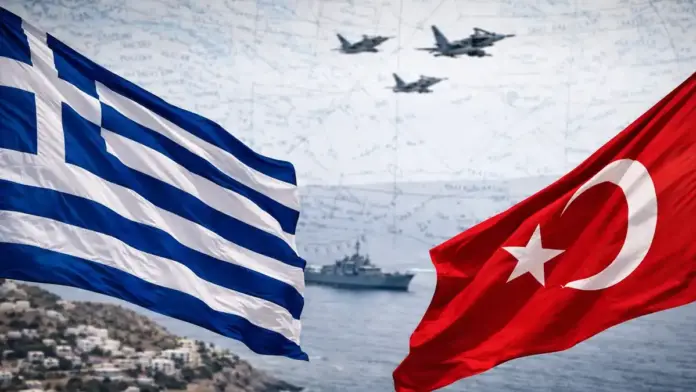
The temperature is rising again, but not everything means the same thing
The latest wave of Turkish media rhetoric over the Greek islands and the eastern Mediterranean should not be read either naively or hysterically. There is a real, long-standing Turkish position that any Greek move to extend territorial waters in the Aegean could constitute a “casus belli,” and that position has remained part of the bilateral dispute even during periods of improved dialogue.
Reuters reported in January that Greece was still planning further extensions of territorial waters despite Turkey’s standing warning, and AP reported in February that Prime Minister Kyriakos Mitsotakis again called on Ankara to lift its decades-old war threat during talks with President Recep Tayyip Erdogan.
But there is also a second layer: media escalation. Not every inflammatory headline on Turkish television or in newspapers automatically amounts to a new formal state doctrine. The right reading requires a distinction between three things: Turkey’s established strategic position, the cyclical intensification of media rhetoric, and the real operational risk in the Aegean and the eastern Mediterranean. That distinction matters because public debate on Greek-Turkish tensions is often distorted either by panic or by dismissal.
What is actually true about “casus belli”
The most important factual anchor is that “casus belli” is not a fresh TV invention. Reuters noted that Turkey’s parliament declared in 1995 that any unilateral Greek extension of territorial waters beyond six nautical miles in the Aegean would be treated as a cause for war.
That is why the term keeps returning whenever maritime rights, islands, or the Aegean are discussed. It is not merely a media flourish; it is tied to a long-running strategic dispute.
That same point surfaced again during the most recent high-level contacts. AP reported that Mitsotakis asked Ankara to remove the war threat, while Erdogan publicly said disputes in the Aegean and eastern Mediterranean could be addressed through dialogue and international law. That combination is important: a softer diplomatic tone does not mean the underlying Turkish red line has disappeared.
Readers who want a broader English-language context for how Newsio tracks fast-moving international disputes can also browse the EN US & Global Politics section.
Where media escalation begins
This is where rhetoric and state policy start to blur. Turkish official and semi-official messaging often takes recurring disputes over islands, demilitarization, maritime jurisdiction, or eastern Mediterranean rights and translates them into sharper public pressure.
Reuters reported in late January that Turkey said Greece must coordinate certain research activities in contested Aegean waters, while reiterating that any unilateral extension of Greek waters beyond six nautical miles in the Aegean remains unacceptable in Ankara’s view.
The problem is not that every such statement means war is imminent. The problem is that repeated pressure creates a permanent high-friction environment in which miscalculation becomes easier. The Aegean has a long history of tactical tension, air incidents, contested readings of maritime rights, and sharply divergent legal arguments.
When media rhetoric amplifies those disputes, it increases political and public nervousness even if no immediate military move follows.
The islands, demilitarization, and the real dispute underneath
One of Ankara’s recurring arguments is that Greece violates treaty-based restrictions by militarizing islands in the Aegean. Greece’s answer is that island defense falls within its right of self-defense, especially while Turkey maintains an open war threat and significant military pressure in the broader theater.
That is not a cosmetic disagreement. It goes to the core of how both sides define security, sovereignty, and deterrence.
This is also why rhetoric about the islands cannot be treated as isolated noise. Even when it appears first through commentators or media outlets, it often rests on a deeper, well-established dispute over sea zones, military posture, and the legal interpretation of the Aegean order. That is what gives the headlines their weight.
Why the eastern Mediterranean matters again
The eastern Mediterranean now carries more strategic weight because it is no longer just a bilateral maritime theater. It sits inside a wider regional environment shaped by energy routes, military deployments, NATO sensitivities, Middle East instability, and the Cyprus question.
AP’s February coverage of the Mitsotakis-Erdogan meeting made clear that the dispute space still includes maritime boundaries, drilling rights, Cyprus, and the broader eastern Mediterranean. That means rhetoric over the Greek islands cannot be cleanly separated from the larger regional map.
In practical terms, this makes every cycle of verbal escalation more consequential than it might look in isolation. When the eastern Mediterranean is already strategically crowded, even old disputes can acquire new sharpness. The risk is not only deliberate confrontation. It is also cumulative pressure, political signaling, and eventual misreading on one side or the other.
For readers who want a cleaner framework for separating established facts from emotional framing in contentious stories, Newsio has also published How to Read the News Without Being Manipulated: A Complete Guide to Fact-Checking, Sources, and Propaganda.
Where misinformation enters the story
The first distortion is panic framing: every aggressive Turkish headline is instantly presented as the direct prelude to armed conflict. The available evidence does not support that kind of automatic conclusion. What it does support is ongoing strategic pressure, repeated rhetorical escalation, and a dispute architecture that remains dangerous even when it does not cross into open confrontation.
The second distortion goes too far the other way: because similar rhetoric has surfaced before, some dismiss all of it as meaningless domestic theater. That is also wrong. The media layer may be louder than the official diplomatic wording, but it often sits on top of real policy continuity. “Casus belli” is not a fantasy phrase created for television. It is attached to a long-standing Turkish stance that Greece continues to challenge publicly.
The third distortion is to collapse legal arguments, strategic signaling, and media excess into one undifferentiated story. They overlap, but they are not identical. A careful reader should distinguish between formal Turkish policy, broader nationalist pressure, and the practical risk environment in the Aegean and eastern Mediterranean. That is how the story becomes readable without becoming sensationalized.
What readers should take away
The first safe conclusion is that Turkey’s “casus belli” language toward a Greek extension of territorial waters is real, old, and still relevant. It is not a fresh invention of television studios or one-off newspaper provocation.
The second is that renewed rhetoric over the Greek islands should not be ignored, but neither should it be translated automatically into a forecast of war. The more accurate reading is that this is part of a continuing pressure framework in which diplomacy, media escalation, and strategic signaling coexist uneasily.
The third is that the latest tension matters more because it unfolds in a more burdened eastern Mediterranean. In such an environment, restraint is not weakness. It is the condition for reading the dispute correctly. For ongoing English-language coverage of broader developments, the EN Current Affairs section is the most natural parallel hub on Newsio.