

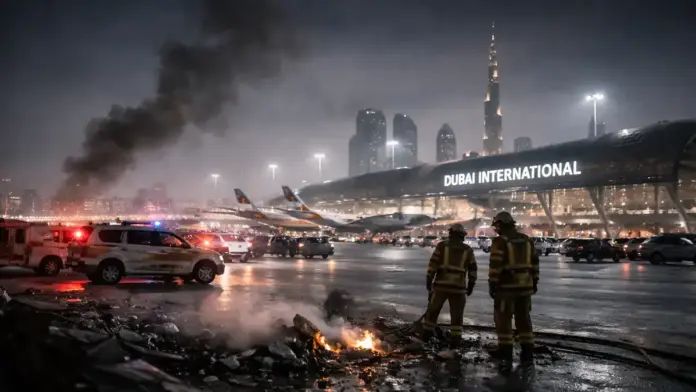
Dubai and Qatar incidents: what’s confirmed so far — and why calm framing matters
When reports mention missiles, damage, and people getting hurt in a place as globally connected as the Gulf, anxiety spreads fast. That reaction is human. But a responsible newsroom has a different job: to separate what’s confirmed from what’s assumed, and to describe verified events without inflating them into a bigger picture that the evidence doesn’t support.
As of now, the fact-checked baseline is this: major reporting describes specific incidents affecting the UAE (with reporting tied to Dubai)—including injuries and limited damage—and injuries in Qatar linked to debris after missile activity and interceptions. These are discrete, documentable events. They are not, based on verified reporting, a description of widespread citywide collapse.
The strongest external anchor for the initial confirmed details—injuries, limited infrastructure impact, and air-travel disruption—is the related report by Reuters.
What is confirmed about Dubai (as a set of specific incidents)
Based on high-credibility coverage, the confirmed picture around Dubai is narrow and concrete:
-
Injuries: reporting indicates injuries connected to an incident linked to airport operations and the immediate area.
-
Limited damage: descriptions point to minor damage at infrastructure level, not a citywide breakdown.
-
Debris/interception effects: additional localized fires or impacts can occur when drones or other threats are intercepted—debris still falls.
-
Air travel disruption: the practical downstream effect is visible: disruption and rerouting in regional air traffic, with heightened security posture.
The key point: the verified record supports specific impacts, not sweeping claims.
What is confirmed about Qatar (and why “debris” matters)
For Qatar, the most consistent fact-checked element in the public record is injuries from debris after missile activity and interceptions. That wording matters because it reflects a real mechanism in air-defense environments:
Interceptions reduce the risk, but they don’t erase it. Debris can still land and cause injuries or localized damage.
About “movement” of people — the accurate, non-alarmist wording
In moments like these, it can be true that small groups move locally—people temporarily stepping away from a specific area, changing routes, or avoiding certain places after a visible incident or heightened alerts. That is not the same as “population displacement,” and it should not be written that way unless a verified source documents formal evacuations at scale.
What we know so far
The deeper story isn’t only the incident count. It’s that the Gulf—often treated as insulated by strong security architecture—has become more directly exposed to spillover risk in a wider confrontation. That reality tends to show up first through disruption: airports, routes, and the everyday systems people rely on.
1) Why targeted incidents can still have an outsized impact
The Gulf is a global node:
-
aviation hubs and long-haul connections,
-
trade and logistics corridors,
-
high-profile infrastructure,
-
and a reputation for operational stability.
So even limited, localized impacts can produce a disproportionate effect on public confidence and operational planning—without evidence that an entire city is “under siege.”
2) How to talk about damage and casualties responsibly
A newsroom that cares about legal safety and credibility uses a simple rule:
-
If a figure is not confirmed by high-credibility reporting, we do not publish it as a fact.
That means we describe the verified shape of the story:
-
Injuries are confirmed in connection with specific incidents.
-
Damage is described as limited in the initial reporting record.
-
Claims of large-scale destruction or mass casualties remain unverified unless documented by reliable sources.
3) What to watch next (measurable indicators)
Over the next 24–72 hours, the situation will be clarified by measurable signals:
-
whether incidents continue near critical infrastructure,
-
whether flight suspensions or no-fly advisories expand,
-
whether official statements add verified casualty or damage figures,
-
and whether additional confirmed debris-related injuries are reported.
If you want a grounded bridge from geopolitics to practical daily impact, visit our category page in English: Geopolitics
What this means for you
1) If you have friends or family in the region
The most helpful move is calm verification. In fast-moving crises, recycled videos and mislabeled footage spread faster than official updates. The most reliable picture comes from confirmed reporting and official notices.
Also, it’s reasonable that some people may make small, local moves—stepping away from a specific site, avoiding crowded areas for a few hours, or changing routes. That is a normal safety response. It does not automatically imply formal, large-scale evacuations.
2) If you are traveling through Gulf hubs
Expect:
-
delays,
-
reroutes,
-
potential cancellations,
-
and tighter security procedures.
This is not necessarily a sign of uncontrolled escalation. It is often a precautionary approach in response to elevated risk signals.
3) If you’re watching economic impact
Short-term risk tends to show up as volatility:
-
higher insurance and logistics costs,
-
risk premiums in transport and energy,
-
operational caution among carriers and companies.
Volatility is not the same as inevitability. It’s a market response to uncertainty.
The reader’s bottom line
This is a serious development because it involves strike activity and injuries in a sensitive, globally connected region. But the verified record supports a careful description: specific incidents, limited confirmed damage, confirmed injuries, and meaningful disruption—without evidence (so far) for mass evacuations or citywide collapse.
• Summary: Major reporting confirms injuries and limited damage tied to incidents affecting Dubai, and debris-related injuries in Qatar, alongside air-travel disruption. Claims of large-scale displacement or widespread devastation are not verified in the confirmed record.