

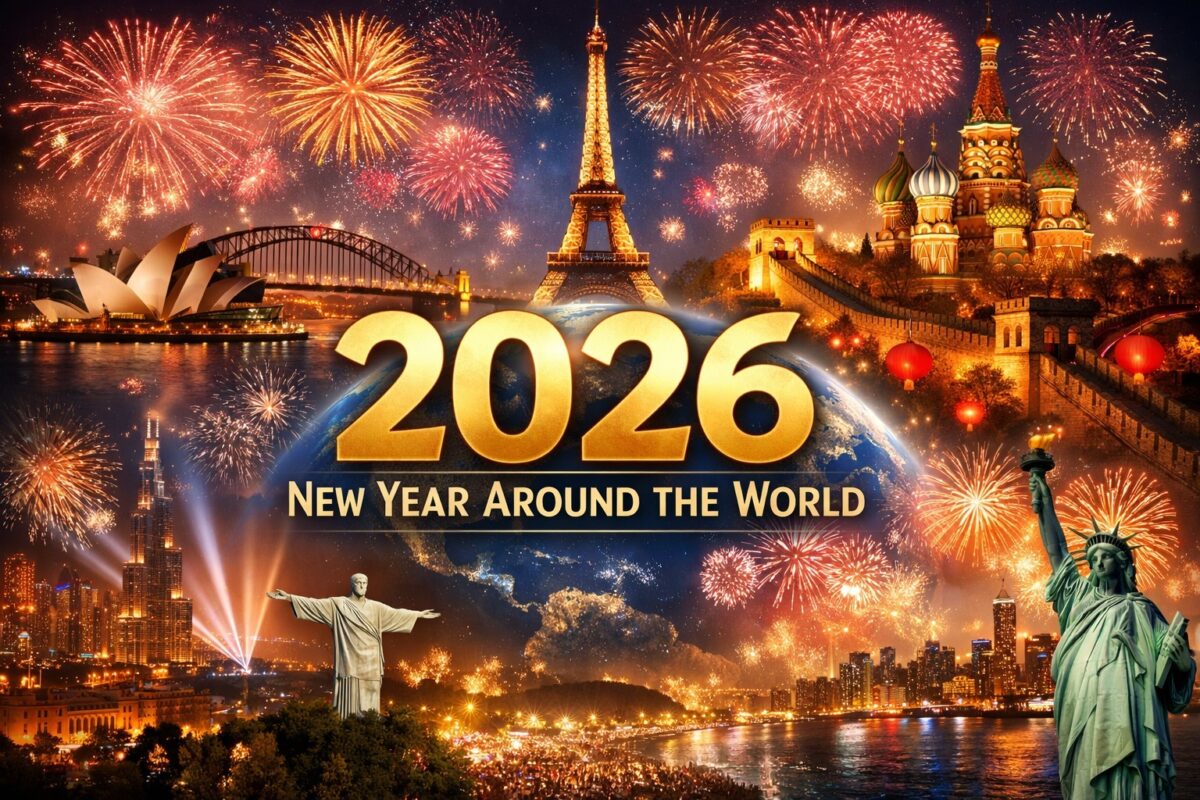
PART A — New Year’s as a “global wave”: it never arrives everywhere at once
New Year’s Eve is the rare truly global ritual that does not happen globally—at least not in the same second. It’s not a single moment; it’s a moving tide. It rises first near the International Date Line in the Pacific, then rolls westward across time zones like a slow, luminous relay: islands and coastal cities, midnight harbors and mountain towns, capitals and villages—each one catching the year at a different hour, under a different sky.
That staggered arrival is the first truth of the night: the world doesn’t celebrate “together.” It celebrates in sequence. One place is already cheering while another is still packing the last minutes of the old year into a final commute, a closing shift, a late dinner. The calendar may be universal. The experience never is.
And in this first stretch of 2026, two patterns were hard to miss across early reports and public scenes:
Memory carried into midnight. Cities folded grief and remembrance into celebration—moments of silence, tributes, altered programs, cancellations where tragedy still felt too near.
A shift from “bang” to “light.” More light shows, more drones, more choreography in the sky—sometimes for environmental reasons, sometimes for public comfort and inclusivity, sometimes simply because modern cities are learning that noise is not the only language of joy.
VIDEO (global rolling coverage across cities/time zones):
PART B — Oceania: celebration as endurance (and security)
Sydney often becomes the world’s first televised New Year’s postcard, a kind of opening chapter for the year’s public imagery. And yes—2026 arrived there with spectacle. But it didn’t read like uncomplicated revelry. The early framing emphasized not only grandeur, but also the weight of public safety and the presence of collective memory—the sense that a city can celebrate and still hold a solemn thread for what it has lived through.
In big Western metropolises, New Year’s is less and less “a crowd and fireworks” and more and more a state-grade production—a carefully managed civic performance where joy must coexist with risk, and where the city’s ability to stay open, safe, and unbroken becomes part of the message: we are still here, still standing, still gathering.
VIDEO (official Sydney live stream):
https://www.sydneynewyearseve.com/live-stream
PART C — East Asia: bells, drums, cleansing, and China’s double clock
Here, the New Year is often felt not as a countdown but as a clearing—a ritual of leaving weight behind.
Japan (Joya-no-kane) carries the architecture of renewal in sound: temple bells and a quiet, communal sense that the year turns not only on a clock, but inside a person. Not merely entertainment—something closer to spiritual housekeeping.
South Korea (Seoul, Bosingak) brings the city to a symbolic center: the bell ceremony is a public gesture of shared hope, a collective “reset” performed by a nation in the open air.
China lives with two timekeepers at once: the global Western calendar and the lunar calendar’s deeper cultural rhythm. Early descriptions of New Year’s scenes referenced ceremonial elements—drumming, iconic locations, the sense of tradition fused to modern staging. In places like Shanghai, municipal programming often turns the night into an urban stage: light, screens, design, synchronized crowds, the city performing itself as a global organism.
Hong Kong showed another side of ritual: how joy changes shape when grief is present. Where tragedy is recent, spectacle may shift from fireworks to light—celebration modified, not erased. A city learns to honor mourning without surrendering to silence.
VIDEO (official Times Square webcast page—useful as a global reference point later in the wave):
https://www.timessquarenyc.org/nye/nye-live-webcast
PART D — Southeast Asia & the Indian subcontinent: crowds, rhythm, and the city as conductor
In much of Southeast Asia, New Year’s arrives with density: dense streets, dense sound, dense movement—people pouring into public space like a river that’s been waiting all year to run free.
Across major hubs, the patterns are familiar and yet never identical: countdowns, fireworks, organized public zones, traffic controls, crowd management—because modern cities can’t hold mass celebration without rules. Here, government isn’t a distant abstraction; it is the unseen infrastructure that determines whether the night becomes memory or becomes tragedy.
New Year’s in these spaces often reveals the most practical truth of public life: freedom needs coordination. A million people in one place is a miracle only if it’s safely possible.
PART E — The Middle East: Dubai and the economy of spectacle
Dubai treats New Year’s like a signature export: a global branding event engineered for the camera—light, lasers, synchronized architecture, the skyline turned into a stage set for the world. It isn’t just “beautiful.” It’s a statement about capacity: we can organize wonder. We can manufacture awe and distribute it across time zones as an image.
In places like this, New Year’s becomes a modern ritual of power: a city declaring itself not merely prosperous, but inevitable—a place that knows how to turn celebration into a global commodity.
VIDEO (Dubai / Burj Khalifa live):
PART F — Europe: from the coin in the cake to the politics of quiet (and security)
Europe holds two instincts together: tradition and regulation. It remembers old rituals, and it also lives inside modern governance—rules, safety frameworks, sustainability concerns, public order.
In parts of Europe, New Year’s has been edging toward lower-noise formats—lighter sound, more light, more careful spectacle—often framed as more inclusive for children, older people, pets, and those sensitive to noise, and more compatible with a contemporary environmental conscience.
Meanwhile, some places preserve charming cultural deviations that remind you how playful time can be—like “midday countdowns,” turning the ritual into an event for families, daylight crowds, and a softer kind of joy.
And everywhere, the security shadow is present: because New Year’s is predictable—predictable crowd, predictable location, predictable hour—and therefore a predictable target. Europe’s modern New Year is often a balancing act: protecting public space without turning public life into a fortress.
PART G — Russia: when New Year’s becomes a mirror of war, control, and “quiet normalcy”
In Russia, New Year’s is traditionally the most important popular holiday of the year—the deep cultural pause, the family table, the winter lights, the sense that the nation exhales together.
But in the Russia that entered 2026, New Year’s also carried the atmosphere of an era shaped by war and heightened state control. The public landscape reflected that tension: tighter management of central spaces, heightened sensitivities, a sense that even celebration is organized under the logic of precaution.
In such conditions, New Year’s becomes something more than a holiday. It becomes a barometer. When a society must discipline its own joy—when public space is narrowed, when communication feels fragile, when the night is managed like a risk—then the holiday quietly reveals what politics often tries to hide: the emotional temperature of the country.
VIDEO (Moscow atmosphere / decorations — user-generated):
Editorial note: The sharpest sign of a hardened political climate isn’t always what is said in speeches. Sometimes it’s what happens on the night people most want to forget everything—when even that night feels watched.
PART H — The Americas: Times Square, Copacabana, and the global studio of midnight
New York’s Times Square is not just an American tradition—it’s a global broadcast symbol. It has become the world’s shorthand for “midnight,” even though the world’s midnight happens many times. The ball drop isn’t only an event; it’s a television ritual, a collective screen where millions watch a city compress time into a single, iconic image.
Rio de Janeiro’s Copacabana offers a different kind of universality: the sea of people, the beach as a civic altar, music and fireworks and bodies moving like one organism. Here, New Year’s is not a studio set; it’s a mass communion—joy as an ocean, not a stage.
VIDEO (Times Square official YouTube live):
VIDEO (EarthCam New Year’s streams):
https://www.earthcam.com/newyears/ts/
Closing — What New Year’s 2026 revealed about the world
New Year’s 2026 didn’t show a planet unified. It showed a planet synchronized only in symbol. Different languages, different foods, different gestures—bells and drums, cakes and grapes, beaches and temples, fireworks and drones. The ritual is shared, but its meaning is local.
And yet, across cultures, something common emerges: celebration is shifting. From noise to light. From spontaneity to organization. From carefree crowds to managed public space. From pure festivity to festivity that must pass through the filters of security, memory, grief, and uncertainty.
The world never celebrates at the same time. But it keeps reaching for the same thing: a brief permission to believe that the next page can be written differently—if not by history, then at least by us.