

Table of Contents
Humans and AI Together: What They Can Actually Build When Judgment, Trust, and Technology Work on the Same Side
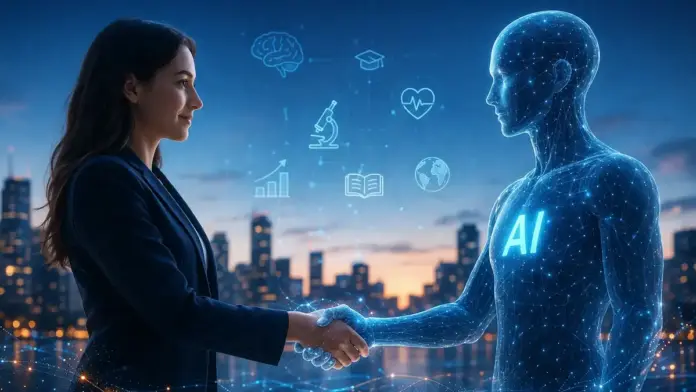
The real question is not whether AI will replace people. The real question is what happens when people and AI stop standing opposite each other.
For too long, the public debate around artificial intelligence has swung between two cheap extremes. In one version, AI is a miracle machine that will solve everything. In the other, it is a force that will swallow jobs, creativity, judgment, and eventually the human role itself. Neither picture is serious enough.
The more important reality is this: the future does not belong to humans alone or to AI alone. It belongs to the quality of the collaboration between them. The OECD’s recent work on generative AI makes this point clearly: the biggest gains appear in defined tasks, but the effectiveness of human-AI collaboration depends on trust, understanding of limits, and proper human use.
That is why the real divide of this era is not “human or machine.” It is human with AI versus human without the right tools in a world that is becoming faster, denser, and more complex. AI can draft faster, search wider, summarize more, and organize chaos at scale.
But it does not bring moral weight, lived memory, civic responsibility, or the instinct to recognize when something is technically polished but humanly wrong. Those remain human functions. And that is exactly why the strongest future is collaborative, not replacement-driven.
That broader point is also reinforced by the OECD’s research on the effects of generative AI on productivity, innovation, and entrepreneurship, which argues that the most meaningful gains appear when AI supports human work through augmentation, task improvement, and better use of skills rather than through simplistic replacement narratives.
Newsio has already opened this field from several angles through AI Is Reshaping the Job Market: Which Careers Are at Risk — and Which Are Rising, Will Artificial Intelligence Take Your Job? What’s True, What’s a Myth, and What Comes Next, and AI Browser Extensions That Read Your Data Without You Knowing. This companion goes further: it is not only about what AI changes around us, but what people and AI can actually build together when the relationship is guided by judgment, honesty, and purpose.
AI works best not when it blindly replaces people, but when it makes capable people stronger.
This is not a slogan. It is one of the clearest conclusions now coming out of serious research. The OECD reports that generative AI can produce meaningful productivity gains, especially in structured tasks, and can improve not only individual output but also team processes and collaboration.
Experimental findings the OECD summarizes show gains in drafting, summarization, editing, and translation, with measurable improvements that in some settings range from modest increases to much stronger jumps.
The deeper point is even more important: those gains are often not distributed evenly. A widely cited NBER study on customer-support work found that access to generative AI improved productivity, raised customer satisfaction, and helped less experienced workers move closer to the practices of top performers.
That is a major structural insight. Used correctly, AI does not only accelerate output. It can also reduce quality gaps by widening access to better methods and better knowledge.
But the hardest lesson sits right next to that promise: AI does not automatically improve everything. The OECD warns that effective human-AI collaboration is not automatic, and that both overtrust and poor use can reduce benefits.
NBER research on human interaction with AI advice has also shown that people can misread, overfollow, or underuse algorithmic input in ways that make outcomes worse, not better. In other words, AI is not a sealed “intelligence box.” It is a force multiplier that works best in the hands of people who know how to question it, shape it, and take responsibility for final judgment.
Where humans bring meaning, AI brings range, speed, and disciplined scale.
Humans still hold the things that matter most in high-stakes work: lived experience, conscience, cultural memory, empathy, moral hesitation, and the ability to sense when a polished answer is still the wrong answer.
AI brings a different set of strengths: breadth, structure, speed, pattern recognition, and the ability to process large volumes of information far faster than unaided human workflows can manage. The strongest outcomes emerge when these strengths are combined instead of confused.
You can already see that across sectors. In journalism, the human role remains central in identifying what matters, spotting propaganda, weighing consequences, and protecting truth from convenience.
AI can help with research organization, comparative analysis, structural drafting, contradiction spotting, and speed. In medicine, clinicians bring judgment, accountability, and the human relationship with patients, while AI increasingly supports image analysis, triage, pattern detection, and diagnostic assistance.
The Stanford AI Index 2025 notes that FDA approvals of AI-enabled medical devices have grown dramatically over time, showing that AI is no longer stuck in theory—it is already reshaping practical healthcare systems.
For the wider global picture beyond any single sector, the Stanford HAI 2025 AI Index Report remains one of the strongest international reference points, because it tracks AI’s technical progress, economic influence, and societal impact with a level of breadth that helps separate real structural change from hype.
In education, teachers are not replaced by models; they are potentially amplified by them. AI can help personalize material, track progress, generate exercises, and adapt content to different levels. In road systems and public safety, the same logic appears in another form, as explored in Newsio’s AI Traffic Cameras and Violations: The Technology Transforming Our Roads. The pattern repeats everywhere: the skilled human does not disappear. The skilled human becomes more capable, more informed, and often more effective when AI is used well.
The next major breakthroughs will not come from “smart buttons.” They will come from new forms of human-AI teamwork.
One of the most mature signs of this moment is that AI is moving beyond the model of a simple one-shot tool and into the model of a collaborative environment. Stanford HAI has highlighted the rise of collaborative AI systems and agent-based workflows as a major direction, where multiple specialized systems can support more complex problem-solving under stronger human guidance.
That is a meaningful shift. The future is not just “a person writes a prompt and gets an answer.” Increasingly, it is about designing workflows where humans direct, evaluate, cut, interpret, and decide—while AI expands what is operationally possible.
That raises the bar for everyone. The winners in this environment will not simply be the people who ask for quick outputs. They will be the people who define problems better, set better boundaries, test results harder, and connect technical power with human standards. In practical terms, the competitive advantage shifts from access alone to method, discipline, and judgment.
And that is why this is not just a technology story. It is a cultural story. It reveals whether a society wants tools that generate more noise or tools that help reality become clearer. It reveals whether AI will be used to manipulate perception or to widen access to better understanding. The machine does not answer that question. People do.
The greatest risks are not inside AI alone. They are inside the human decisions that shape how AI is used.
AI can strengthen medicine, education, research, business productivity, accessibility, and independent publishing. It can also be used for low-cost disinformation, synthetic certainty, deepfakes, scaled propaganda, and industrialized noise. The Stanford AI Index 2025 captures that dual reality well: AI adoption is spreading across business and daily life, but so are the governance, reliability, safety, and social-risk questions that come with it.
That is why the core struggle of this era is not machine versus person. It is truth versus distortion, responsible use versus manipulation, and higher-quality judgment versus scaled confusion. Without human honesty, AI can become an accelerant of garbage. With human honesty, it can become an accelerant of truth. That is the line that matters.
The labor side of this is equally important. That labor transition is also mapped clearly in the World Economic Forum’s Future of Jobs Report 2025, which argues that the AI era is less about human disappearance than about large-scale skill disruption, role redesign, and the urgent need for adaptation across industries.
The World Economic Forum’s Future of Jobs Report 2025 projects that by 2030 millions of roles will be displaced, but even more new roles may be created, resulting in a net positive shift globally. The same report says a large share of core worker skills will change over the decade. The implication is not that people vanish. It is that people must upgrade—structurally, not cosmetically.
The deepest promise of human-AI collaboration is not just productivity. It is the ability to scale truth, clarity, and serious work.
This is where the subject becomes bigger than efficiency. A single person can already research, write, investigate, compare, and analyze. A person using AI well can do those things across wider terrain, with more structured comparison, faster synthesis, and a level of operational scale that once belonged mainly to larger institutions. That matters enormously for independent researchers, smaller media brands, educators, analysts, and creators who care more about quality than spectacle.
For the first time, technology can give smaller, cleaner, more independent voices access to capabilities that used to require far larger teams and budgets. That does not make the human creator all-powerful. But it does shift the equation. Quality no longer depends only on size. Increasingly, it depends on method, intention, and the disciplined use of technology. That is one of the most democratic possibilities in the whole AI moment.
And that is why the strongest version of AI is not the one that makes people intellectually passive. It is the one that makes good people more capable. Not lazier, but sharper. Not louder, but clearer. Not more manipulative, but more precise. That is the future worth building.
The real future is not mechanical. It is human, technologically reinforced, and morally tested.
Put simply, the future does not belong to a machine that “does everything.” It belongs to people who know how to combine soul, judgment, and responsibility with technological force. AI does not diminish human value when used correctly. It makes human value easier to see. Because that is where method, conscience, character, and clarity become decisive again.
AI has no childhood memory, no burden of history, no civic instinct, and no lived sense of what one published sentence can do to a real person, a real community, or a real public debate. Humans do. That is why collaboration matters more than automation rhetoric. When people meet AI correctly, they do not become smaller. They become more capable of transmitting their best qualities at larger scale.
If you want a parallel Newsio line on the labor side of this transition, Will Artificial Intelligence Take Your Job? What’s True, What’s a Myth, and What Comes Next and AI Is Reshaping the Job Market: Which Careers Are at Risk — and Which Are Rising show the practical side of task change, adaptation, and responsibility. The broader lesson is the same: the future belongs neither to blind faith in AI nor to fear of it, but to the discipline of building with it correctly.
What readers should keep
The strongest current research does not say AI makes humans obsolete. It says AI creates the most value when it works with people, especially in clearly defined tasks and well-structured workflows.
The evidence also suggests that AI can improve productivity, widen access to better methods, and reduce some skill gaps—but only when human oversight, evaluation, and responsibility remain intact.
The central conflict of this era is not human versus machine. It is honest use versus manipulative use, clarity versus noise, and whether societies will deploy AI to improve judgment or to industrialize confusion.
The real question, in the end, is not whether AI will change the world. It already is. The real question is which people will use it to make the world clearer, fairer, more capable, and more truthful.