

Table of Contents
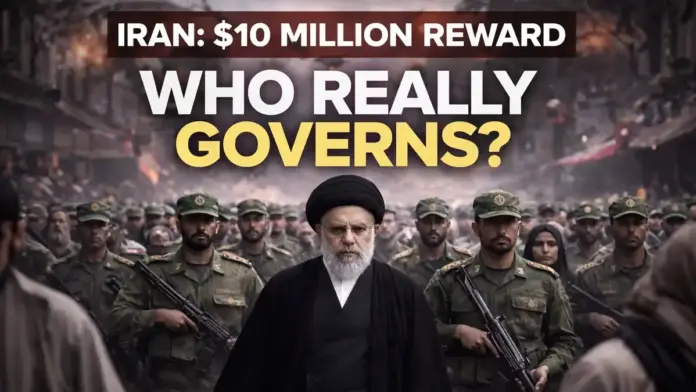
The United States is offering $10 million for information. The deeper story is about power, visibility, and who is actually making decisions in Tehran.
The new U.S. move to offer up to $10 million for information on Mojtaba Khamenei and other senior Iranian military and intelligence figures looks, at first glance, like a pressure tactic and an intelligence play. In reality, it says something larger and more revealing: Washington is signaling that it sees Iran’s real command structure as opaque, layered, and at least partly hidden behind a narrow public façade.
That is why the central question is no longer just where Mojtaba Khamenei is. It is who is actually governing Iran while the country is under military pressure and the region remains on edge.
The second major point is the contradiction at the center of the story. While the United States publicly offered the reward for information on Mojtaba Khamenei and nine other senior Iranian figures, Reuters also reported that one of those top officials, Ali Larijani, appeared openly at a Tehran rally alongside President Masoud Pezeshkian and Foreign Minister Abbas Araqchi.
That does not invalidate the American move. But it does undermine any simplistic reading that the entire upper tier of the Iranian system has disappeared from public sight. Some figures are visible. Others are not. The real power map remains uneven and hard to read.
That is exactly why this story matters. It is not enough to say that Iran is functioning, and it is not accurate to say that Iran is completely headless. The stronger conclusion is narrower and more serious: the state is still operating, but the public face of its leadership has become so selective and so unclear that the question of who governs de facto is now entirely legitimate.
For broader background on how Newsio has already framed the succession issue, readers can also see Iran: who is really in charge? What is confirmed about Mojtaba Khamenei, what is not, and why the silence at the top matters.
What has actually been confirmed about the U.S. reward
The clearest factual point is that the United States is offering up to $10 million, not euros, for information on ten senior Iranian military and intelligence officials linked to the IRGC, including Mojtaba Khamenei. Reuters reported that the State Department framed the move as part of its pressure campaign against figures it sees as central to Iran’s security and command structure.
A strong external factual anchor for the article is this Reuters report on the U.S. reward offer for Mojtaba Khamenei and other senior Iranian officials.
That detail matters, but it should not be overread. A public reward for information does not automatically mean the United States has no idea where these people are. It does mean Washington wants to widen pressure, expand human intelligence opportunities, and increase the psychological cost of belonging to the regime’s inner circle. In wartime, that kind of move operates on several levels at once: informational, political, and symbolic.
What has been confirmed about Mojtaba Khamenei himself
The strongest public reporting still does not support the claim that Mojtaba Khamenei is in a coma. Reuters reported on March 11 that an Iranian official described him as lightly injured but still active, while a separate Israeli assessment cited by Reuters also said he had been lightly wounded. That does not prove strong, visible leadership. But it does rule out the most dramatic version of the rumor based on the highest-trust public reporting currently available.
At the same time, the lack of confirmed coma does not solve the power question. Mojtaba Khamenei remains strikingly absent from normal public leadership behavior. He has not provided the kind of visible, repeated, confidence-projecting presence one would expect from a supreme leader taking control in wartime. That gap between formal title and public visibility is exactly why the question of real authority remains open. For a parallel example of how difficult verification becomes inside Iran’s information environment, Newsio has already examined that problem in “5,000 Dead in Iran”: What’s Actually Confirmed, What Isn’t, and Why Verification Is So Difficult.
The Larijani appearance changes the picture — but not in the way many assume
Ali Larijani’s public appearance may be the most revealing detail in the entire story. Not because it resolves the mystery, but because it shows how the regime wants this moment to be read. If a figure included in the U.S. pressure frame can appear publicly in Tehran, then the Iranian system is sending two messages at once: first, that it has not vanished; second, that it still controls who is seen, when, and for what symbolic purpose. In systems like this, visibility is not just optics. It is a governing instrument.
That is also where the irony becomes sharper. Washington offers a reward for information about people it sees as central to the regime’s core. Tehran responds, at least in part, with controlled public visibility from some of those same circles. But the most symbolically important figure in the new order — Mojtaba Khamenei himself — still does not provide that same reassuring image of open command. Others can be shown. He largely is not. And that only intensifies the underlying question.
Who appears to hold the real weight of power
This is where the article stops being a story about one man’s condition and becomes a story about the structure of the Iranian state. Reuters has reported that the Revolutionary Guards pushed Mojtaba Khamenei’s elevation and viewed him as more likely to support their harder-line direction.
It has also reported that the Guards have taken on a heavier role in wartime strategy. That does not mean Mojtaba Khamenei is politically fictional. It means the formal supreme leader may not be the only meaningful center of power — and perhaps not even the heaviest one.
That is the real analytical core. Iran can be led de jure by one man while being driven de facto by a broader coalition of security actors, ideological enforcers, and clerical hardliners. The less visible Mojtaba Khamenei becomes, the more plausible it is that the state is being steered through a shadowed arrangement in which the Guards and their allied clerical core exercise decisive influence behind a narrower public façade. Readers who want the broader thematic map for stories like this can also follow Newsio’s Geopolitics coverage.
What this moment is — and what it is not
It is not confirmed that Iran has become fully leaderless. It is not confirmed that Mojtaba Khamenei is in a coma or completely disconnected from his environment. It is not accurate to say that every top official has vanished from sight, because Larijani’s public appearance shows otherwise. Those would all be overstatements.
What is supported by the public record is more serious than any slogan. Iran’s top structure appears more opaque than a wartime regime would normally want it to be. The United States is targeting not just an individual but a cluster of senior figures linked to the IRGC. Some members of that upper tier are publicly visible, while the man formally placed at the top remains unusually hard to see. That combination is not proof of collapse. It is proof of opacity.
Why this matters for the public — inside and outside Iran
When a state is under attack, returning fire, and trying to preserve regime continuity, the absence of a clear, visible leadership center is not a minor communications issue. It becomes a destabilizing factor in its own right. If the public cannot clearly see who is speaking for the state, and if outside governments cannot clearly map who is setting red lines and escalation thresholds, the room for miscalculation grows. That matters for Iranians living under the system, and it matters for every country trying to read what Tehran may do next.
This is the deeper reason the story matters. The real issue is not simply whether Mojtaba Khamenei can be found. It is whether power in Iran is now operating through such an opaque wartime architecture that formal leadership and real command no longer sit in the same visible place.
What readers should take away
The first safe conclusion is that the United States is offering up to $10 million for information on Mojtaba Khamenei and other senior Iranian officials. That part is confirmed.
The second is that Mojtaba Khamenei has not been publicly confirmed to be in a coma. The strongest reporting points instead to injury and continued activity, not total incapacitation.
The third — and most important — is that the story now reaches beyond one person. It points to a state that is still functioning, but through such a selective and opaque leadership picture that invisibility itself has become political evidence. And in a country at war, that makes the real question unavoidable: not just who is seen, but who decides.