

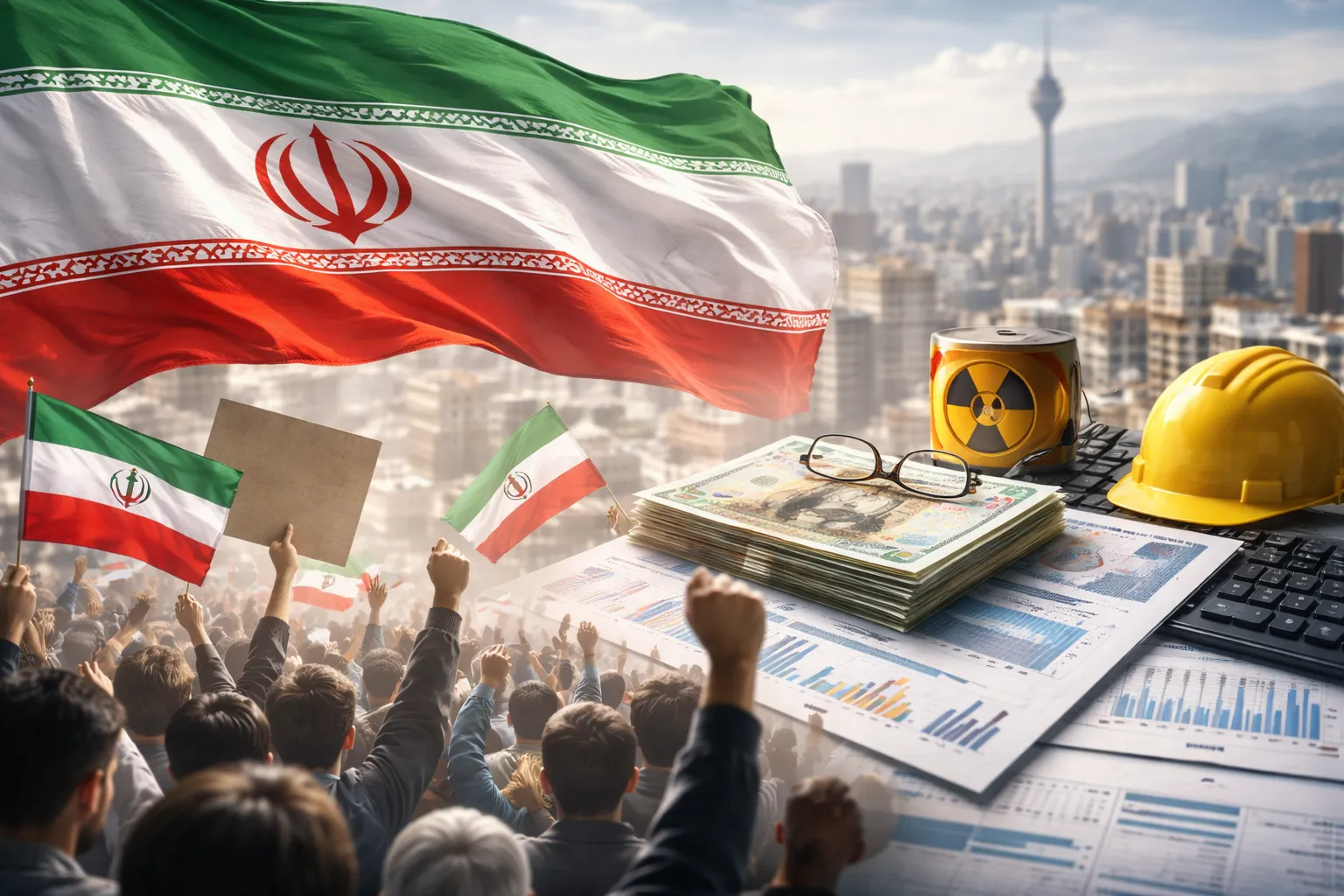
Iran 360°: What’s happening now, what people are demanding, and the realistic outlook for 2026
Iran has entered another high-pressure moment where domestic economics, social demands, and international confrontation collide—fast. What makes the current phase especially volatile is the way the triggers stack: a sharp currency shock, rising costs for basic goods, and a political environment that offers limited channels for grievances to be processed institutionally.
This is a four-part, 360-degree guide designed for clarity: what’s happening now, what ordinary people say they want, how the nuclear/sanctions file feeds back into daily life, and which 2026 scenarios are realistic—not wishful.
Part A — What is happening now, and what people are demanding
A1) The immediate trigger: currency stress that becomes a social shock
Recent reporting indicates that protests accelerated after a steep deterioration in the currency’s purchasing power, pushing everyday goods further out of reach for many households. In Iran, when the rial slides sharply, the effect is felt immediately—food, medicine, rent, transportation, imported components for local businesses—everything becomes more expensive, quickly.
That economic spark, however, rarely remains “only economic.” Iran’s recent protest cycles have shown a familiar pattern: cost-of-living pain starts the fire, and then broader political and social demands enter the conversation.
A2) The scale and the information fog
Two realities can be true at once: the unrest can be widespread, and accurate data can still be difficult to confirm in real time. Reporting this week referenced large numbers of arrests and significant casualties compiled by rights groups, while also noting that journalists and observers face constraints and that official Iranian figures may not be published in full.
This “information fog” is not a footnote—it becomes part of the crisis. When communication is restricted and uncertainty grows, public fear rises, rumor spreads, and escalation becomes easier.
A3) What people are demanding: a practical map of recurring demands
When you strip away slogans and focus on recurring themes, the demands that surface most consistently fall into five buckets:
1) A livable cost of living and a currency that doesn’t collapse overnight
For ordinary households, “stability” is not an abstract word. It means the ability to budget rent, medicine, and food without the fear that prices will jump again next week.
2) Jobs, wages, and dignity—especially for younger Iranians
A large share of Iran’s population is young. When the path to stable employment narrows and purchasing power erodes, frustration becomes a generational experience.
3) Corruption, unequal access, and accountability
Even under sanctions, citizens judge how burdens are distributed. When parts of society appear shielded while others pay the full price, anger deepens.
4) Social freedom and daily-life rights—particularly around women’s autonomy
Human-rights reporting has documented pressure on peaceful dissent and women’s rights activism, alongside broader constraints on civil society.
5) Political change—at different “temperatures,” from reform to transition
Some demand reforms within the system; others demand structural change. The shared thread is the insistence that power should be accountable and responsive.
A4) Why state response matters as much as the trigger
How a state reacts can determine whether a crisis narrows or widens. Recent reporting describes intensified crackdowns, including arrests and allegations of lethal force, while Iranian authorities have often blamed unrest on “rioters” and foreign influence.
For many citizens, the core question becomes less “what started this?” and more “is there any credible channel for the state to hear us without punishment?” When the perceived answer is “no,” pressure tends to remain in the streets.
Part B — The deeper causes: economy, society, and the state’s stress points
B1) Economic fatigue is cumulative, not episodic
Iran’s economic strain is not a one-week phenomenon. Years of high inflation, currency weakness, and constrained investment create cumulative fatigue. Over time, households stop thinking in terms of improving their future and start thinking in terms of surviving the month. (For inflation and macro indicators, the IMF’s World Economic Outlook database is a standard reference point for cross-country comparisons and projections.)
This is where “small shocks” become big: when people are already stretched, even modest new price jumps can trigger outsized reactions.
B2) The dignity threshold
In many societies, protest becomes more likely when economic pain crosses a dignity threshold—when people feel they’re not only poorer, but also trapped. In Iran’s context, dignity is connected to:
-
the ability to secure basic needs,
-
the ability to plan a future,
-
and the expectation that the rules apply equally.
When those conditions fail simultaneously, pressure becomes structural.
B3) Women and youth: the country’s social engine and pressure point
Women’s rights, youth aspirations, and the desire for a more “normal” daily life are not side issues. They are central to Iran’s social story—especially after years of highly visible tensions around public life, policing, and civil liberties. Human Rights Watch’s country reporting has emphasized ongoing repression of peaceful dissent and pressure on rights defenders, including women and minorities.
The result is a protest dynamic that is not only about prices, but also about identity, autonomy, and voice.
B4) Center–periphery strain
Iran is not one uniform political geography. Economic opportunity, public services, and political attention are not evenly distributed. In high-stress periods, that imbalance becomes sharper: some regions feel doubly distant—from money and from power.
B5) Why coercion can suppress symptoms but not causes
Every state has security instruments. But a state cannot “police” inflation, expectations, and dignity indefinitely. Heavy security responses can compress visible protest activity for a time, yet often leave the underlying drivers intact—sometimes even strengthening them by hardening mistrust. Recent coverage has emphasized that crackdowns can be severe and the human cost significant.
Part C — The international dimension: sanctions, the nuclear file, and why it hits ordinary people
C1) Sanctions are not abstract; they pass through prices, investment, and daily life
Sanctions—especially financial restrictions—make trade, banking, and investment more difficult and expensive. Even when goods still enter the country, the transaction costs rise. That cost is often passed down to consumers through higher prices.
This is why domestic debates and foreign policy debates cannot be separated in Iran’s case: international constraints amplify internal economic fragility.
C2) The nuclear file as a domestic economic variable
For many readers, the nuclear issue can feel technical. In practice, it acts like a macroeconomic lever: when the nuclear file escalates, sanctions risk rises; when sanctions risk rises, the currency and prices often suffer.
International monitoring bodies have repeatedly flagged concerns about Iran’s enrichment and verification environment. For context, the IAEA’s reporting framework and related analyses emphasize the significance of enriched uranium accumulation and monitoring limitations.
C3) Why “deal/no deal” matters in 2026
A credible diplomatic opening can reduce risk premiums in the economy—stabilizing expectations even before material change occurs. Conversely, escalation can intensify pressure quickly.
Iran’s 2026 outlook therefore depends heavily on whether the nuclear track moves toward de-escalation, stalemate, or confrontation—because each path has direct economic consequences at home.
C4) Regional security as a multiplier
The Middle East’s broader security environment matters for Iran not only militarily but economically: insecurity raises uncertainty; uncertainty raises capital flight and reduces investment; reduced investment worsens jobs and wages. In that loop, geopolitics becomes domestic economics.
Part D — The realistic 2026 outlook: scenarios, indicators to watch, and what it could mean beyond Iran
D1) Three realistic scenarios (no prophecy—just structured risk)
No serious analysis pretends to predict Iran’s future with certainty. But we can outline realistic scenarios:
Scenario 1: Managed de-escalation with partial economic relief
The state pursues selective economic stabilization measures and attempts to reduce pressure through targeted relief and tighter price management—while avoiding concessions that it views as existential. This scenario becomes more plausible if external tensions ease even slightly.
Scenario 2: Prolonged tension with waves of escalation and pauses
Pressure continues but fluctuates. Protests spike around economic shocks, security incidents, or symbolic moments. The economy remains fragile, and society stays on edge. This is often the “default” trajectory when neither side achieves a decisive shift.
Scenario 3: Escalation into a deeper legitimacy crisis
A combination of severe currency deterioration, major triggering events, and perceived political closure could push the situation into deeper institutional stress, with broader and more persistent mobilization and heavier repression. Recent reporting about death tolls and mass arrests underscores how quickly escalatory dynamics can accelerate.
D2) The indicators that matter more than statements
If you want to follow Iran’s trajectory seriously in 2026, watch indicators—not rhetoric:
-
Currency and inflation direction (stabilization vs. renewed collapse)
-
Prices of essential goods (food, medicine, fuel)
-
Breadth of protest participation (localized vs. cross-sector)
-
Labor activity and strikes (economic pressure turning organized)
-
Intensity of internet restrictions and arrests (political closure signal)
-
Diplomatic signals on the nuclear file (risk premium driver)
D3) What “the people want,” in one sentence that doesn’t oversimplify
If we compress the message without betraying complexity:
Many Iranians want a life that is economically livable, politically accountable, and socially breathable—without fear.
It’s a demand for stability and dignity, not just for cheaper prices.
D4) Why this matters beyond Iran
For Europe, Iran is simultaneously:
-
a security and non-proliferation issue (nuclear monitoring and escalation risks),
-
a human-rights issue (treatment of dissent and civil liberties),
-
and a regional stability issue (spillovers into energy markets and security dynamics).
For a wider audience, Iran is a reminder that domestic legitimacy and economic stability are inseparable—and that international pressure often lands on ordinary people first.
FAQ
What triggered the current unrest?
Multiple reports indicate that a sharp currency drop and cost-of-living stress were key triggers, with protests then expanding into wider political demands.
Are casualty and arrest figures confirmed?
Rights groups have published estimates and international outlets have reported them while noting independent verification is difficult and that Iranian officials may not publish comprehensive numbers.
Why does the nuclear file matter to everyday life?
Because it shapes sanctions risk, which influences currency stability, trade costs, investment, and ultimately prices and jobs.
What is the most realistic 2026 path?
A prolonged tension scenario—with waves of escalation and pauses—often becomes the most realistic when economic stress persists and institutional compromise remains limited. Recent developments show how quickly situations can escalate under these conditions.