

Table of Contents
Iran and Cluster Munitions: the real story is not only the launch, but what was left behind
The biggest story is not only that Iran fired missiles toward Israel. The biggest story is what those missiles appear to have left behind after they came down. That is the part too many war updates blur into the background. Up in the sky, the story looks military. On the ground, it becomes human, urban, material, and legal.
Reuters reported that Iran has launched missiles with cluster-munition warheads at Israel and that one such missile that was not intercepted scattered small bomblets into civilian areas of Tel Aviv, where a couple in their 70s was killed and a major train station was damaged.
That changes the weight of the story immediately. This was not a clean, bloodless exchange of long-range fire. It was an attack pattern tied to real deaths, real damage, and wider civilian exposure. AP separately reported that Iran said it had launched multiple-warhead missiles at central Israel and that two people were killed in Ramat Gan, east of Tel Aviv. Reuters also reported that a foreign worker was killed in central Israel after an Iranian missile attack.
That is why this piece cannot stop at the launch. The point is not only what left Iran. The point is what reached people. For broader conflict context, this naturally connects to Newsio’s earlier analysis on Iran and Lebanon entering a more dangerous phase and to the companion explainer on what was confirmed and what remained unconfirmed in the U.S.–Israel–Iran escalation.
What cluster munitions actually are
Precision starts with language. The most accurate description is not simply that Iran “dropped cluster bombs,” as though this were only an air-delivered bombing story. The strongest current reporting points instead to missiles or missile warheads that separate in the air and release multiple smaller submunitions. Reuters described them as cluster-munition warheads, while AP referred to multiple-warhead missiles designed to spread maximum damage and improve the chances of evading Israeli defenses.
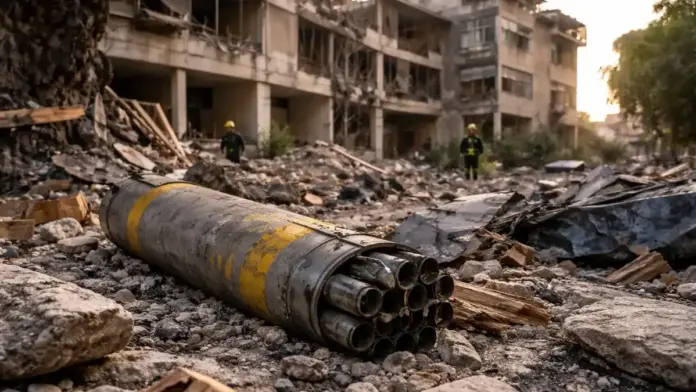
That distinction matters because it explains why the weapon is especially alarming. Cluster munitions are not just one blast in one place. They spread explosive danger across a broader area. The International Committee of the Red Cross explains that these weapons are “area weapons” and warns that their wide-area effects, combined with the large number of submunitions that can fail to explode as intended, have caused large numbers of civilian casualties and can leave contamination behind for years or even decades.
In plain language, a weapon like this can remain dangerous twice: once when it falls, and again later if unexploded submunitions are left behind. That is one of the most important facts the public needs to understand, because it turns a missile strike from a moment into an ongoing hazard. The ICRC says unexploded submunitions can threaten civilians returning home, obstruct relief, and hinder reconstruction long after the attack itself.
What Iran is reported to have fired at Israel
According to Reuters’ reporting on Iranian cluster-munition warheads and the added challenge for Israel’s air defenses, Iran is believed to have launched missiles carrying warheads that disperse about 24 smaller bomblets, each with roughly 2 to 5 kilograms of explosives. Reuters added that once the warhead opens and the bomblets separate, they can no longer be intercepted in the same way as the original incoming missile. That is a crucial technical point, because it means the window for successful defense narrows sharply before dispersal.
AP’s reporting points in the same direction, even if the wording is slightly different. It reported that Iran said it fired multiple-warhead missiles at central Israel and described them as weapons designed to spread maximum damage and evade Israel’s layered air defenses. That means the broad operational picture is consistent across major reporting: this was not just another single-warhead conventional strike. It involved a warhead type designed to increase the spread of danger.
This is exactly where the story moves from military jargon to public meaning. The threat was not only the missile seen in the sky. It was also the smaller explosive elements released afterward and the larger footprint they could create on the ground. For an internal Newsio angle on escalation logic, this also pairs well with the piece on the targeted killings inside Iran’s security leadership, because both stories point to a conflict moving into riskier and less containable territory.
The real issue is the aftermath
This is the heart of the article. From launch to impact, the event is military. From impact onward, the event becomes human. That shift is the real story. It is where journalism either becomes meaningful or stays superficial.
The aftermath means asking what people found on the ground. Were there deaths? Were there injuries? Did the strikes hit residential or mixed civilian areas? Was critical civilian infrastructure damaged? Were unexploded submunitions left behind? Reuters’ reporting on Tel Aviv makes clear that the answer is not abstract. People were killed, infrastructure was damaged, and the risk pattern changed because of the kind of warhead reportedly used.
This is what many large sites compress into a few lines and then move on from. But the aftermath is where the truth of the event actually lives. Missile launches are spectacle. The aftermath is consequence. A serious news site has to dwell there, because that is where the public learns what the attack meant beyond the headline. Reuters’ report on the foreign worker killed in central Israel underscores that the ground reality was not symbolic. It was fatal.
Damage is still damage even when a state can absorb it
One of the easiest mistakes in public discussion is to look at a state like Israel, with its defense systems, resources, and institutional capacity, and assume that damage somehow matters less because the country can absorb it materially. That is the wrong lens.
Damage is still damage. A destroyed home is still destroyed. A dead civilian is still dead. A neighborhood under missile threat is still a neighborhood under missile threat. Reuters explicitly reported deaths in Tel Aviv and damage to one of the city’s main train stations after a cluster-style warhead got through. That alone is enough to reject any lazy narrative of harmless or merely psychological attacks.
For the ordinary person living under that reality, the question is not whether a state can finance repairs. The question is who was inside when the missile struck, who managed to get to shelter, who did not, and what danger may still remain afterward. That is why the aftermath matters more than military theater. It pulls the story back to people.
Why this raises a serious humanitarian issue
The humanitarian issue here is not marginal. It is central. When a weapon with wide-area effects is used in or near populated areas, the concern is not only whether the attacker had a military objective in mind. The concern is whether the nature of the weapon itself makes civilian harm harder to prevent.
The ICRC has long argued that the wide-area effects of cluster munitions and the unexploded submunitions they leave behind create especially grave risks for civilians.
That has to be explained plainly, not sensationally. The public needs to know that this kind of attack can leave danger behind after the explosions stop. It can affect residents, children, first responders, and anyone returning to damaged areas. It can obstruct relief and reconstruction. That is not rhetoric. That is the documented humanitarian concern surrounding these weapons.
This is also why the story matters globally, not just regionally. A lot of war coverage gets trapped in geostrategy and misses the human residue. But the residue is the point. Once the ground is contaminated, once civilian spaces are hit, once people are killed in areas where daily life was supposed to continue, the story is no longer only about states. It is about the people those states have placed under threat.
For a practical contrast in Newsio’s own editorial approach, that same concern for the human result rather than the bureaucratic announcement is what gives weight to pieces like Greece is changing how rent must be paid the point is not the rule itself, but what it does to people’s lives.
And it raises a serious legal issue too
This part needs precision, not slogans. There is a real treaty: the Convention on Cluster Munitions. The official convention site says 123 states have committed to its goals, including 112 States Parties and 12 Signatories. That matters because it shows there is broad international recognition that these weapons pose a distinct humanitarian problem.
But Reuters also reported that neither Iran nor Israel has joined the cluster-munition ban. So the narrow legal point is clear: they are not treaty parties to that specific convention.
That does not make the issue legally harmless. It simply moves the debate into the broader framework of international humanitarian law: distinction, proportionality, and precautions in attack. In practical terms, even if a state has not joined a specific convention, using a weapon with wide-area effects and persistent explosive risk near civilians still raises severe humanitarian and legal scrutiny. The ICRC has emphasized that existing IHL concerns around cluster munitions were serious enough to justify specific international rules against them.
So the most responsible newsroom formulation is this: not that journalists themselves have issued a final criminal ruling, but that the reported use of cluster-style warheads in or near civilian areas creates serious humanitarian and legal concern that the public has every right to understand.
What many large sites still miss
A lot of major coverage will give readers the number of missiles, the name of the weapon, maybe the interception rate, and perhaps a casualty line. Then it moves on. What often remains underdeveloped is the full footprint of the event.
That footprint is the translation of a military action into lived reality. It is the bridge between launch and body, between warhead and home, between strategy and the person who has to walk through the damaged street afterward. That is the part a serious news site should own. Not because it is more dramatic, but because it is more true.
The world does not need one more update that simply repeats that missiles were launched. It needs to understand what kind of danger was used, what it did on the ground, and why the humanitarian and legal implications matter. That is where the public value is. That is also where the story becomes hard to ignore.
What readers should keep
The first thing to keep is accuracy. The strongest current reporting does not support a vague, imprecise headline and stop there. It points to missiles or missile warheads that dispersed multiple submunitions over Israeli territory. Reuters and AP differ in phrasing, but not in the core picture.
The second thing to keep is consequence. There were deaths, injuries, and damage. Reuters reported a couple killed in Tel Aviv, AP reported two people killed in Ramat Gan, and Reuters separately reported a foreign worker killed in central Israel. This was not consequence-free.
The third thing to keep is why the aftermath matters more than the launch. Cluster-style warheads raise particular alarm because they spread danger more widely and can leave unexploded hazards behind. That is why the civilian, humanitarian, and legal dimensions are not side notes. They are the center of the story.