
Table of Contents
The image is powerful. The real story is the machinery behind it.
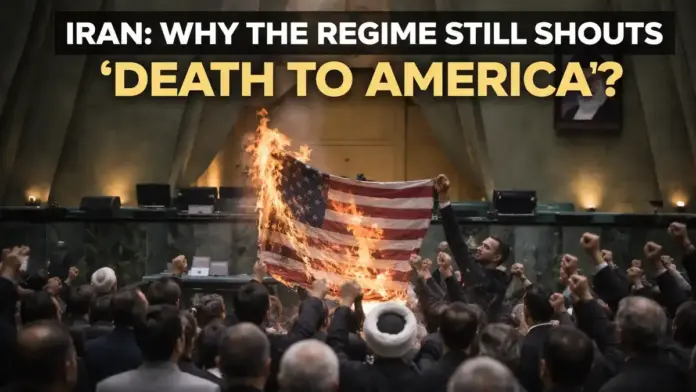
In Iran, a burning U.S. flag and chants of “Death to America” are not just outbursts of rage. They function as rituals of regime discipline. The point is not only to express hostility toward Washington. The point is to remind the political class, the security apparatus, and the public that the state still claims the authority to define the enemy, control the emotional language of politics, and stage ideological unity in moments of pressure. That is why these scenes matter. They are not just visual theater. They are political communication in its rawest official form.
To be accurate, the best-known parliament scene is not a brand-new 2026 incident. Reuters documented that in May 2018, hardline lawmakers in Iran’s parliament burned a U.S. flag and a symbolic copy of the nuclear deal after President Donald Trump withdrew from the accord.
Reuters also documented that in June 2019, Iranian lawmakers again chanted “Death to America” in parliament after Washington designated the Islamic Revolutionary Guard Corps as a foreign terrorist organization. That distinction matters because it protects readers from two errors at once: treating old footage as fresh, and treating the pattern itself as something marginal or accidental.
What is new is not the slogan itself. What is new is the renewed relevance of this rhetoric in a far more explosive regional environment. The Associated Press reported in February 2026 that state-organized anniversary rallies of the 1979 Islamic Revolution again featured anti-American slogans, anti-U.S. imagery, and heavily choreographed regime symbolism. That shows continuity, not improvisation. The message is not simply historical. It remains politically active.
What is actually confirmed about parliament, the flag, and the slogan
The factual backbone is clear. Reuters reported in 2018 that hardline Iranian lawmakers burned a U.S. flag and a paper copy of the nuclear agreement inside parliament while chanting “Death to America,” in response to Washington’s withdrawal from the nuclear deal. That was not rumor, recycled internet noise, or disputed visual material. It was a documented political act inside a state institution.
Reuters also reported in 2019 that Iranian lawmakers again chanted “Death to America” in parliament, this time amid escalating tensions after the U.S. designation of the IRGC as a terrorist organization. In other words, this is not a one-off image frozen in time. It is part of a recurring institutional vocabulary that the regime reactivates when confrontation with Washington sharpens.
At a broader public level, Reuters has also documented anti-U.S. demonstrations around the anniversary of the 1979 seizure of the U.S. embassy, where demonstrators chanted “Death to America” and burned American flags. That places the slogan in a wider official and semi-official ecosystem: parliament, street mobilization, revolutionary commemorations, and state-aligned symbolism all reinforce each other.
What this is — and what it is not
It would be wrong to present every image of flag-burning or anti-U.S. chanting as proof that all of Iranian society thinks with one voice. AP’s February 2026 reporting on regime anniversary rallies made clear that Iran remains deeply divided, with anti-regime anger, repression, and severe domestic grievances running alongside official mobilization. That means the scene is real as regime symbolism, but it should not be translated into total social unanimity.
It would also be too simplistic to read “Death to America” only in the most literal narrow sense, as if it were merely a spontaneous street threat with no ideological structure behind it. Inside the political language of the Islamic Republic, the slogan has long functioned as shorthand for hostility to U.S. power, U.S. policy, and what the regime frames as Western domination. That does not make it harmless. It makes it more politically structured than many outside observers assume. Reuters’ repeated documentation of the slogan in parliament and public commemorations supports that reading.
At the same time, dismissing it as empty theater would also be a mistake. A performance repeated over years, absorbed into institutions, and reactivated during every major rupture stops being “just symbolism.” It becomes a mechanism. Readers who want a broader framework for separating political theater from factual distortion can also see Newsio’s English guide, How to Read the News Without Being Manipulated: A Complete Guide to Fact-Checking, Sources, and Propaganda.
Why this propaganda is so useful to the regime
In coercive ideological systems, propaganda does more than persuade. It defines reality. It marks which emotions are legitimate, which enemies must remain central, and which forms of dissent become politically suspect. When parliamentarians or state-organized crowds chant “Death to America,” the regime is not speaking only outward. It is also speaking inward. It is telling its own society that the revolutionary frame still rules the moral order of politics.
This becomes even more valuable to the system when internal legitimacy is under pressure. Economic deterioration, public anger, and repression all weaken organic support. External hostility then becomes adhesive. The foreign enemy gives the regime a language through which it can re-discipline its base, justify coercion, and convert vulnerability into ideological mobilization.
That is one reason anti-American rhetoric remains useful even when the country itself is fractured. Newsio has already explored a parallel problem of verification and narrative control in “5,000 Dead in Iran”: What’s Actually Confirmed, What Isn’t, and Why Verification Is So Difficult.
The same logic helps explain why the slogan survives across different phases of the regime’s life. It binds together the clerical state, the Revolutionary Guards, and the hardline political culture that still defines revolutionary legitimacy against an external adversary. In that sense, propaganda here is not decorative. It is connective tissue. For broader international context around state rhetoric, coercive politics, and geopolitical framing, readers can also browse EN US & Global Politics.
Where misinformation enters the story
The first distortion is chronological manipulation. Viral posts often recirculate old footage as if it were breaking evidence of a brand-new turn. Reuters’ 2023 fact-check specifically addressed one such case, explaining that a video of Iranian lawmakers chanting “Death to America” in parliament dated to 2020, not to a 2023 prisoner-swap deal. That matters because a real image can still be used deceptively if the timing is falsified.
The second distortion moves the other way: because the image is sometimes recycled, some people dismiss the whole pattern as meaningless spectacle. That also misses the point. A repeatedly recycled symbol can still be politically real if the state itself keeps returning to it as part of a living ideological grammar. Reuters and AP reporting together show exactly that continuity.
The third distortion is to isolate the slogan from the broader power system. “Death to America” does not float freely in the air. It belongs to a regime where clerical authority, security structures, and revolutionary mythology still overlap. That is what gives the phrase its persistence and its institutional usefulness.
What readers should take away
The first safe conclusion is that scenes of anti-American chanting and U.S. flag-burning in Iran’s parliament and in state-aligned public mobilizations are real and documented. They are not fabricated internet inventions.
The second is that authenticity does not eliminate the need for verification. A real image can still be misleadingly dated, selectively framed, or used to support conclusions that go beyond the evidence. That is why serious reading begins where the viral clip ends.
The third is the most important. In Iran, propaganda is not just messaging. It is part of governance. The burning flag and the chant do not only speak to America. They speak to the internal architecture of the Islamic Republic: how it defines enemies, stages loyalty, and tries to keep ideological control alive even as pressure mounts around it.