

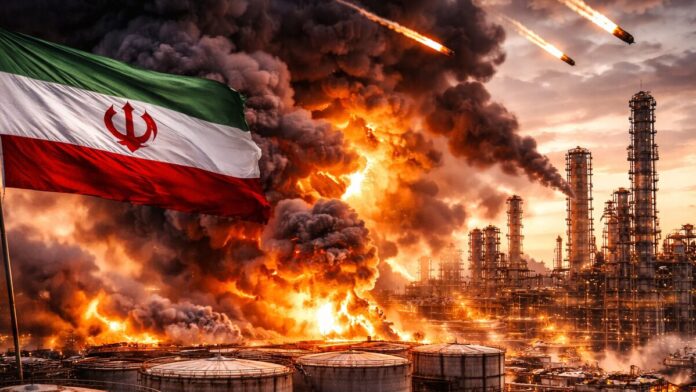
The new development is not just escalation. It is that the energy damage is spreading beyond Iran.
The most important development is not simply that the war continues. It is that the energy shock is no longer confined to Iran itself. It is spreading across the Gulf and affecting refineries, LNG facilities, export systems, storage, and production flows that matter far beyond the region. Reuters reported that about 1.9 million barrels per day of refining capacity in the Gulf has already been shut, with disruption affecting Bahrain, Iraq, Kuwait, Qatar, Saudi Arabia, and the United Arab Emirates.
That is exactly where clean fact-checking matters. Saying, in broad terms, that Iran has “started hitting oil fields in other countries” captures only part of the reality and can mislead readers if it is left there. The confirmed picture is broader and more serious. In some cases there are direct attacks or strike-related disruptions involving energy infrastructure.
In others, output is falling because exports are blocked, storage is filling up, LNG flows have stalled, or operators consider the risk too high to keep running normally. AP’s reporting makes that distinction clear by describing a wider threat to pipelines, terminals, refineries, and export systems, not just isolated oil-well damage.
That means this is no longer only a battlefield story. It is now a geoeconomic story. Once a regional war begins to impair energy arteries across several states at once, the danger stops being local. It becomes a global risk for oil, gas, shipping, inflation, insurance, and economic growth. Reuters has already warned that the war threatens a prolonged hit to global energy markets, with roughly one-fifth of world crude and gas supply under direct or indirect pressure from the conflict.
What is actually confirmed so far
The clearest confirmed point is that the crisis is now affecting critical energy infrastructure and energy flows in multiple Gulf states, not just inside Iran. Reuters reported that Bahrain, Iraq, Kuwait, Qatar, Saudi Arabia, and the UAE have all been affected either through direct disruption or through forced curbs at refining and processing facilities. The same Reuters report said Qatar’s Ras Laffan LNG hub stopped production and declared force majeure, while Bahrain’s Bapco also declared force majeure.
Reuters has also reported separately that Iraq cut southern oil output because export disruptions and storage constraints made it difficult to keep producing at normal levels while Hormuz remained out of normal commercial use. That is a crucial distinction. It shows that the system does not require a direct hit on every field for damage to spread. Sometimes the damage comes because the export route itself becomes dysfunctional.
Saudi Arabia’s own export shift tells the same story. Reuters reported that Saudi Red Sea crude exports hit record highs in March as the kingdom redirected volumes away from Gulf exposure through the Yanbu route. That matters because it shows the regional energy map is already being rearranged under pressure. This is no longer just a story about whether one installation was struck. It is now about a wider emergency reconfiguration of the Gulf energy system.
Where the misinformation sits
The misinformation here usually works in two ways.
The first is oversimplification. It treats every production cut as if it came directly from a missile strike on an oil field. That is not accurate. In several cases, cuts are being driven by export bottlenecks, storage problems, force majeure declarations, LNG shutdowns, and war-risk calculations. AP’s reporting is especially useful here because it shows how direct attacks and fear-driven operational shutdowns are both part of the same energy crisis.
The second distortion is minimization. It says, in effect, that unless every major facility is physically destroyed, the world economy has no reason to panic. That is also wrong. Energy markets do not wait for full destruction before reacting. They react once they see risk spreading across the system. Reuters and AP are both describing that phase right now: not total collapse, but cascading destabilization.
That is why the safer conclusion for readers is more disciplined. The issue is not whether all oil fields have been directly struck. The issue is whether the Gulf’s energy architecture is being degraded in a way that keeps exports, refining, LNG, and trade under continuing stress. On the evidence available, the answer is yes.
What is really being hit is the region’s energy architecture
People often imagine the oil market as a collection of separate wells. In reality, what matters is an interconnected architecture: fields, storage, terminals, LNG plants, refineries, shipping routes, insurance, chartering, pipelines, and export hubs. Once that network starts breaking in several places at once, the damage multiplies.
AP framed this clearly by describing the war as a threat to some of the world’s most critical oil and gas infrastructure, the very pipelines, refineries, and shipping terminals that keep energy moving from the Gulf into the global economy. That means the crisis is not only about barrels that are not produced. It is about whether the system still trusts that the whole chain can function.
That also fits naturally with Newsio’s wider English-language coverage. Readers who want the broader context can connect this piece with Newsio’s earlier fact-based explainer on Strait of Hormuz closure claims and the real data, as well as the Newsio breakdown of what is actually confirmed about U.S. ground-force scenarios involving Iran. Both help place today’s energy disruption inside the wider strategic crisis rather than treating it as a disconnected incident.
Why this matters so much for the global economy
The first effect is obvious: price shock. Reuters reported that oil surged to its highest levels since 2022 before later falling sharply on de-escalation hopes, showing how violently prices are reacting to any sign about Gulf disruption. AP likewise described sharp pressure on gasoline, diesel, and the wider consumer economy once energy markets tightened.
The second effect is broader than crude alone. Qatar is one of the world’s most important LNG exporters, and AP reported that its exports had shut down as the war risk intensified. That means the problem extends into power generation, industrial fuel, and manufacturing costs, especially in Asia. Reuters also reported that Southeast Asian refineries have already begun cutting operations because crude and feedstock disruption tied to Hormuz is biting far beyond the Gulf itself.
The third effect is defensive behavior by governments and companies. AP reported that governments are looking at oil reserves, even if most have not moved yet to tap them. That matters because once officials and markets start preparing emergency responses, the crisis has already crossed from war reporting into economic policy and global supply management.
The most realistic scenario from here
The most realistic scenario is not that everything stops tomorrow, and it is not that the system simply shrugs this off. The more plausible path is a dangerous middle ground: prolonged disruption, rolling shutdowns, force majeure declarations, partial rerouting, insurance stress, output cuts, and a persistent war premium in both oil and LNG pricing.
Reuters’ current reporting points directly to that kind of scenario. The market is no longer just asking whether there is a war. It is asking whether the shock is spreading into more countries and whether the Gulf’s energy machinery can still function at scale. Today’s evidence suggests the shock is indeed spreading.
That is why this update carries more weight than it might seem at first glance. It is not simply that “there were more strikes.” It is that the war is entering a phase where it threatens not just adversaries, but the energy ecosystem of the Gulf itself. Once that happens, the cost is no longer mainly regional. It becomes systemic.
What readers should keep
The safe conclusion is clear. Yes, there are confirmed disruptions and strike-related effects now touching energy infrastructure and energy flows in multiple Gulf countries beyond Iran. No, it is not accurate to compress that whole picture into the phrase “attacks on oil fields in other countries,” because that leaves out the crucial difference between direct strikes, force majeure, blocked exports, filled storage, LNG shutdowns, and production cuts caused by logistics breakdown.
The deeper problem is that the crisis is spreading into the Gulf’s wider energy web. That is the point where a regional war begins turning into a global economic risk. As Reuters reported, the loss or reduced operation of energy installations now extends across several countries in the region. That is not regional noise. It is a warning with international consequences.