

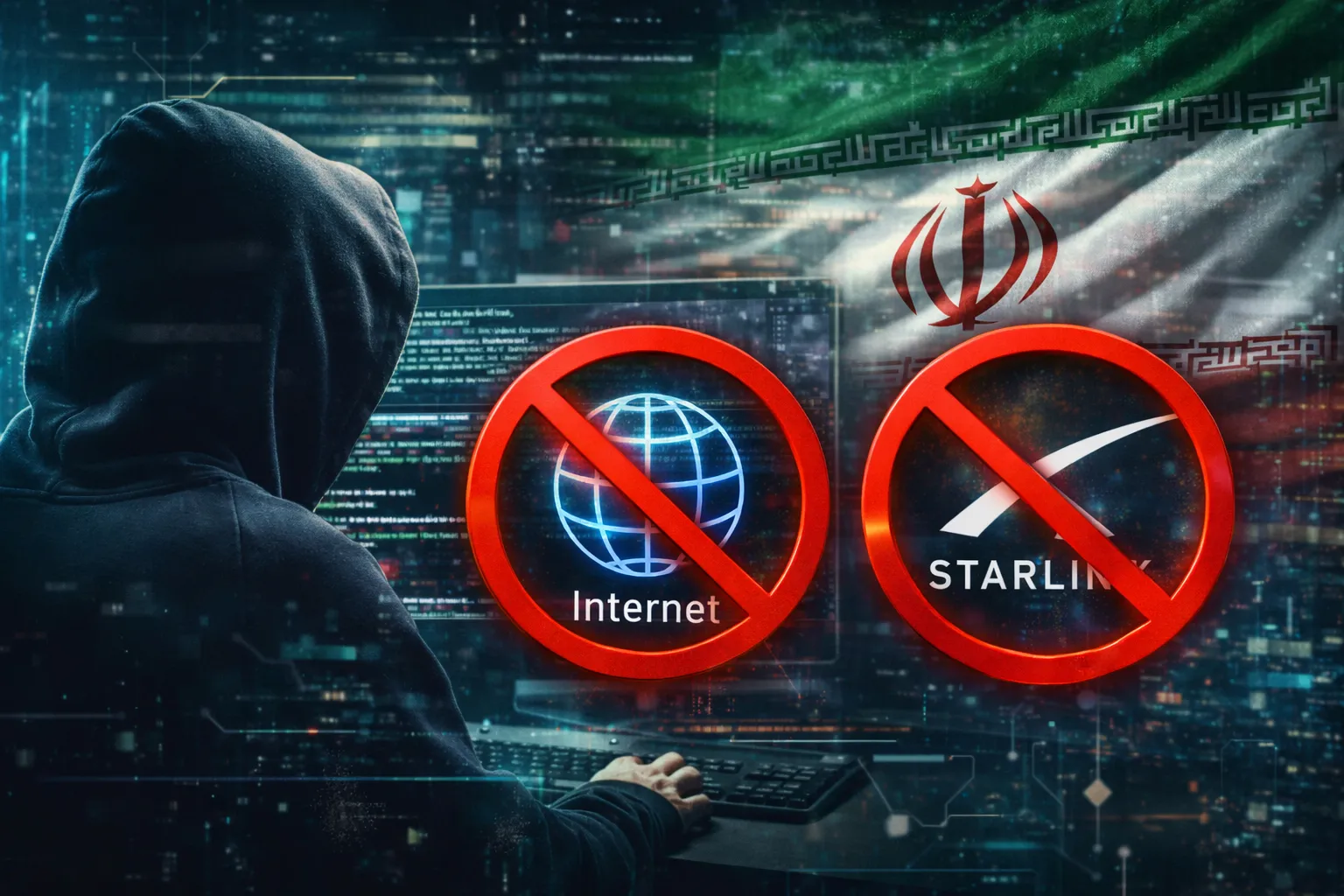
Iran: Nationwide internet disruption and reports of Starlink interference — what’s confirmed, what remains unverified, and why connectivity has become a tool of power
When a country goes dark online, the story is never only technical. It is political, social, and deeply human. Over recent days, multiple network-monitoring indicators and international reporting have pointed to a large-scale disruption of internet connectivity in Iran, consistent with patterns seen during past periods of heightened unrest: throttling, platform restrictions, and then a sharp drop that resembles a near-total shutdown.
Alongside the reported nationwide disruption, a second claim has gained attention: that Starlink satellite connectivity was also affected—whether through deliberate interference, operational constraints, or intensified enforcement against ground equipment. This is where serious reporting must be precise: the broad internet disruption is the primary, observable event. The Starlink aspect is plausible and widely discussed, but it should be treated as reported/under investigation unless and until more complete technical verification emerges.
In other words: we can describe what is happening. We can explain how it may be happening. But we should not pretend we have perfect visibility inside a blackout.
A) What we can say with confidence: the “digital blackout” phenomenon
In modern states, internet access is not a convenience. It is an infrastructure of daily life. It supports payments, logistics, health services, education, work, news, emergency coordination, and family communication. When connectivity collapses at national scale, the effects cascade quickly:
-
families lose contact,
-
media verification becomes harder,
-
businesses stall,
-
hospitals and services operate under strain,
-
and fear spreads faster than facts.
That is why widespread disruption is often described as a “digital blackout.” It creates information asymmetry: authorities retain institutional access and messaging power, while the public loses the ability to verify events independently in real time.
For journalists and readers, this matters because it changes the evidence environment. During blackouts, firsthand confirmation becomes scarce, and the risk of rumor increases. High-quality reporting therefore relies more heavily on independent network measurement signals, reputable international reporting, and careful language.
B) The Starlink question: can a state “block satellite internet”?
This is the most frequently misunderstood point.
Satellite internet does not work like traditional terrestrial networks. A government cannot simply flip one domestic switch and “turn off the satellite.” However, states can still severely disrupt satellite connectivity in practice through a combination of:
1) Interference (jamming) and electronic disruption
Radio-frequency interference can degrade or deny service in targeted areas, depending on capabilities, geography, and the specific system’s resilience.
2) Ground enforcement against terminals
Satellite connectivity still depends on user terminals on the ground—hardware that can be located, confiscated, or criminalized. Even the threat of enforcement can reduce real-world usage dramatically.
3) Environmental and operational constraints
Even without deliberate interference, reliability can be affected by placement, power availability, obstructions, or the inability to deploy equipment safely during a crisis.
That is why the claim “Starlink will automatically solve censorship” is never guaranteed. In high-control environments, the state does not need to defeat the satellite in space. It can attack the system’s practical usability on the ground.
So what should we say responsibly?
It is plausible for satellite access to become unreliable or disrupted under pressure. It is also plausible for authorities to deter its use through enforcement. But the more specific the claim (exact methods, scope, or confirmation that “Starlink was blocked nationwide”), the more it requires technical validation.
C) Why governments cut connectivity: the strategic logic
Large-scale internet disruptions tend to serve three strategic functions:
1) Control visibility
When citizens cannot upload videos, share location data, or communicate widely, it becomes harder for the outside world to verify events quickly. This can reduce external pressure and slow international scrutiny.
2) Disrupt coordination
Connectivity enables organization. Removing it can fragment collective action, disrupt logistics, and raise the cost of mobilization—both for protesters and for everyday civic life.
3) Expand uncertainty
A blackout produces a vacuum. In a vacuum, anxiety rises, rumors multiply, and people often hesitate to act because they cannot assess risk. Uncertainty becomes a tool.
But this strategy has a cost. Internet disruptions also damage economic activity, public services, and a country’s basic functioning. That cost is sometimes deemed acceptable by authorities when political control is prioritized over economic continuity.
D) What to watch next: indicators that separate evidence from speculation
If you want to follow this story with discipline, monitor the signals that are hardest to fake:
1) Independent connectivity measurements
Watch for time-stamped connectivity graphs and updates from reputable monitoring groups and major outlets that cite measurable network drops and recovery patterns.
2) Restoration pattern
Full restoration, partial restoration, or cycling blackouts (open/close) each suggest different strategic intent:
-
partial restoration often means targeted filtering,
-
cycling blackouts often track moments of heightened unrest,
-
prolonged near-total disruption suggests a deliberate and sustained control strategy.
3) Satellite-use environment
Look for credible reporting on:
-
terminal seizures,
-
arrests/penalties related to satellite equipment,
-
verified interference patterns (where available),
-
and changes in user reports across different regions.
4) Diplomatic and corporate signals
In major connectivity incidents, political actors may publicly raise the issue, and technology companies may comment indirectly through service-status changes or policy positions.
Conclusion: connectivity is now a frontline
This story matters beyond Iran because it illustrates a reality of the 21st century: connectivity is power. Turning the internet off—partially or fully—functions as more than censorship. It becomes a method of controlling narrative, coordination, and the public’s ability to verify reality.
The most responsible way to cover such events is to hold two truths at once:
-
The widespread disruption of internet access is a serious, observable event with immediate human consequences.
-
Claims about satellite disruption (including Starlink) may be credible, but should be framed as reported and under verification until technical evidence becomes clearer.
That balance is not caution for caution’s sake. It is how credibility survives in an environment designed to erase evidence.