

Table of Contents
From Missiles to Water: Why the Threat Against Desalination Plants Opens a New Phase in the Iran-Israel War
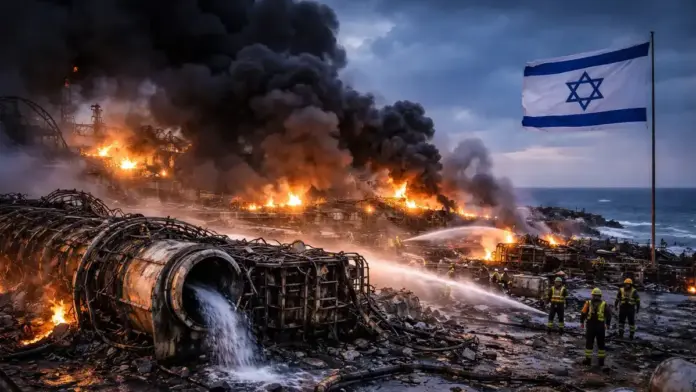
This escalation cannot be understood only through the image of missiles in the sky. The more serious development is strategic: Tehran has now openly threatened critical infrastructure, including desalination plants and energy facilities, if the United States strikes Iranian power-generation infrastructure.
That is not just another wartime line. It signals a possible shift toward a form of conflict in which the target is no longer only military capability, but the operational resilience of entire societies.
At the same time, the recent damage inside Israel shows that this is no longer a theoretical conversation. Reuters reported that Iranian ballistic missiles struck Arad and Dimona, injuring people and damaging buildings, while AP described new casualties in southern areas near sensitive sites. The conflict is already pressing against the boundaries of civil protection, public safety, and social endurance.
To understand why this matters, it helps to read this development as the next step in a wider pattern. When war does not break an opponent’s political will through direct military pressure, it begins searching for the systems that keep everyday life functioning. In that sense, the threat against desalination plants is not random. It is a threat against continuity itself.
Why desalination plants matter so much
Desalination plants are not neutral industrial assets. In a water-stressed region, they are directly tied to drinking water, municipal supply, industrial continuity, agriculture, and basic public health. In Israel specifically, desalination has become central to national water security. UNESCO has noted that by 2019, desalination provided about 70% of the country’s domestic and municipal water supply.
That means a serious hit on desalination infrastructure would not be “just another infrastructure strike.” It would be a strike on the practical stability of daily life. The consequences would move quickly beyond engineering and economics. They would affect households, hospitals, local authorities, emergency systems, and the broader public sense that the state can still guarantee normal function under fire.
This is exactly where the nature of the war begins to change. A missile attack on a military target is one thing. A credible threat against the systems that keep water flowing is something else entirely.
A war moving toward critical infrastructure
Until recently, most of the discussion centered on missiles, drones, air defense, nuclear facilities, and leadership targets. Now the frame is widening toward something darker: a war on critical infrastructure.
Reuters has already reported pressure and risk around energy-linked sites in the region, while AP explicitly documented the Iranian warning about water and power systems. That points to a shift away from purely military cost and toward societal cost.
Once water, electricity, fuel, and logistics enter the target map, the war stops being a matter only for armies and war rooms. It becomes a matter for civilians, hospitals, municipalities, supply chains, and daily life. Societies can absorb military tension for a period of time. They become far more vulnerable when the systems behind basic normality are drawn into the conflict.
That is why desalination threats must be treated as strategic signals, not rhetorical noise.
The logic of pressure and fear
The threat against water infrastructure also carries a second message. It is not just operational. It is psychological.
The message is clear: critical civilian systems can be made part of the battlefield. Even before any such strike occurs, the threat itself forces defensive reallocation, security reinforcement, and political recalculation. It changes the way a state thinks about vulnerability. It changes the way a population thinks about survival.
That is what makes this phase so dangerous. A state that must suddenly protect not only bases, airports, and command centers, but also desalination plants and water networks, is already fighting on a broader front. A public that begins to understand that water supply can become a wartime concern is already experiencing a different kind of conflict.
This is not just rhetoric anymore
The mistake would be to dismiss this as inflated wartime language. The region has already shown that red lines can move quickly. Recent reporting from AP and Reuters suggests that both the rhetoric and the operational environment are widening toward systems that sustain civilian life. When a war approaches water infrastructure, it is no longer merely intensifying. It is being redefined.
That is also why the international dimension matters here. An official institutional frame comes from the IAEA Director General’s statement to the Special Session of the Board of Governors, which places the current military crisis and strategic infrastructure risk inside a wider regional and nuclear-security context. The issue is no longer only the exchange of strikes. It is the possibility that the conflict begins consuming the systems that keep whole societies running.
What the reader should keep
The key conclusion is simple and heavy at the same time.
If desalination plants move from threatened assets to actual targets, then the Iran-Israel conflict will have crossed into a phase that is measured not only in missile launches, interception rates, and battlefield damage. It will be measured in water security, civic resilience, and a state’s ability to preserve basic normality for its population.
That is what makes the current moment so serious.
This is no longer only about military signaling. It is about the possibility that water itself becomes part of the war.