

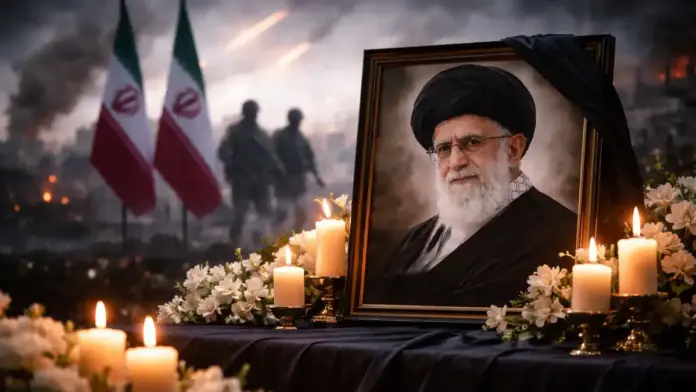
Khamenei death confirmed: what we know so far
Iran’s political system is built around continuity at the very top. When that apex suddenly disappears, it doesn’t just create a leadership story—it reshapes the risk map for the country, the region, and any capital that has to price uncertainty overnight.
Multiple major outlets are now reporting that Iranian state media has confirmed the death of Supreme Leader Ayatollah Ali Khamenei, framing it as a decisive, historic rupture after strikes that have already pushed the region into a new phase. The baseline authority reference many newsrooms are using for the confirmed fact pattern is this Reuters report: Reuters.
In practice, the most important distinction for readers is simple: the confirmation is about the core fact (Khamenei is dead), not about every operational detail. Timelines, command chains, and the precise mechanics of the strike typically arrive in layers—sometimes with corrections as independent verification catches up.
Even so, the strategic implications begin immediately, because Khamenei was not a ceremonial figure. He sat at the junction of religious legitimacy, security power, institutional appointments, and the regime’s strategic direction. Remove that junction, and the system enters a period where signals matter as much as statements.
For background on how Iranian society, power centers, and fault lines interact beneath the headlines, this explainer gives the essential internal context: Iran 360: what’s happening now, what people are demanding, and the realistic outlook for 2026.
Why this is a strategic inflection point, not just breaking news
1) Succession becomes the central battlefield—politically and institutionally.
Iran’s succession process is not a Western-style electoral contest. It is a high-stakes convergence of formal procedures and informal power—where security institutions, clerical authority, and political factions all have veto points. The key question is not only who comes next, but how the transition is managed: smoothly, coercively, or with visible internal tension.
2) Perception of control becomes a security objective.
When the top leader is removed, every actor—inside and outside Iran—reads the moment for weakness. The regime’s priority becomes preventing a power vacuum narrative. That means rapid cohesion messaging, visible continuity, and potentially a tougher security posture to deter internal unrest and external opportunism.
3) Escalation risk rises because deterrence logic collides with restoration logic.
Adversaries may interpret the strike as proof they can reach the pinnacle. Iran and its security establishment may interpret the same event as requiring a response that reasserts deterrence. Those dynamics, running simultaneously, are where miscalculation becomes most dangerous.
What is likely to move first inside Iran
In the early hours of a leadership rupture, Iran’s system typically prioritizes command continuity over public transparency. Watch the structure of messaging—not just the words.
The first layer: institutional continuity signals
-
Who speaks with authority, and who stays silent.
-
Whether key institutions project a unified line.
-
Whether the language emphasizes stability, mourning, retaliation, or all three at once.
The second layer: security posture signals
-
Internal security deployments and constraints on public assembly.
-
Alerts tied to critical infrastructure and strategic sites.
-
Messaging that frames dissent as a security threat rather than a political response.
The third layer: succession signaling
Succession isn’t only a name. It’s a set of cues: endorsements, alignment among power centers, and the absence—or presence—of contradictory narratives from influential institutions.
What could change externally—and why markets care before diplomats finish talking
When a central node is removed, the region doesn’t wait for a complete dossier. Risk is repriced immediately.
Energy and shipping risk premium
Even a short-lived spike in perceived danger can raise insurance costs for shipping, tighten risk pricing in energy, and create volatility that hits consumers far from the immediate battlefield.
Proxy dynamics and “distributed escalation”
A major leadership shock can trigger responses that are not direct state-to-state actions. Regional actors aligned with Iran—and those opposing it—may increase activity in ways that widen the crisis without a single definitive “new war” declaration.
Diplomatic pressure and deconfliction attempts
Once confirmation is established, the next critical question is whether channels exist to prevent the crisis from turning into a chain reaction. In some escalations, time windows—real or perceived—shape decision-making and rhetoric. This recent analysis frames that “window” logic and why it matters: Trump’s “10-day window” on Iran: what the claim suggests, and what to watch next.
The information war will intensify—because uncertainty is power
After a leadership break, competing narratives multiply:
-
To claim victory.
-
To deter retaliation.
-
To fracture the opponent’s public confidence.
-
To shape international legitimacy.
This is where readers get dragged into false certainty. A practical way to stay anchored—without switching off from the news—is this guide: How to read the news without being manipulated: fact-checking habits, sources, and propaganda signals.
What this means for you
If you’re reading from Greece—or anywhere outside the immediate battlefield—this story still matters in concrete ways. Not because everyone will feel it tomorrow morning, but because it shifts the parameters that shape cost, risk, and stability.
1) Expect volatility before clarity
In the short term, uncertainty is the headline. Markets and institutions react to risk faster than investigators can publish complete timelines. That can translate into unstable energy pricing, elevated transport costs, and “risk-off” behavior across sectors exposed to geopolitical shocks.
2) Watch the succession process—not the loudest claim
The most decisive indicator isn’t a viral assertion or an anonymous post. It’s whether Iran’s power centers converge on continuity. A transition that appears cohesive can reduce immediate escalation incentives. A transition that looks contested can raise them.
3) Pay attention to escalation geometry
Escalation does not have to be a single dramatic event. It often arrives as distributed pressure: cyber activity, proxy actions, maritime incidents, or reciprocal strikes that gradually expand the theater. The danger is less about one move and more about cascading decisions made under time pressure.
4) Separate confirmed facts from fast-moving details
Here is the safe reader’s framework:
-
Treat the death confirmation as established at the level reported by major outlets.
-
Treat operational specifics as provisional unless independently corroborated.
-
Treat predictions—“regime collapse,” “instant peace,” “inevitable world war”—as narrative, not reporting.
This is a major strategic inflection point. The next phase will be defined by three measurable signals: how succession is handled, what form retaliation takes (or doesn’t), and whether external actors open deconfliction channels quickly enough to prevent chain escalation.
• Summary: Khamenei’s death has been confirmed by Iranian state media as carried by major reporting, triggering a high-stakes succession moment and a new risk phase for the region.