

Table of Contents
Iran is under pressure, but the big new uprising has not been confirmed this week
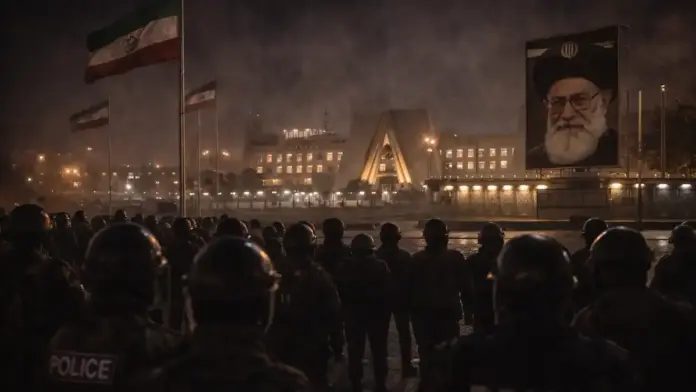
The most accurate starting point for a global audience is this: public anger inside Iran is real, deep, and politically dangerous for the regime, but the strongest reporting available this week does not confirm a new mass, organized, nationwide anti-government uprising in the streets.
That distinction matters because the information space has split into two bad extremes — one claiming the regime is already being overrun from below, the other pretending nothing is moving inside Iranian society at all. The evidence supports neither version.
What the evidence does support is a more serious and more useful conclusion. Iran is not socially calm. It is not politically healed. It is not internally reconciled. But fear, repression, war, and a still-powerful security apparatus have, for now, blocked public anger from turning into a newly confirmed nationwide uprising this week.
For readers who want the deeper succession background behind this atmosphere of uncertainty, Newsio has already mapped the power question in Iran succession: what it means if power passes to Khamenei’s son.
What has actually been confirmed this week
The clearest high-trust reporting this week comes from Reuters. Israeli officials acknowledged there is no certainty Iran’s government will fall despite war, and the same reporting said fear, harsh warnings from the authorities, and continuing bombardment have all worked against the emergence of large new protests right now.
Reuters also reported that U.S. intelligence did not assess the Iranian government as being at immediate risk of collapse. That does not mean the regime is healthy. It means the public record does not support claims of an already unfolding national overthrow this week. A strong external factual anchor here is Reuters’ report on why war has not automatically translated into regime collapse or a new nationwide uprising.
Associated Press reporting points in the same direction. AP described some Iranians celebrating the death of Ali Khamenei, including open jubilation in some places, but said fear and uncertainty remained dominant and that many people were still too afraid of the security services to see the moment as an immediate opening for a broad revolt.
In other words, there are visible signs of hatred toward the regime, but not yet a newly verified nationwide street movement on the scale many outside observers are expecting.
This is exactly the line serious reporting has to hold. It is not accurate to write that “the people have already risen.” It is also not accurate to write that public anger is absent. What is confirmed is the pressure, the fear, the fragmentation, and the unresolved possibility of future unrest.
Newsio has already handled that verification challenge in “5,000 Dead in Iran”: What’s Actually Confirmed, What Isn’t, and Why Verification Is So Difficult.
Why the streets look quieter than the society actually is
A quieter street does not necessarily mean a quieter society. One of the main reasons the current moment can be misread is that many outside observers expect revolt to be visible immediately if the regime is weakened.
Iran does not work like that. A society can be deeply anti-regime and still remain publicly restrained if the cost of visible action is too high. Reuters’ January reporting on the protests made clear just how violent the crackdown became, while later March reporting showed that this memory of repression still hangs over the public mood.
That memory matters. If people believe the system is still willing and able to kill, disappear, imprison, and isolate them, they do not automatically rush into a fresh round of confrontation simply because the ruling structure looks more fragile from the outside. They hesitate. They wait. They calculate. They test the atmosphere. That is why a regime can be both socially hated and temporarily stable in public space.
War adds another layer. Foreign military pressure does not always produce domestic revolt. Sometimes it does the opposite: it freezes action, creates survival anxiety, and introduces patriotic or defensive instincts even among people who profoundly distrust or despise their rulers.
Reuters quoted opposition voices saying bombing alone would not topple Iran’s clerical system and that real change would still require a popular uprising combined with internal resistance. That is a crucial distinction. The precondition for revolt may still exist, but the revolt itself has not yet been newly confirmed this week.
The January trauma still shapes March reality
Anyone trying to understand this week’s mood has to understand January. Reuters reported in January that protests spread across the country, that internet and phone restrictions were imposed, and that dozens were killed in the early phase alone. Later Reuters reporting cited officials and rights monitors pointing to dramatically higher death tolls as the crisis deepened. That earlier wave is essential context because it changed the cost structure of dissent inside Iran.
Once a society has lived through that level of repression, silence becomes harder to interpret. It may mean fear rather than loyalty. It may mean exhaustion rather than reconciliation. It may mean that anger has gone underground rather than disappeared.
That is why the absence of a newly confirmed nationwide uprising this week should not be confused with the absence of regime vulnerability. For broader context on how Newsio tracks these state-pressure environments, readers can also browse EN US & Global Politics.
What the strongest reporting suggests about the social mood
The strongest current reporting suggests Iran is living in a state of compressed tension. AP’s reporting described a country where some people openly celebrated the supreme leader’s death, while others were fearful of what might come next and deeply uncertain about whether this was the beginning of change or the start of something worse.
Reuters’ broader March reporting also pointed to cracks in the loyalist base and growing doubts even among some people tied to the regime’s social infrastructure.
That matters because it shows the crisis is not binary. Iran is not a society that has rallied cleanly behind the regime, and it is not a society that has already converted its rage into a new unified national street movement. It is a society that looks wounded, divided, hostile, intimidated, and politically unresolved all at once.
For readers who want a parallel framework on how opaque, high-noise authoritarian information environments distort what outsiders think they are seeing, Newsio has also explored that logic in AI Deepfakes After the Maduro Crisis: How Synthetic Videos Go Viral—and How to Verify Them.
The biggest analytical trap
The biggest mistake right now is to confuse the absence of a newly confirmed uprising with the absence of a deep national crisis. Those are not the same thing. Reuters’ reporting that the regime is not in immediate collapse does not equal social legitimacy. It means only that the state still functions, the security organs still matter, and outside pressure has not yet produced a clean revolutionary moment from within.
The opposite mistake is just as dangerous: assuming that because some people celebrated or because the loyalist base is fraying, a nationwide anti-regime explosion is already underway. The strongest available reporting does not support that conclusion this week. That is why the correct headline has to live in the tension: Iran is under severe internal and external pressure, but a new mass uprising is not yet verified.
Why this matters beyond Iran
This matters globally because Iran’s internal stability affects much more than Iranian domestic politics. It affects regional war calculations, energy markets, security planning, allied strategy, and the risk of further escalation across the Middle East. If outside governments misread silence as stability, they may underestimate the fragility of the system.
If they misread anger as imminent revolution, they may build policy on a collapse that is not yet happening. Reuters’ reporting is useful precisely because it resists both fantasies.
That is why the current moment should be described with discipline. Iran is not calm. Iran is not solved. Iran is not openly exploding this week in a newly verified nationwide uprising either. It is sitting in a dangerous middle ground: socially combustible, politically brittle, militarily pressured, and still held together by fear and force.
What readers should take away
The first safe conclusion is that this week has not produced a newly confirmed mass, organized, nationwide uprising inside Iran. The strongest available reporting does not support that claim.
The second is that anti-regime anger remains real, deep, and potentially explosive. The absence of a new nationwide revolt does not mean the regime has repaired its legitimacy. It means fear, repression, war, and fragmented opposition still outweigh public readiness for another open confrontation right now.
The third is the most important for a worldwide audience: the correct story is not “Iran is fine,” and it is not “Iran has already risen.” The correct story is that Iran is under pressure, society remains deeply hostile in large parts, but a new mass uprising has not yet been verified this week. That is the line that informs the reader without pushing them into propaganda from either side.