
Table of Contents
Iran’s message to Americans is real. The contradiction behind it is even more real.
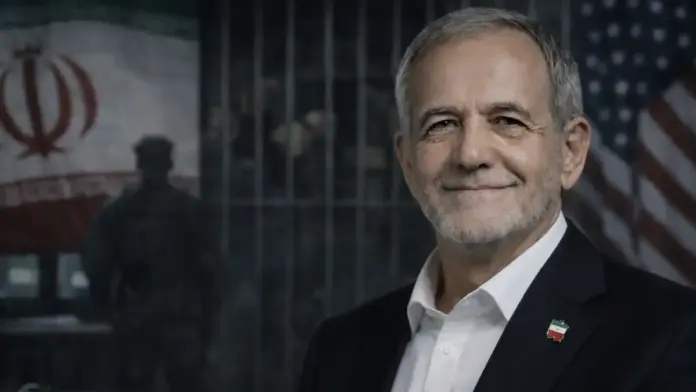
When Masoud Pezeshkian addressed the American people directly, the point was not simply diplomatic language. It was political framing. His letter tried to separate ordinary Americans from U.S. policy, arguing that Iran does not harbor hostility toward the American public and urging readers to look beyond what he described as distorted narratives about his country.
Reuters reported the letter on April 1, and other major outlets also treated it as a real and significant communication to a foreign audience.
That matters. But it is only the beginning of the story, not the end of it. A serious article cannot stop at the text of the letter itself. It has to ask whether the system behind the letter behaves in a way that supports its softer tone. And when that question is asked honestly, the gap becomes the story.
The letter says one thing to the outside world. The record inside Iran points to something much darker: information control, intimidation, legal threats, arrests, and a climate of fear that no polished external message can erase. Reuters reported days before the letter that Iranian authorities warned of death penalties and asset seizures for those accused of aiding “enemy states,” while Freedom House continues to classify Iran as heavily restricted on internet freedom.
This is the key distinction the public needs to understand. The issue is not whether the letter exists. It does. The issue is whether the letter proves moderation. It does not. At most, it proves that the regime knows how to speak differently to different audiences. That is not the same thing as political transformation. It is often the opposite: a sign of a system skilled enough to present a softer face abroad while tightening pressure at home.
Newsio readers who want the broader internal pattern should read The Regime in Tehran, the Billions It Reached, and the People It Never Chose to Build, The X-Ray of Tyranny: Iran’s shadow state, the Khamenei dynasty of fear, and the global danger of a regime built on coercion, and Can Iran Threaten Europe With Missiles?.
There is another reason this distinction matters. A public letter to Americans is not aimed only at policymakers. It is aimed at perception. It tries to alter how Iran is read morally, politically, and emotionally by people outside the country.
That is why it must be measured not against rhetoric from Iran’s enemies, but against verified reporting on Iran’s own conduct. Once you do that, the contrast is hard to miss: softer language outward, harsher rule inward.
The regime does not speak with one language. It speaks with two.
To foreign audiences, especially Western audiences, the regime can sound restrained, reasonable, even wounded by what it calls misrepresentation. It speaks of peoples rather than governments, of peace rather than threat, of misunderstanding rather than coercion. The point is not friendship.
The point is strategic influence. In moments of war or acute geopolitical pressure, shaping perception abroad becomes part of the battlefield. Pezeshkian’s letter fits that logic exactly. Reuters and Time both framed it as a direct appeal to Americans during a dangerous period of escalation.
Inside Iran, the language changes. There, the governing vocabulary is not empathy but control. Reuters reported that Iranian authorities threatened capital punishment and confiscation of assets for people accused of spying or helping hostile states, and said more than 1,000 arrests had taken place in the previous month under wartime conditions. This is not the behavior of a system merely asking to be understood better. It is the behavior of a state that treats information, dissent, and visibility as security risks.
The internet environment tells the same story. Freedom House’s latest Iran assessment describes a digital sphere under severe pressure, with authorities making open access harder and steering users toward a more controlled domestic ecosystem. Human Rights Watch said Iran’s internet shutdowns violated rights and increased risks for civilians, while the Committee to Protect Journalists documented arrests of journalists as news emerged only in fragments during blackouts.
That is not a side detail. It is the mechanism by which reality itself gets filtered before citizens can even judge it.
This is why the phrase “double messaging” is not exaggeration. It is a structural description. Outwardly, the system seeks to soften pressure, divide foreign opinion, and present itself as a misunderstood actor trapped inside hostile narratives. Inwardly, it relies on surveillance, intimidation, censorship, and legal escalation to preserve power. These are not contradictory modes.
They are complementary ones. The external message reduces pressure; the internal one prevents rupture. Readers looking for more Newsio context in English can connect this piece with Strait of Hormuz: energy infrastructure strikes and ship hit and Iran: What the killings of Larijani and Soleimani really mean.
The most important test is not what the regime says abroad. It is how people live under it.
Any government can write a carefully framed letter. The harder question is whether the daily reality under that government reflects the tone it exports. In Iran’s case, the evidence points in the opposite direction. The UN’s independent fact-finding mission on Iran reported continuing serious violations, a sharp rise in executions, persistent impunity, and entrenched repression.
Amnesty International reported that executions in Iran surpassed 1,000 in 2025, the highest level it had recorded there in at least 15 years. Those are not ideological talking points. They are documented findings from bodies whose work exists precisely to cut through propaganda and political convenience.
That is what strips the softer external messaging of its protective coating. If a regime asks Americans to see beyond caricature, it is reasonable to ask whether it allows its own people to see freely, speak freely, organize freely, and report freely. The record says no. Blackouts, journalist arrests, legal threats, and fear-driven control point in the opposite direction. A state that fears open information at home but asks for empathy abroad is not demonstrating transparency. It is demonstrating selectivity.
There is also a critical credibility point that makes this article stronger, not weaker. I have not found strong primary-source verification that Pezeshkian himself, in that April 1 letter, said America would face “permanent consequences” or anything equivalent to “wiped off the map.”
The verified reporting supports the existence and general tone of the letter, but not that specific quote as a clean, sourced line from him in that text. That distinction matters. Strong journalism does not add rhetorical heat where the evidence does not support it. It separates the verified from the convenient.
And the verified material is already serious enough. It shows a regime that wants to be read through its most careful words when addressing foreigners, but governs through pressure when dealing with its own society.
That contradiction is not marginal. It is central. It is the operating logic of a power structure that understands image management as part of survival. For readers who want to stay disciplined about what is confirmed versus what is merely circulating, Newsio’s Iran: no new mass uprising confirmed this week and From Missiles to Water: A New Phase in the Iran-Israel War belong in the same reading chain.
This is why the letter should be read as strategy, not innocence.
The world is flooded with partial truths. That is why propaganda so often works. It does not always invent. It selects. It highlights one layer of reality and suppresses another. Pezeshkian’s letter is best understood in exactly that framework. It is not meaningless. It is not fake. But it is incomplete by design.
It presents a softer version of the regime’s outward intent without carrying the full weight of the regime’s inward practice. That is why it cannot be read alone. It has to be read beside the documented structure of coercion that still defines political life in Iran.
For international readers, the practical lesson is simple. Do not judge a regime only by the tone it uses in export mode. Judge it by how it treats dissent, how it handles information, how it punishes citizens, and how much fear is required to keep the system intact. In Iran today, the best available reporting describes a state that speaks softly outward when useful, but governs inward through pressure, uncertainty, and control. That is not a temporary communication glitch. It is a model of rule.
This is also where the distinction between Iran’s people and Iran’s rulers becomes morally important. The argument is not that an entire nation should be reduced to the behavior of those who govern it. Quite the opposite. The strongest reporting repeatedly shows that the people of Iran are often among the first victims of the regime’s choices.
That is exactly why soft messaging abroad should not be confused with decency at home. And it is why international audiences should read such appeals with both empathy and discipline at the same time.
The cleanest conclusion is also the strongest one: the Pezeshkian letter does not prove that the regime changed its nature. It shows that the regime understands the value of changing its tone. That may help it in headlines.
It does not erase the deeper record. For further external reading, this article can naturally link to Reuters’ report on the letter, Reuters’ report on death-penalty threats and wartime arrests, Freedom House’s Iran internet-freedom profile, the UN fact-finding mission report on Iran, Amnesty International’s executions findings, Human Rights Watch on Iran’s internet shutdowns, and CPJ on journalist arrests during the blackout