

Table of Contents
Iran, Qatar, and Saudi Arabia: why the strike on Gulf energy infrastructure is bigger than a regional escalation
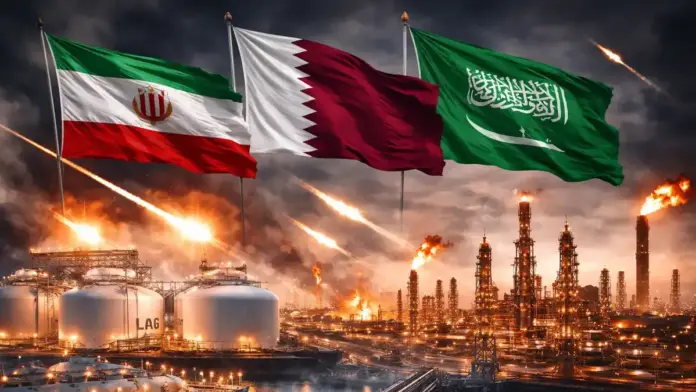
This is not just another Middle East war headline. If Iran has indeed struck major energy targets in Qatar and Saudi Arabia, then the story is no longer confined to military retaliation or regional signaling. It moves directly into the heart of global energy security. Reuters reported that Iran targeted energy facilities in Qatar and Saudi Arabia after Israel hit key Iranian gas installations, pushing the conflict into a far more dangerous economic phase.
The heaviest part of the story is what QatarEnergy reportedly told Reuters. According to that report, the attacks damaged about 17% of Qatar’s LNG export capacity, and repairs could take three to five years. Reuters also reported that QatarEnergy estimated annual revenue losses of around $20 billion and warned of broader supply consequences for Europe and Asia.
That changes the scale of the event immediately. Once Qatar’s LNG capacity becomes part of the battlefield, this is no longer only a Gulf security story. It becomes a global market story, a supply-chain story, and a political-stability story all at once. For English-side internal context, this piece connects naturally to Newsio’s earlier explainer on what was confirmed and what remained unconfirmed in the U.S.–Israel–Iran escalation and to the broader regional piece on what the targeted killings inside Iran’s leadership structure really meant.
What exactly was hit in Qatar
According to Reuters’ exclusive report on the damage that wiped out about 17% of Qatar’s LNG export capacity for up to five years, the Iranian attacks caused extensive damage at Ras Laffan Industrial City, the world’s largest LNG production hub, and also hit infrastructure at Mesaieed Industrial City. According to the same report, two of Qatar’s fourteen LNG trains and one of its two gas-to-liquids facilities were damaged.
That matters because Ras Laffan is not just another industrial site. It is one of the main balancing points of the global gas market. Reuters noted that Qatar supplies roughly 20% of the world’s LNG. So when Ras Laffan is hit, the story is not simply that one country suffered an energy attack. The story is that a key stabilizer of international LNG flows has been damaged.
This is where the public needs the full picture. A missile strike on Ras Laffan is not a localized industrial incident. It is a shock to one of the most important energy nodes on earth. That is why traders, governments, utilities, and energy planners far outside the Gulf react so quickly when the name Ras Laffan enters the war narrative. Reuters reported that the strikes sent European gas prices sharply higher.
What happened in Saudi Arabia
Iran reportedly did not stop at Qatar. Reuters also reported a strike on Saudi Arabia’s Ras Tanura refinery, after which Saudi Aramco shut the refinery, according to a source cited by the agency. Ras Tanura is one of the best-known and most strategically important points in Saudi Arabia’s oil system. That means the target set was not narrow or symbolic. It was designed to signal that key Gulf energy arteries could be placed under pressure at the same time.
That raises the stakes in two ways. First, it puts direct pressure on Saudi energy infrastructure itself. Second, it shows that Iran’s message is broader than a one-off retaliatory strike against a single state. Reuters’ wider Gulf coverage framed the logic clearly: Iran was warning that if pressure on Tehran continues, the cost will not remain inside Iranian borders.
This is the point where the escalation becomes strategic rather than merely tactical. A strike on both Qatari LNG infrastructure and Saudi energy facilities suggests a deliberate willingness to widen the economic footprint of the war. That is much larger than a simple strike-for-strike exchange.
Why the blow to Qatar LNG may be the most important part of the story
In many crises, audiences hear about explosions, missiles, retaliation, and military messaging, and that is where coverage stops. But here the center of gravity is elsewhere. It is in the damage to infrastructure that feeds entire countries.
Qatar’s LNG is not a regional commodity. It is a major pillar of energy supply for Asian buyers and an important source for European markets as well. Reuters reported that 12.8 million metric tons per year of LNG production capacity were knocked out, equal to about 17% of Qatar’s export capacity.
This is why the story should be read as more than another Middle East escalation. It is also a global energy-security event. Once a major producer loses a significant slice of LNG export capacity for years rather than days, the issue stops being immediate disruption and becomes structural instability. Reuters reported that repairs may take three to five years. That duration matters as much as the strike itself.
Many quick headlines focus on the attack. Fewer stay with the timeline. But the timeline is where the real weight sits. A short outage can shock prices. A multiyear impairment can reorder contracts, cargo flows, storage planning, and political calculations across multiple regions. That is the part that deserves much more attention than it usually gets.
What this could mean for Europe, Asia, and global prices
Europe and Asia are not watching from a safe distance. Reuters noted that QatarEnergy’s customer base is heavily concentrated in Asia, but Qatar’s broader role in LNG means serious disruption affects global pricing and competition for cargoes well beyond one region. Reuters separately reported that European gas prices surged after the news of the attacks.
That matters because energy markets do not wait for full certainty before reacting. They move on fear, anticipated shortages, and revised risk calculations. But in this case the concern is not only market psychology. It is tied to a reported physical loss of production capacity. Once that is on the table, the stress stops being hypothetical.
And if the damage proves durable, the consequences can extend from industrial planning to household energy costs. That is why this is a story with international public relevance, not just geopolitical interest. The Gulf is not some distant theater when its energy infrastructure is directly connected to supply and pricing across continents.
Why this is not just “retaliation”
The easiest version of the story is to say this was Iran retaliating after Israel hit Iranian gas installations. Reuters does connect the new attacks to earlier Israeli strikes on Iran’s South Pars field. But the word “retaliation” does not fully explain the scale or the logic of what happened.
When a state hits Qatar’s LNG heart and Saudi energy infrastructure in the same escalation cycle, the action goes beyond symmetrical payback. It becomes a strategic warning to the Gulf and to the outside world: if pressure on Iran continues, energy security itself may be dragged deeper into the conflict. Reuters’ reporting on Tehran’s warnings to Gulf energy installations points in exactly that direction.
That is why the event has to be framed properly. It is not only about missiles landing on installations. It is about the deliberate expansion of the conflict into systems the world depends on.
The political meaning is as important as the physical damage
The attacks pressure Qatar and Saudi Arabia materially, but also politically. Both states are now forced to manage damage, reassure markets, secure critical infrastructure, and decide how to position themselves inside a conflict that is widening. That means the crisis deepens in two directions at once: economic and diplomatic.
Reuters also reported that President Trump told Israel not to repeat strikes on Iranian energy installations as the crisis deepened, which shows that concern over an uncontrolled energy spiral has already reached the highest diplomatic level.
That matters because it signals that the world is no longer only watching a conflict. It is managing the risk that the conflict could destabilize major energy routes, producers, and markets at once.
What readers should keep
The first thing readers should keep is that this is not a narrow regional incident. Iran’s reported strikes on Qatar and Saudi Arabia hit energy assets at the core of Gulf stability and global LNG and oil security.
The second is that the damage appears serious, not cosmetic. Reuters reported that about 17% of Qatar’s LNG export capacity was knocked out and that repairs may take three to five years.
The third is that this changes the nature of the war. The conflict is no longer only about military exchanges and deterrence signals. It is now directly entangled with energy systems that affect markets, governments, companies, and households around the world. Reuters reported that prices jumped and supply concerns spread quickly after the attacks.
That is why this story matters so much. The missiles are one layer. The energy shock is another. But the real headline is bigger than either of those alone: the Gulf’s infrastructure has become part of the battlefield, and that means the consequences are no longer regional by default.