

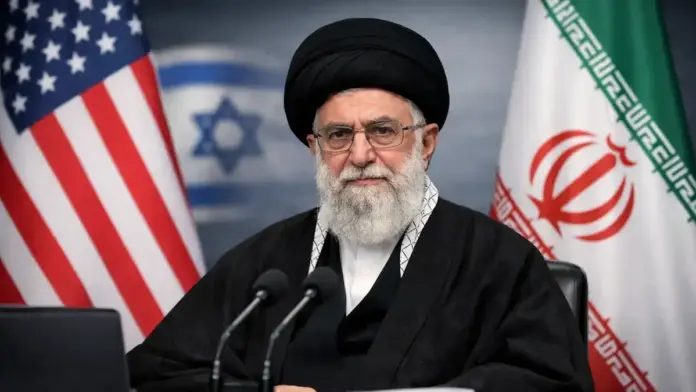
They Are Not Hitting Iran as a People. They Are Hitting the Regime: What the Strategy Against Tehran Really Means
The first analytical mistake in wars like this is to confuse a country with the regime that rules it.
In Iran’s case, that confusion distorts the entire picture. The central issue is not whether “Iran” is being targeted as a civilization, a society, or a people in the broadest sense. The central issue is that the current campaign has focused on the Islamic Republic’s leadership, coercive institutions, missile and nuclear infrastructure, and command structure. That distinction matters because it is the difference between shallow rhetoric and serious analysis.
That does not mean ordinary Iranians are untouched. They are not. Civilian suffering, disruption, fear, and economic damage are real consequences of war even when the stated military objective is regime capability rather than population-wide destruction. But analytically, it is still essential to separate the Iranian people from the political-military system that governs them.
Why the distinction matters
Iran is not a single ideological block. It is a large society with urban professionals, students, women’s rights activists, reform-minded currents, minorities, conservative loyalists, apolitical survivalists, and people shaped by decades of pressure, censorship, and state violence. Treating all of that as identical to the ruling system is simply inaccurate.
The regime, by contrast, is a specific structure: supreme leadership, the IRGC, Basij enforcement networks, intelligence arms, loyal clerical and security institutions, and the strategic programs that allow Tehran to project power and deter enemies. When outside powers hit nuclear sites, missile networks, command nodes, and top officials, they are targeting that structure of rule.
For readers who want a broader framework for how institutions and power structures shape outcomes beyond slogans, it is useful to read Will Artificial Intelligence Take Your Job? What’s True, What’s a Myth, and What Comes Next, which explains why systems should be analyzed through structure rather than surface-level panic. It also helps to read The Impact of Remote Work on Global Economic Trends and The 8 “Invisible” Fees That Shrink Your Paycheck Without You Noticing, because all three pieces share the same core logic: real pressure comes from systems, not slogans.
What Washington and Jerusalem appear to be trying to do
The public justifications have shifted at times, but the broad operational pattern is still visible. Reuters has reported that the stated U.S. objectives included degrading Iran’s missile capacity, weakening parts of its defense industry and naval capability, and preventing a nuclear weapons pathway.
AP reporting has likewise described repeated strikes on Iranian military and nuclear-linked targets, including Natanz.
That pattern points to a decapitation-and-degradation strategy. The idea is not that a country of many millions can be erased with a few strikes. It cannot. The idea is that the regime can be weakened at the top, stripped of strategic tools, thrown into a leadership crisis, and forced into a narrower space of action.
In that sense, the campaign is not best understood as “war on Iran” in the civilizational sense. It is better understood as war on the regime’s ability to command, threaten, and survive on its own terms.
Why leadership losses do not automatically mean collapse
This is where a lot of commentary becomes careless.
A regime can lose high-level figures and still keep functioning. A command structure can be damaged and still retain enough coercive capacity to continue repression and war. AP’s recent reporting on executions and crackdowns inside Iran shows exactly why this matters: even under heavy outside pressure, the state has continued to use violence, death sentences, and fear to preserve control.
That means the fall of top figures does not automatically create an uprising. It may create fractures. It may deepen uncertainty. It may undermine internal confidence. But revolt is not generated by symbolism alone. It requires something harder: a weakening of the public belief that the regime can still punish, surveil, and outlast the people beneath it. And that threshold has not clearly been crossed.
The nuclear issue is part of the regime question
This is also why the nuclear dimension cannot be treated as a side issue. It is central to how the regime is understood strategically by its enemies.
The concern is not just what Tehran is doing today. The concern is what a heavily armed, deeply hostile regime could do tomorrow if it preserved or rebuilt strategic nuclear-related capacity under military pressure. That is why an official international source matters here. The IAEA Director General’s statement to the Special Session of the Board of Governors is a strong institutional reference point because it places the military strikes and the nuclear risk in the same formal international frame.
That does not prove every worst-case scenario. It does show why regime capability, rather than national identity, sits at the center of the current strategic logic.
What this does not mean
It does not mean outside powers are “helping the Iranian people” in any simple moral sense.
It does not mean every strike is clean, precise, or free of civilian consequences.
It does not mean regime pressure automatically produces freedom.
And it does not mean the Iranian public experiences this war in neat analytical categories. People live through power outages, fear, uncertainty, grief, propaganda, and repression all at once. Any serious article has to keep that complexity intact.
What this most likely does mean
It means the campaign is best understood as an attempt to break the regime’s upper architecture, not to “eliminate Iran” as a nation.
It means the regime is under pressure precisely because it is seen as the source of strategic danger: missiles, coercive networks, regional projection, and nuclear-related risk.
It means the distinction between people and regime is not rhetorical decoration. It is the key to understanding the war correctly.
And it means the outcome remains open. A damaged regime can still be dangerous. A wounded system can still kill. A leadership crisis can still produce either internal fracture or harder authoritarian consolidation. There is no serious basis yet for treating regime collapse as automatic.
What the reader should keep
The Iranian people are not the same thing as the Islamic Republic.
The regime is not merely a government in the routine sense. It is a hardened political-military system built on leadership control, ideological enforcement, strategic deterrence, and internal repression.
That system appears to be the real target.
The most accurate conclusion, then, is not “they are attacking Iran” in the broadest civilizational sense. It is this:
They are trying to damage the regime deeply enough that it loses the ability to threaten outward, dominate inward, and survive unchanged.
Whether that pressure becomes internal rupture, prolonged repression, or a new phase of regional escalation is still unresolved.
That is what makes this moment serious.