

Table of Contents
Iran: what the targeted killings of Ali Larijani and Gholamreza Soleimani really mean
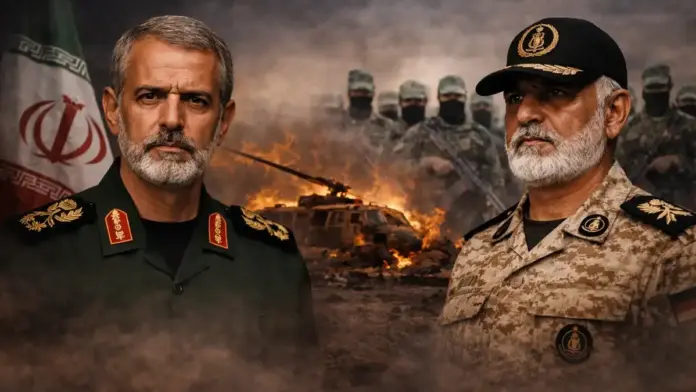
This is not just another war headline. The killings of Ali Larijani and Gholamreza Soleimani hit two different layers of Iranian power at the same time: the top security decision-making core and the internal coercive machinery that helps the state keep control under pressure. Reuters reported on March 17 that Iran confirmed the killing of Ali Larijani, described as Iran’s security chief, and separately confirmed the killing of Gholamreza Soleimani, the commander of the paramilitary Basij force.
The first thing that has to be locked down is accuracy. This is not a story about an Iranian “prime minister” being killed. That claim is not supported by the current Reuters or AP reporting. The confirmed story is narrower, but in strategic terms it is still enormous: two senior figures tied to state security and internal control were eliminated in a major blow to the Islamic Republic’s leadership.
The second thing that matters is what these killings say about the war’s new phase. When a conflict moves from infrastructure, missile exchanges, and external proxies into the top layer of leadership targeting, it becomes more volatile. It is no longer only about attrition. It becomes a contest over cohesion, fear, command continuity, and deterrent credibility. For a verification-first internal context on how Iran-related claims should be read under information pressure, see “5,000 Dead in Iran”: What’s Actually Confirmed, What Isn’t, and Why Verification Is So Difficult.
Who Ali Larijani was — and why his loss matters
Reuters described Larijani as the most senior figure targeted since the opening phase of the war and as someone widely viewed as one of Iran’s most powerful men, with deep standing inside the ruling system. That makes this more than a symbolic strike. It removes a figure associated with the strategic center of the state, not a peripheral commander.
That matters because systems like Iran’s do not run on title alone. They run on networks, access, trust, institutional memory, and the ability to coordinate across factions under pressure. A person like Larijani matters not only because of formal office, but because he sits at the intersection of security management, elite balance, and regime continuity. Reuters explicitly framed him as a confidant of the late Ali Khamenei and of Mojtaba Khamenei, underscoring how close to the core he was perceived to be.
In plain language, this is the kind of strike that forces the surviving leadership to think in two directions at once. First: who can replace the operational role quickly enough to avoid paralysis? Second: how do you restore the image of control after such a deep penetration? Those are not small questions. They go to the regime’s sense of survivability.
Why Gholamreza Soleimani was a very different but equally important target
If Larijani represented the upper security architecture, Gholamreza Soleimani represented a different pillar: internal enforcement. As Reuters reported on the killing of the Basij commander, this was not only a military loss but a strike against a key instrument of domestic control.
Reuters reported that Soleimani commanded the Basij, the paramilitary force often used to quell protests inside Iran. That is a crucial distinction. This was not only a military loss. It was a strike against a tool of domestic control.
The Basij matters because it sits at the intersection of ideology, street power, and regime discipline. It is one of the mechanisms through which the state projects fear inward, not only force outward. In moments of unrest, a force like that is not secondary. It is part of the regime’s nervous system. Removing its commander sends a message that the internal shield is vulnerable too.
This is why the two killings together matter more than either one alone. One strike hit strategic leadership. The other hit the apparatus of internal coercion. Put together, they target both the regime’s decision-making top and one of the structures it relies on to contain domestic instability. That is a deeper wound than a battlefield casualty count can show on its own.
Why “targeted killings” is the right newsroom language here
Language matters in pieces like this. “Assassinations” is understandable and often used in public debate, but it can carry a sharper legal and rhetorical charge. “Targeted strikes” is colder and more operational. “Targeted killings” sits in the middle: clear, serious, and aligned with how many newsrooms frame leadership eliminations during active conflict.
For this companion article, “targeted killings” is the most stable formulation. It does not soften what happened. It does not dramatize beyond the verified facts either. It tells the reader exactly what kind of event this was: deliberate, leadership-focused, and strategically significant. That matters because Iran stories are especially vulnerable to inflated language, rushed titles, and viral mislabeling. Newsio’s own verification discipline in “5,000 Dead in Iran”: What’s Actually Confirmed, What Isn’t, and Why Verification Is So Difficult is relevant here for the same reason: clarity first, shock second.
Where misinformation starts distorting the story
The first distortion is title inflation. A senior security official becomes a “prime minister,” a “second ruler,” or a vague “top regime boss” in fast-moving social media circulation. That is exactly how a real story gets bent into a misleading one. Reuters and AP are clear enough on the confirmed facts to reject that slippage.
The second distortion goes in the opposite direction. Some commentary reduces these killings to routine wartime attrition, as if replacing people at the top changes little. That misses the real point. Leadership targeting at this level is not only about the loss of one person’s job function. It is about the pressure it puts on trust, process, succession, and perceived invulnerability. A regime can survive such blows and still be strategically shaken by them.
The third distortion is the temptation to declare immediate collapse. That is also too easy. The current reporting supports a major blow, not a proven regime breakdown. Iran still has institutions, remaining commanders, political control mechanisms, and retaliatory capacity. In fact, AP reported that Iran responded on Wednesday with renewed missile and drone attacks on Gulf Arab neighbors and Israel, which is the opposite of immediate paralysis.
What these killings mean for Iran’s next move
The critical issue now is not only who was killed. It is what the surviving leadership believes it must do next to restore deterrence and internal confidence. Reuters reported that Iran rejected de-escalation proposals and tied the crisis to broader threats involving the Gulf and U.S. regional partners. That suggests the leadership is not treating these events as isolated losses to be absorbed quietly.
When a state believes its inner security layer has been penetrated, it often feels pressure to answer in a way that is visible, costly, and legible to enemies and allies alike. That answer does not have to be symmetrical. It can take the form of missile strikes, proxy activation, Gulf disruption, pressure on shipping, or calibrated escalation designed to remind adversaries that deep leadership targeting comes with a regional price. Reuters and AP reporting already point to this broader retaliatory logic.
This is where the story connects to the larger Middle East risk map. If leadership targeting continues, the conflict is more likely to generate overcorrection, miscalculation, and prestige-driven escalation. That is how wars become harder to contain. For a broader conflict frame on how signaling, escalation, and uncertainty can matter as much as immediate battlefield damage, Newsio’s explainer on Russia’s “Oreshnik” claim in a massive strike on Ukraine — why the signal can matter more than the blast offers a useful parallel in strategic reading, even though it concerns a different theater.
Why this is more than a leadership story
It is tempting to see this only as a story about two men. It is bigger than that. Larijani and Soleimani represented two different kinds of state power: one near the strategic nerve center, the other tied to the regime’s ability to police society and suppress unrest. Their deaths therefore matter not only because they were senior, but because of what their roles reveal about how the Iranian system actually functions.
That is also why outside audiences should resist reading this through a single frame. This is not only a military story. It is also a state-resilience story, a domestic-control story, and a deterrence story. When all of those layers are hit together, the consequences are rarely simple. The regime may respond with discipline, overreaction, or a mix of both. What it is unlikely to do is behave as though nothing fundamental was touched.
A clean authority reference on the immediate confirmation itself remains Reuters’ reporting on the Basij commander’s death and on Iran’s confirmation of Larijani’s killing. That is the level of sourcing the reader should trust above rumor circulation.
What readers should keep
The first safe conclusion is factual: the confirmed story is the killing of Ali Larijani and Gholamreza Soleimani, not the killing of an Iranian “prime minister.”
The second is structural: these were not interchangeable figures. One sat close to the security core. The other led an apparatus associated with internal repression and regime discipline. Together, their deaths amount to a strike on two distinct pillars of power.
The third is strategic: this kind of leadership targeting usually increases the risk of harder retaliation, tighter internal control, or both. It does not automatically prove collapse. It does prove that the crisis has entered a more dangerous phase, because the conflict has now cut directly into the command and control layer of the Iranian state.