

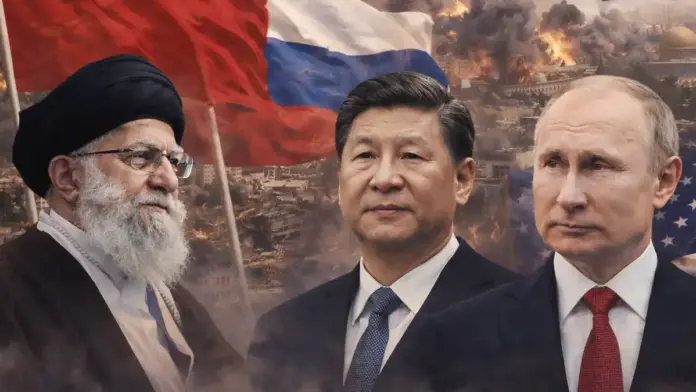
The real question is not only what happens to Iran. It is who gains around Iran.
After the U.S. strike on Iran and the regime’s effort to preserve continuity through a father-to-son transition, the central issue is not only whether Tehran survives the shock. It is also which outside powers can turn the crisis into strategic advantage. On the evidence available, Russia gains more directly and more quickly, while China seeks a more careful but still meaningful benefit from a U.S. and Israeli deepening entanglement in the Middle East. Reuters reported that Russia and China have largely stayed out of direct military involvement while still trying to extract geopolitical value from the crisis.
That matters because one of the most misleading narratives in circulation is that Moscow and Beijing are “saving” Iran or moving decisively to fight on its behalf. That is not what the available reporting shows. Reuters and AP both point instead to a colder calculation: condemn Washington, avoid direct confrontation, protect their own interests, and let the U.S. and Israel absorb the costs of escalation.
So the strategic story is bigger than Iran itself. It is about how Russia and China use American military absorption, regional instability, oil-market stress, and global perception battles to weaken U.S. room for maneuver. That is where the actual gain sits.
Russia is the more immediate winner of the crisis
If one major power is positioned to benefit quickly and measurably, it is Russia. Reuters reported that European Council President Antonio Costa described Russia as, so far, “the only winner” from the Middle East war because higher energy prices strengthen Moscow while global attention shifts away from Ukraine. AP’s reporting points in the same direction: oil-producing states outside the direct war zone, including Russia, benefit when the conflict drives prices higher.
The energy channel is the most obvious part of the story. When oil surges, Russia’s revenue base gets breathing room. That matters because Moscow remains locked in a costly war in Ukraine and continues to depend heavily on energy income to sustain its fiscal and military posture. A Middle East crisis that sends prices upward does not solve Russia’s structural problems, but it does improve its operating environment.
The second Russian gain is strategic distraction. Every week in which Washington’s military planners, diplomatic bandwidth, and public attention are pulled deeper into Iran, the Gulf, and Israel is a week in which Moscow faces less concentrated Western pressure over Ukraine. Reuters has already reported concerns that a wider Iran conflict could divert U.S. weapons and attention from other theaters. That does not mean the West abandons Ukraine. It means Russia gets time, space, and a relative reduction in pressure.
That broader pattern fits naturally with Newsio’s existing English-language coverage. Readers can place this latest crisis alongside the earlier Newsio fact-based piece on what is actually confirmed about U.S. ground troops and Iran and the Newsio breakdown of what is confirmed about mass-casualty claims in Iran, both of which appear in the Newsio article sitemaps.
China’s gain is more complicated, but still real
China does not benefit from this crisis in exactly the same way. Beijing is far more exposed to shipping instability, energy disruption, and prolonged disorder in the Gulf. It does not want an uncontrolled Strait of Hormuz crisis or an open-ended regional war. That is why its public line is more restrained and more diplomatic. Reuters reported that China called for a ceasefire and stressed restraint, sovereignty, and de-escalation.
But restraint does not mean strategic loss. China’s first gain is American diversion. Reuters reported that U.S. allies in Asia fear a prolonged war with Iran could weaken American deterrence against China, especially if naval assets, munitions, and strategic attention are pulled toward the Middle East. That concern is not abstract. It goes directly to the heart of Indo-Pacific balance, Taiwan-related deterrence, and alliance confidence in the region.
The second Chinese gain is diplomatic branding. The more Washington appears to rely on military force in the Middle East, the easier it becomes for Beijing to present itself as the power that talks about stability, sovereignty, and restraint. This is not neutrality. It is image management with strategic purpose.
China can speak the language of calm while allowing the United States to absorb the political and reputational costs of another violent regional escalation. AP reported that China sees an opportunity to strengthen its influence in the Middle East and position itself as a counterweight to U.S. power, even as it remains wary of damage to its trade interests.
The third Chinese gain is observational. A live conflict involving the U.S., Israel, Iran, missile defense, logistics, energy routes, and crisis communications gives Beijing a real-world laboratory. AP reported that China may use the situation to study U.S. capabilities and improve its own military and strategic understanding.
That kind of learning value should not be dismissed. Great powers do not only profit from wars they fight. They also profit from wars they watch closely.
The U.S. pays the cost of engagement, and both Moscow and Beijing understand that
The largest strategic advantage for Russia and China lies in a simple reality: when the United States gets pulled into another major Middle East confrontation, it pays in money, focus, weapons readiness, political capital, and diplomatic bandwidth. Reuters has reported that Asian allies worry about exactly this kind of overextension. AP’s reporting has also shown how the crisis is already feeding energy anxiety and strategic unease far beyond the immediate battlefield.
That does not mean Washington is collapsing. It means Washington is absorbing friction on multiple fronts at once. For Russia, that creates indirect relief. For China, it creates opportunity in the Indo-Pacific. For both, it reinforces a narrative they are eager to spread: that U.S. power generates instability, drains resources, and pulls America into costly conflicts with uncertain long-term returns.
This is where a second false narrative needs to be broken down. It is misleading to say that because the U.S. struck Iran, China and Russia therefore automatically “control the game.” They do not. They are not dictating the battlefield outcome. But it is equally misleading to suggest they gain nothing. The more accurate conclusion is that they do not need full control to benefit. They only need Washington and Israel to remain tied down long enough for the costs to accumulate.
The Khamenei-to-Khamenei transition does not really trouble Moscow or Beijing
The regime’s attempt to preserve power through a Khamenei-to-Khamenei succession matters here because Russia and China are not primarily asking whether the transition is legitimate in democratic or institutional terms. Their real question is whether Iran remains functional as an anti-Western pole, a pressure point against the U.S. and Israel, and a state that does not drift into the Western camp. Reuters reported that even under fire, Iran’s power structure was trying to project continuity and endurance while Russia and China kept their distance militarily.
So another distortion needs to be stripped away. The evidence does not show that Moscow or Beijing “engineered” Iran’s succession or exercise direct custodial control over the regime. What it does show is that both powers prefer an Iran that is wounded but not destroyed, authoritarian but not pro-Western, pressured but still alive enough to complicate American and Israeli strategy. That is a colder and more realistic reading of their interest.
That line of analysis also connects with Newsio’s existing English coverage on Khamenei repression and executions, fact-checked, which helps frame why succession in Tehran cannot be treated as a narrow palace story, but must be read through the wider structure of regime continuity, coercion, and regional posture. The same uploaded sitemap also shows Newsio’s Strait of Hormuz explainer, which remains directly relevant because energy disruption is one of the main channels through which Russia, and to a more limited degree China, can benefit strategically.
How they try to weaponize the crisis against the U.S. and Israel
Russia exploits the crisis on at least four levels. First, economically, through stronger oil pricing. Second, strategically, through reduced Western concentration on Ukraine. Third, diplomatically, by condemning U.S. force and positioning itself as a critic of American overreach. Fourth, informationally, by feeding the narrative that Washington and Israel are the drivers of regional destabilization. AP’s reporting on Moscow’s reaction to the war supports that pattern: loud condemnation, but no real willingness to pay the costs of directly saving Tehran.
China does something subtler. It avoids Russia’s louder posture and instead leans into the language of order, restraint, and regional stability. It keeps channels open with Gulf states, protects its trade logic, and lets the U.S. absorb the heavier military and political burden. Reuters and AP together point to that dual posture: concern about the economic fallout, but also recognition that a distracted U.S. and a more nervous alliance system can create strategic openings for Beijing.
Against Israel, the gain for both powers is less about directly weakening Israeli military capacity and more about placing Israel inside the same wider political frame as the United States. In that frame, Washington and Jerusalem become the visible face of escalation, bombing, and regional destabilization. That matters in the Arab world, in parts of Africa, in Asia, and across the Global South, where narrative warfare often shapes diplomatic room more than battlefield detail does. This is one of the most valuable indirect gains that Moscow and Beijing try to extract from the crisis.
The Strait of Hormuz makes Russia’s gain more tangible and the global risk more severe
The more insecure the Strait of Hormuz becomes, the more direct Russia’s advantage can look. Reuters reported that governments are scrambling to limit fallout as oil surges and tankers sit idle, while AP described the broader energy and security anxiety spreading across multiple regions. A prolonged Hormuz shock does not help the global economy, but it can still help a major oil exporter like Russia relative to its adversaries.
This is another place where public discussion often goes wrong. It is entirely possible for a crisis to hurt Iran and still benefit Russia. Those two realities can coexist. Geopolitics is not a morality play in which harm to one adversary automatically translates into strategic gain for the other side. Reuters’ coverage of the war’s ripple effects makes that clear: instability can punish several actors at once while still giving a comparative edge to one player.
The safe conclusion is not that China and Russia control the crisis, but that they know how to exploit it
The clearest conclusion is this: Russia does not need to win militarily in Iran to gain strategically. It only needs higher energy revenue, reduced Western concentration on Ukraine, and a prolonged sense of international disorder that weakens U.S. coherence. China, for its part, does not need to enter the war. It only needs Washington to stay absorbed, allies in Asia to grow more nervous, and Beijing’s own image as a calmer alternative to keep gaining traction.
That is also where the anti-misinformation line has to stay sharp. The evidence does not support the claim that China and Russia rushed in to rescue Iran. It does support the conclusion that both are trying to turn American and Israeli engagement into a long strategic burden for their rivals. Reuters’ reporting on Russia and China standing aside while still pursuing their own interests captures that dynamic well.
As Reuters reported, Russia and China have chosen to stay out of direct warfighting while prioritizing their own strategic gains. That is the key to the whole picture: not the rescue of Iran, but the exploitation of crisis.