
Table of Contents
The Iranian people are not the enemy — the enemy is Tehran’s regime and the system of fear keeping the crisis alive
The first truth matters more than any slogan
The most important point is not military. It is human.
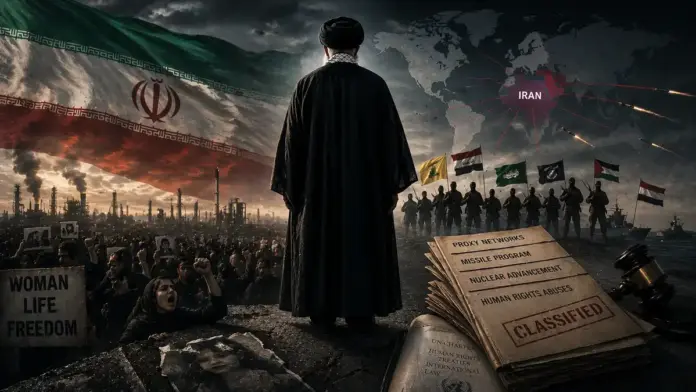
The world is not at war with the Iranian people. The Iranian people are not the enemy. Their lives, dignity, freedom, and future matter exactly as much as those of any other people. The problem is Tehran’s regime: the power structure that rules through fear, exports instability, dresses repression in ideology, and tries to survive by turning reality itself into a propaganda battlefield.
That is the line that has to remain clear. Reuters’ reporting on Iran’s wartime crackdown, the OHCHR’s warning about repression, and the IAEA’s continuing concerns all point in the same direction: the central issue is the regime ruling over society, not the worth of society itself.
That distinction is not rhetorical softness. It is precision. A people are not the same thing as the faction dominating them. A nation is not identical to the machinery that terrorizes it to stay in power.
That is why this article belongs naturally alongside Newsio’s English analysis The Regime in Tehran, the Billions It Reached, and the People It Never Chose to Build, When Tehran Fears Its Own End: Diplomacy, Propaganda, and Regional Threat, and Iran: who is really in charge? What is confirmed about Mojtaba Khamenei. Those pieces all point to the same deeper reality: the regime wants to speak as though it is Iran. It is not. It is the cage built around Iran.
The regime does not speak like a power that wants peace
This is the second major truth.
Tehran does not speak like a power genuinely seeking peace. It speaks like a power trying to buy time, preserve itself internally, present every pause as victory, and keep alive every pressure point that gives it psychological or strategic leverage.
Reuters reported that Iran’s side entered talks while simultaneously pushing claims about frozen assets and wider conditions, even as Washington publicly denied that any $6 billion unfreezing agreement had been reached. That is not the language of transparent stabilization. That is the language of negotiation wrapped in narrative warfare.
That is why the safest reading is not that Tehran has moved into a sincere post-crisis phase. The safest reading is that the regime is trying to preserve internal legitimacy, keep its domestic victory story alive, and stay upright under pressure.
Genuine stabilization would require less aggressive messaging, less coercion around Hormuz, less manipulation of half-formed diplomatic developments, and less reliance on wartime propaganda. What we have instead is a fragile negotiation environment, open strategic distrust, and a regime that still needs theater as much as it needs diplomacy.
Internal repression is not a side story. It is the core.
If anyone wants to understand what Tehran’s regime actually is, they should begin with what it does to its own people.
Reuters reported that Iran warned of the death penalty and asset seizures for people accused of spying or aiding enemy states, with more than 1,000 arrests in a month and about 200 indictments already issued. That is not the profile of a system reluctantly defending itself. It is the profile of a system that turns fear into policy.
The OHCHR warned that Iranian civilians are caught between armed hostilities and domestic repression, and the U.N. fact-finding mission warned that an already severe rights crisis could worsen further. The IAEA’s technical concerns over enrichment exist on one track; the regime’s internal machinery of arrests, repression, and coercion exists on another. Together they form a state structure that does not merely punish dissent when convenient. It needs coercion in order to reproduce itself.
That matters because it brings us back to the human center of the story. The Iranian people are not living inside a normal environment of speech, accountability, and free civic life. They are living under filters, surveillance, risk, and fear.
Even those who understand exactly what the regime is may not be able to say it openly without putting themselves in danger. That is one of the deepest moral indictments against Tehran’s system: it does not merely export instability. It also silences the people trapped beneath it.
For Newsio readers who want a broader English reading chain here, What Really Happened in Iran in the Last 48 Hours and Iran is under pressure, but the big new uprising has not been confirmed this week are part of the same fact-based map: repression is real, public anger is real, and precision still matters.
Tehran exports crisis. It does not contain it.
One of the regime’s most useful myths is that it acts as some kind of stabilizing or resistant force against disorder. The real record points elsewhere.
Reuters, AP, and U.S. government sanctions records all describe a wider Iran-backed network of armed actors across the region, including Hezbollah, the Houthis, Hamas, Palestinian Islamic Jihad, and Iraqi militias.
Those groups retain different structures and degrees of autonomy, but the larger pattern is clear: Tehran and the IRGC-QF have funded, armed, trained, and politically sustained a regional ecosystem of pressure.
Precision matters here too. The public record does not prove that Tehran wrote every operational order for every attack. But it proves something already grave enough: the regime built, financed, armed, trained, and kept alive a regional infrastructure of violence. It does not need to sign every order to bear deep responsibility for the machine it sustains.
That is the strongest, cleanest, and most durable way to state the case. Reuters’ reporting on the “Axis of Resistance” and U.S. sanctions language on IRGC support both support that conclusion.
This is why the right line is not “Iranians are the problem.” The right line is this: Tehran’s regime functions as the central state patron of a broader regional architecture of destabilization. That is factual, serious, and politically useful in a way that rage against entire populations never is.
For internal Newsio context in English, this article also belongs beside Why Israel Is Right to Defend Itself Against Tehran and Iran and Cluster Munitions: What They Left Behind in Israel. Those pieces help keep the focus where it belongs: not on abstract slogans, but on what Tehran-backed pressure looks like on the ground.
Hormuz showed who actually held the initiative
If this crisis needed one place where reality cut through propaganda, it was the Strait of Hormuz.
Tehran tried to present this phase as endurance, leverage, and even victory. At the same time, Donald Trump publicly said U.S. forces were “clearing” Hormuz, Reuters reported that two U.S. warships moved through the passage as part of the effort to restore safe navigation, and the first supertankers began passing again after the Iranian blockade phase. That does not mean normal conditions have fully returned. But it does mean the passage stopped being governed only by Tehran’s narrative.
The International Energy Agency explains why Hormuz matters so much: it is one of the most important chokepoints in the global energy system. That means the conflict over Hormuz is not just a military angle. It is a test of control, energy security, shipping stability, and global economic credibility. Whoever restores motion there gains more than a tactical point. They gain symbolic and geopolitical initiative.
That is why this article connects naturally with Newsio’s English reporting Strikes on energy infrastructure and a ship hit in the Strait of Hormuz, Strait of Hormuz: What a “closure” claim really means, and The United States has entered Hormuz to reopen it. Those pieces show the crisis moving from threat, to disruption, to pressure over restored control.
The nuclear issue is not a fantasy
Another truth that should not be softened is this: concern about Iran’s nuclear trajectory is not paranoia.
The IAEA reported that Iran is the only non-nuclear-weapon state party to the NPT that has produced and accumulated uranium enriched up to 60% U-235, with more than 400 kilograms of that stock verified in late 2025. That does not by itself prove a final weapon. But it makes it impossible to present the issue as a routine, transparent, ordinary civilian energy file with no exceptional cause for alarm.
That matters because a regime with this record of internal repression, proxy warfare, strategic coercion, and aggressive rhetoric cannot simply ask the world to suspend judgment and assume benign intent. If a state structure behaves this way at home and abroad, then international concern over its nuclear advancement is not only reasonable. It is obligatory. The question is no longer whether trust has been damaged. The question is how much trust is even left.
The strongest position is also the fairest one
This brings us back to the beginning.
The strongest position is not the loudest one. It is the one that distinguishes clearly between people and rulers, between societies and systems, between ordinary believers and the use of religion as a shield for coercive power, and between truth and propaganda.
That is what this whole Iran discussion has really been about. We are not writing to make people hate a nation. We are writing to help people understand what exactly should worry them: a regime that terrorizes internally, sustains regional pressure networks, tries to brand every pause as “victory,” and needs permanent crisis as a condition of its own survival.
That is what the public needs to know. Not in slogans. In structure.
What readers should keep
If all of this has to be reduced to a few sharp lines, these are the right ones:
The Iranian people are not the enemy.
Tehran’s regime is the problem.
Internal repression is not an accident. It is the system.
Regional proxies are not a theory. They are a strategic tool.
Hormuz showed that propaganda cannot defeat operational reality.
And the nuclear issue is not an abstract fear. It rests on a concrete technical record.
The strongest and fairest conclusion is this:
With the Iranian people.
Against Tehran’s regime.
Against fear, propaganda, and the machinery that needs crisis in order to survive.