

Table of Contents
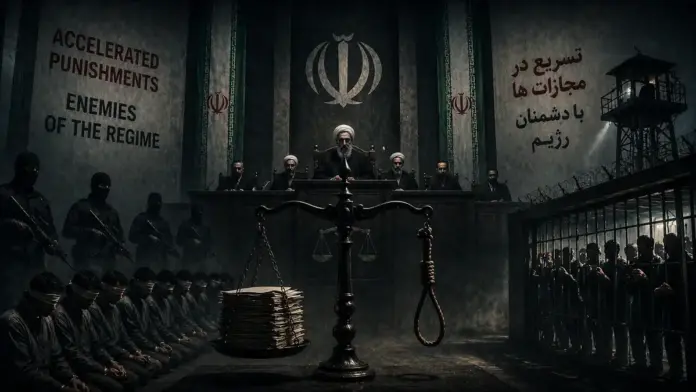
The Iranian regime is accelerating punishments and executions for “agents of the enemy” — what the new crackdown really means
This is not a rumor
The core claim is broadly confirmed: Iran’s judiciary has moved to speed up cases involving people accused of being “agents of the enemy” or of assisting hostile states. Reuters reported that Iran warned of the death penalty and asset seizures for those accused of spying or aiding enemies, and that the policy was framed as part of a wartime response to internal betrayal and external pressure.
That matters because this is not just harsher rhetoric. It is the acceleration of a real machinery of repression that is already producing death sentences, executions, and mass prosecutions.
Reuters reported more than 1,000 arrests in a month under accusations such as recording sensitive sites, spreading anti-government material, or helping foreign enemies, with about 200 indictments already issued.
Who set the line, and what it means
The message from the top of Iran’s judicial system is not simply to process these cases. It is to process them faster. In a system with a long record of unfair trials, coerced confessions, political prosecutions, and capital punishment, “speed” does not translate into efficiency. It translates into a greater risk of faster, harsher, and less reversible outcomes.
This broader logic has already been visible in Newsio’s own English coverage, including The Regime in Tehran, the Billions It Reached, and the People It Never Chose to Build, which draws the same core distinction: this is not about the people of Iran. It is about the regime that rules over them and treats society as both shield and hostage.
This is already happening, not merely being threatened
The most important correction to make is that this is not theoretical. Reuters reported on April 2 that Iran executed Amirhossein Hatami over an alleged attack on a military site during the January protests. Reuters then reported on April 5 that two more men, Mohammadamin Biglari and Shahin Vahedparast, were executed over the same case, and on April 6 that Ali Fahim was executed as well. Amnesty criticized the proceedings as grossly unfair and tied to torture-tainted confessions.
That means the regime is not just threatening to escalate. It is already applying the harshest edge of that policy. Once the state starts framing protest-linked defendants, alleged spies, and accused collaborators as internal wartime enemies, the judicial process stops looking like justice and starts looking like political punishment under emergency logic.
Repression is being reframed as defense
This is the most dangerous part of the story. The regime is not saying, “we are punishing dissent.” It is saying, “we are defending the country from enemy agents.” That shift in language changes everything.
When a state rebrands internal opponents, dissenters, or accused defendants as instruments of foreign enemies, it becomes much easier to justify extreme punishments, exceptional procedures, and public tolerance for state violence. Repression no longer presents itself as repression. It presents itself as patriotic duty. Reuters’ reporting on wartime penalties shows exactly that logic at work.
That logic also fits the wider Newsio internal web around Iran, especially articles that explain how the regime externalizes crisis while tightening control at home. The point is not simply that the regime punishes. It is that it now seeks to fuse external conflict with internal repression more aggressively than before.
What human rights bodies are warning about
International human rights bodies are not treating this as an ordinary internal legal matter. U.N. experts and OHCHR mechanisms have already demanded transparency and accountability over detainees, disappearances, and protest-linked prosecutions in Iran. They warned that civilians are being trapped between regional hostilities and domestic repression.
That makes the strongest external authority link for this article especially clear: the OHCHR’s warning that Iranian civilians are caught between armed hostilities and repression is directly relevant here. It shows that the new judicial line is not emerging in a neutral environment. It is emerging on top of an already severe human rights crisis.
Why this matters politically
The regime is not accelerating these punishments only to punish. It is doing so to send a message.
The first message is domestic: anyone who deviates, questions, or is accused of helping the enemy will be treated not as a critic, but as an internal target. The second is external: even under pressure, the regime wants to show that it is still willing to escalate inside the country in order to preserve control. Reuters’ reporting on the threats, arrests, and executions makes that pattern unmistakable.
But that projection of strength reveals something else too. A regime that feels secure does not need to accelerate death sentences in order to steady itself. A regime that feels deeply threatened often does. That is why this story is politically larger than a judicial update. It is a window into how Tehran manages fear, power, and survival.
The people of Iran are not the regime
This distinction has to stay absolutely clear. The fact that the regime is accelerating punishments and executions for alleged “agents” does not mean Iranian society as a whole is aligned with this logic. On the contrary, the public record points to a population exposed to fear, information control, and state violence.
The regime does not control the public sphere only through police, courts, and prisons. It also controls it through language. A dissenter is not described as a citizen with a view, but as an “agent.” A witness or recorder of events is not described as someone documenting reality, but as an accomplice of the enemy.
That is how communication itself becomes criminalized. This is also why Newsio’s internal distinction between people and regime is not rhetorical. It is essential to understanding the country honestly.
What readers should take away
The clearest line is this:
Yes, the Iranian regime is moving toward faster punishments and possible executions for those it labels “agents of the enemy.” And no, this is not just wartime bluster. It is a real hardening line already tied to mass arrests, death sentences, and executions.
That is what needs to remain clear in public discussion. We are not looking at a regime that is softening because it is under pressure. We are looking at a regime that appears willing to become even harsher at home precisely because it is under pressure. That is the real significance of the story.