

Table of Contents
Is Iran Threatening the World More Than It Seems? What Is Real, What Is Unproven, and Where This Escalation Could Lead
If this crisis is read only as a war between Iran and Israel, half the picture disappears.
What is unfolding now is not just a hard regional conflict. It is a widening chain of threats and actions touching oil flows, maritime chokepoints, critical infrastructure, market stability, and the global sense of security. Iran is no longer appearing only as a state exchanging military blows with Israel. It is acting as a destabilizing force whose pressure now reaches far beyond the battlefield itself. That is the real scale of the story.
That does not mean every dramatic claim now circulating is true. In fact, the opposite is true. This is exactly the kind of moment when serious reporting has to become stricter, not looser. Some things have been clearly confirmed. Some are strategic warnings. Some are market fears. Some are still unverified escalation chatter. If all of that is blended into one undifferentiated panic narrative, the public does not get informed. It gets flooded.
What has been clearly confirmed so far
The first confirmed fact is that the Strait of Hormuz has become central to the crisis. Reuters reported that Washington threatened to strike Iranian power plants unless maritime access through the strait was restored, while Iran warned of retaliation against regional infrastructure and signaled that it could mine Gulf waters, sharply worsening the risk to global shipping and energy flows.
The second confirmed fact is that Iran has threatened infrastructure tied directly to civilian life, especially energy and water systems, pushing the conflict toward a wider regional critical infrastructure risk.
Reuters also reported production adjustments by ADNOC Gas in the UAE because of shipping disruption and falling missile debris, showing that the consequences are already operational, not hypothetical.
The second confirmed fact is that Iran has threatened infrastructure tied directly to civilian life, especially energy and water systems. Reuters reported that Tehran warned of tit-for-tat retaliation against Gulf energy and water infrastructure if Iranian power plants were hit. This matters because it moves the conflict beyond classic military targets and into systems that support the daily function of entire societies. That is a different level of escalation.
The third confirmed fact is that the energy shock is real already. Reuters reported that Goldman Sachs lifted its 2026 Brent forecast and now expects Brent to average about $110 per barrel in March and April, with a risk peak of $135 under a severe disruption scenario. That is not a fringe prediction. It is a major financial institution reacting to a war-driven threat premium around Hormuz and regional supply risk.
What has not been proven the way it is being repeated
This is where the line between truth and distortion becomes crucial.
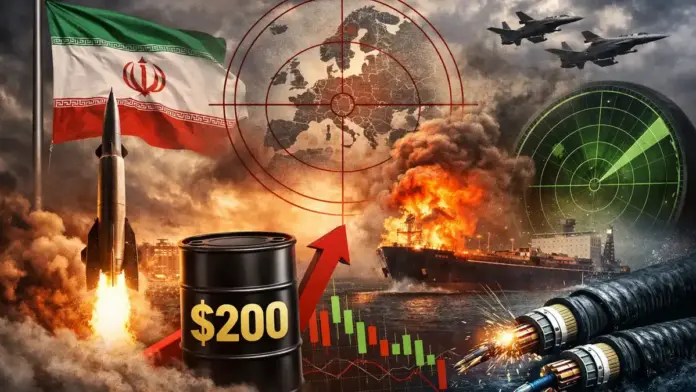
One of the loudest claims now circulating is that Iran will “cut the internet cables.” As it is being widely repeated, that claim is not clearly verified by strong primary reporting from outlets like Reuters or AP. There are real concerns around undersea cable vulnerability, especially in regional maritime bottlenecks, and there are secondary reports discussing possible threats or fears around Red Sea cable routes.
But vulnerability is not the same thing as a confirmed Iranian operational decision to sever global internet infrastructure. That distinction matters. Right now, this belongs in the category of serious risk discussion, not established fact.
The same caution applies to the claim that oil is “going to $200.” That number is currently better understood as an extreme fear scenario than as the main evidence-based forecast. The strongest public reporting available points to $110 in the near term and a $135 peak under a severe disruption case. That is already a major shock. There is no need to inflate it into a headline number that goes beyond what the strongest available reporting supports.
Iran is not threatening only with missiles. It is threatening with uncertainty
This may be the most important point in the whole story.
Iran does not need to carry out every extreme threat in order to impose real cost. It only needs to make enough of those threats seem plausible enough for oil traders, insurers, shipping firms, energy planners, and governments to react. In geopolitical crises, uncertainty itself becomes a weapon. It raises prices. It reshapes routes. It hardens military planning. It makes the world more expensive before a worst-case event even happens.
That is why the core question is no longer just what has been struck. The deeper question is what systems now have to live under the assumption that they could be struck next: oil lanes, desalination systems, export terminals, maritime insurance chains, and possibly data-adjacent infrastructure. Once that happens, the conflict has already moved from local war into systemic stress.
Europe is part of the conversation, but it is not the whole story
This is also where the missile-range debate enters. Reuters reported that Israeli military officials said Iran had used long-range ballistic missiles of around 4,000 kilometers and argued that such range could theoretically place European capitals within reach. Britain, however, publicly said it had no such confirmed assessment.
The disciplined conclusion is not to dismiss the warning, but not to overstate it either: Israel is trying to widen the strategic frame of the threat, while European governments have not fully adopted that framing as verified operational fact.
So yes, Europe has entered the discussion. But Europe is not the whole issue. The larger issue is whether the crisis is becoming a standing source of global instability in which the Middle East repeatedly exports shocks into energy, shipping, infrastructure, data routes, and financial confidence. That is the real global dimension.
Where the next day could lead
This is where a serious explain piece has to go further than the headlines.
The first scenario is controlled but hard escalation. In this path, Iran keeps striking, threatening, and pressuring Hormuz and regional infrastructure without crossing into a move so extreme that it triggers a fully uncontrollable global rupture. This is probably the most realistic near-term scenario because it allows Tehran to keep imposing cost without automatically inviting maximum retaliation at once.
The second scenario is a war on critical infrastructure. In that case, the conflict moves more directly into energy systems, desalination facilities, export terminals, logistics nodes, and other civilian-supporting networks. If that happens, the war stops being measured mainly in strikes and interceptions. It starts being measured in water, electricity, shipping access, and a state’s ability to preserve basic normality for its people.
The third scenario is gray-zone disruption without a single dramatic declaration. This would not necessarily mean a formal announcement about cutting cables or closing every route. It could mean incidents, signal interference, rerouting, maritime risk, infrastructure scares, and a widening perception that more parts of the global system are vulnerable than markets had assumed.
This is one of the most dangerous scenarios precisely because it may arrive as a sequence of pressures rather than one spectacular event. The public claim about internet cables is not sufficiently verified today, but the vulnerability discussion is not imaginary.
The fourth scenario is a temporary diplomatic brake before the worst shock. AP reported that Trump delayed planned strikes on Iranian power infrastructure by five days amid mediation efforts and claimed productive talks were underway, while markets reacted sharply. That shows how sensitive the system already is to even small shifts in signaling. A narrow de-escalation window still exists. But it shrinks every time the war shifts deeper into infrastructure threats and coercive uncertainty.
What the truth actually points to
The truth does not point to easy slogans. It points to a hard but clear conclusion.
Iran is not harmless, not finished, and not operating only at the level of cheap rhetoric. It is still capable of striking, threatening, pressuring, and forcing the world to think in terms of energy insecurity, maritime risk, and infrastructure vulnerability. At the same time, serious journalism has to say the second half just as clearly: not every viral escalation claim is a verified fact.
Readers who want to follow the wider regional picture can continue through Newsio’s broader EN Geopolitics coverage, where the conflict is tracked across infrastructure, security, and strategic escalation.
The internet-cables story is, right now, more a risk field than a proven operation. The $200 oil headline is, right now, more an extreme fear scenario than the main evidence-based forecast. But the energy shock is already real, and the logic of infrastructure war is already open.
That is where the next day leads if the crisis keeps deepening.
If Iran moves from missiles into sustained pressure on infrastructure systems, then this stops being only another violent Middle Eastern war. It becomes a global shock across energy, supply chains, maritime security, and digital stability. At that point, the real question will no longer be only what is happening in the region. It will be what parts of the world system can still be called stable.