
Table of Contents
Islamist-tinged protests, pro-Iran mobilizations, and anti-Western slogans: what is documented, what is exaggerated, and what matters now
There is a real pattern here, but it is not the cartoon version circulating online. In several countries, authorities are dealing with Islamist protests/demonstrations that are openly pro-Iranian, heavily charged by Al Quds Day politics, or shaped by hardline anti-Western rhetoric.
In some cases, police and governments are responding not as if these are routine marches, but as if they carry a serious risk of public disorder, extremist messaging, or direct confrontation. That part is real. Reuters reported this week that British authorities banned the annual pro-Iran Al Quds march in London because of “extreme tensions” and the risk of severe public disorder.
But the second part matters just as much: it is analytically weak and politically dangerous to turn that reality into the blanket claim that “Muslims all over the world are rising up against the West.” The documented record supports a narrower and more serious conclusion.
There are specific mobilizations, specific organizers, specific ideological ecosystems, and in some cases specific slogans or symbols that alarm authorities. That is not the same thing as a unified global Muslim front. Serious reporting has to separate radical networks, regime-aligned mobilization, and politically charged protest culture from sweeping claims about entire religious communities.
Reuters and other major reporting on the London case focus on public-order risks, prior arrests, and the specific profile of the Al Quds event, not on collective blame against Muslims as a whole.
What is actually being documented
The clearest current case is London. Reuters reported that British police banned the annual Al Quds march, backed by the Home Office, after warning of “extreme tensions,” severe disorder risks, and likely clashes with counterprotesters. Police also pointed to past Al Quds events that had led to arrests involving support for terrorist organizations and antisemitic offenses.
Reuters further reported that, even after the march ban, police planned to use the River Thames as a physical barrier between a pro-Iranian static rally and its opponents, with around 1,000 officers deployed.
That is not symbolic concern. It is a state-level assessment that a specific protest environment had become unusually volatile. The Guardian independently reported that the march was considered at significant risk of serious public disorder and that the annual event had previously drawn controversy over displays linked to Hezbollah and to Iran-aligned political messaging.
In the United States, the picture is less centralized but still relevant. Coverage of this year’s Al Quds Day activity described planned protests in cities such as New York, Chicago, and San Francisco, with critics arguing that some organizers or associated rhetoric cross from political protest into open glorification of extremist actors or hardline anti-Western narratives.
Those claims should be handled carefully, but they do show that authorities and analysts are not treating these mobilizations as politically neutral street theater.
Why Western authorities are increasingly concerned
The concern is not just about crowds. It is about the mix that can appear inside these environments: regime-linked symbolism, slogans that test legal limits, past associations with support for banned groups, and geopolitical timing that raises the risk of confrontation.
Reuters reported that British police tied their assessment directly to the war environment, the anticipated counterprotests, and the disorder risk around the London Al Quds event. The Financial Times separately noted that recent Iran-linked security concerns in Britain added to the sensitivity around the march.
This is where serious analysis matters more than panic. Not every march with Palestinian flags, Muslim participants, or anti-war language belongs in the same category. But neither should every demonstration be treated as harmless by reflex when authorities are documenting a pattern of escalating tensions, prior arrests, and ideological signaling around specific events.
The right approach is discrimination in the analytical sense: identify what exactly is being organized, who is behind it, what slogans are being tolerated, and where the line from protest into intimidation, incitement, or glorification of violent actors begins.
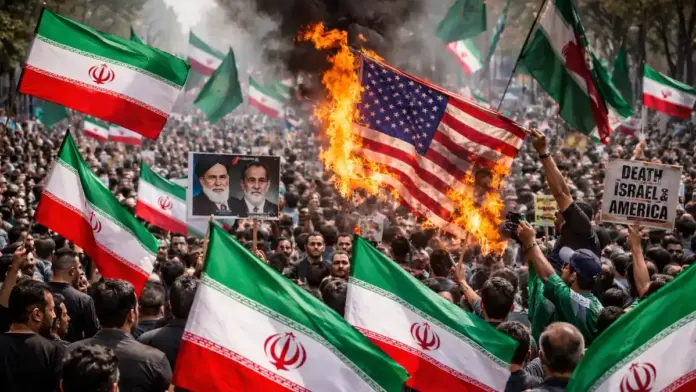
That is also why verification discipline matters. In our earlier Newsio analysis on casualty claims from Iran, we explained how emotionally loaded narratives often outrun verified evidence. The same discipline applies here. A frightening image, a burning flag, or a viral clip may be real, but it still needs context before it is used to describe an entire population or a worldwide trend.
Where the easy generalizations go wrong
The biggest analytical error is to collapse everything into one category. Iran’s regime, Iran-aligned activism, Shiite political theater around Al Quds Day, Sunni jihadist rhetoric, anti-Western street anger, anti-Israel protest, and ordinary Muslim participation in public demonstrations are not interchangeable. They overlap in some moments, but they are not the same thing. Once all of them are merged into a single label, the result is not clarity. It is distortion.
That distortion is not harmless. It can feed collective blame, lower the quality of threat assessment, and make it harder to identify the actors who actually matter. If a city is facing a protest where support for banned groups or explicit incitement is the problem, then that is what should be named. If a protest is mainly oppositional, symbolic, or politically inflammatory without crossing into illegality, that should be named too. Good journalism becomes useless the moment it starts treating every Muslim crowd as evidence of global Islamist alignment.
This is also consistent with Newsio’s correction policy: facts have to be separated from projection, especially in fast-moving stories where ideology tries to outrun verification.
What the anti-Western imagery really means
Images of burned flags, threatening chants, or aggressive anti-Western symbolism matter because they communicate political intensity and, at times, open hostility. They should not be brushed aside. But they also should not be allowed to do all the analytical work by themselves. One image can go viral globally in minutes and create the impression of a coordinated worldwide uprising even when it captures only one place, one faction, or one especially theatrical moment.
That is why external sourcing has to be strong. For this topic, the most useful anchor remains Reuters’ reporting on the London Al Quds ban, because it gives the story a verified institutional frame: who banned what, why it was banned, and what risks the authorities said they were managing. That is much stronger than trying to build the entire analysis on social media clips.
What readers should take away
There are real pro-Iran and Islamist-tinged mobilizations in multiple countries. Some feature rhetoric, symbolism, or organizational backgrounds that legitimately concern Western authorities. In at least one major current case, London, police and the government judged the risk serious enough to ban the annual march and prepare extraordinary separation measures for rival groups.
But the evidence does not support the lazy conclusion that Muslims worldwide are acting as one unified anti-Western bloc. That claim is broader than the facts. The real task is harder and more important: identify the specific protest ecosystems, the radical networks, the regime-linked messaging, and the public-order risks without turning serious analysis into blanket civilizational blame. That is where the story actually is.