

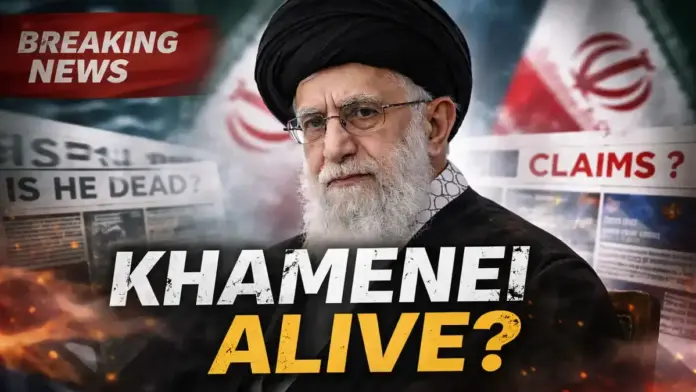
What we know so far
In a crisis, “confirmed” can mean two very different things. It can mean a fact is settled beyond reasonable doubt. Or it can mean something more limited: that a specific institution or official has said something publicly. When the story is about the fate of a top leader, that distinction is everything—because information itself becomes part of the conflict.
Right now, the most verifiable point is not the final truth of Khamenei’s condition. It’s that Iran’s state-linked media ecosystem is pushing a clear line: Ayatollah Ali Khamenei is alive. Multiple reports describe Iranian outlets and aligned channels rejecting death claims and presenting the story as psychological warfare or hostile propaganda. That is a confirmed position.
At the same time, rival claims—linked to opposing actors and political messaging—have pointed in the opposite direction. The result is a familiar pattern in modern escalation: two narratives racing to become reality in the public mind before reality is institutionally locked.
To understand why Iran’s internal messaging matters so much in moments like this, it helps to keep the broader context in view: Iran 360: what’s happening now, what people are demanding, and the realistic outlook for 2026.
The question most readers instinctively ask is simple: “So is he alive or not?” The honest answer is that a newsroom can’t trade clarity for speed. What we can do is state, precisely, what has been confirmed at each layer—and what still isn’t locked.
What is confirmed (as statements and transmissions)
-
Iran’s state-linked outlets and aligned messaging are publicly asserting that Khamenei is alive.
-
International coverage has explicitly framed the situation as contested, noting the absence of a single, universally accepted institutional confirmation that ends the dispute in one direction.
That is enough to write one safe, accurate sentence: Iran’s state-linked media says he is alive. It is not enough to write: It is confirmed he is alive.
What is not confirmed as a settled fact
-
A single, definitive, widely accepted institutional closure of the matter that leaves no room for competing claims.
This may sound like cautious language, but it’s the core of credibility. In tightly controlled systems, leadership announcements can be delayed for security, succession management, or deliberate ambiguity. Conversely, external claims can be amplified for deterrence or psychological effect. Both dynamics can be true at once.
This is also the precise environment where misinformation thrives: a vacuum of hard proof filled by confident claims. For a practical, reader-first way to follow such stories without being pulled into manipulation, the best baseline rules are here: How to read the news without being manipulated: fact-checking habits, sources, and propaganda signals.
For readers who want a high-authority anchor to the broader reporting record and how major outlets are framing the competing claims, here is the baseline reference many newsrooms use when tracking the claim-versus-denial timeline: Reuters.
What this means for you
If you want a clean understanding, not a fast one
This is the disciplined way to read the situation:
-
Treat “Iran’s state-linked media says he is alive” as a confirmed statement.
-
Treat all opposing claims as claims unless and until they are institutionally locked by unmistakable evidence.
-
Watch for the next indicators that close the gap.
Why the “alive” narrative matters—even if it’s only a narrative
If Iran’s aligned media insists he is alive, that message is doing work. It is meant to:
-
prevent a perception of a power vacuum,
-
protect internal cohesion,
-
and deny adversaries the psychological victory of suggesting the apex has fallen.
Whether that message is reflecting reality or strategy, the intent is the same: stabilize the system during high pressure.
What would actually “lock” the picture next
If this story becomes settled beyond reasonable doubt, you’ll typically see:
-
unambiguous signals from official channels that do not rely on inference,
-
sustained convergence across major agencies on one independently supported core,
-
and, if relevant, visible continuity or succession cues that eliminate ambiguity.
Until then, the most accurate headline remains the one that respects the evidence: Iran’s state-linked media says he is alive, while the wider information environment remains contested.
• Summary: The confirmed element is the message: Iran’s state-linked media ecosystem says Khamenei is alive. The unresolved element is the final, universally accepted fact amid competing claims.