

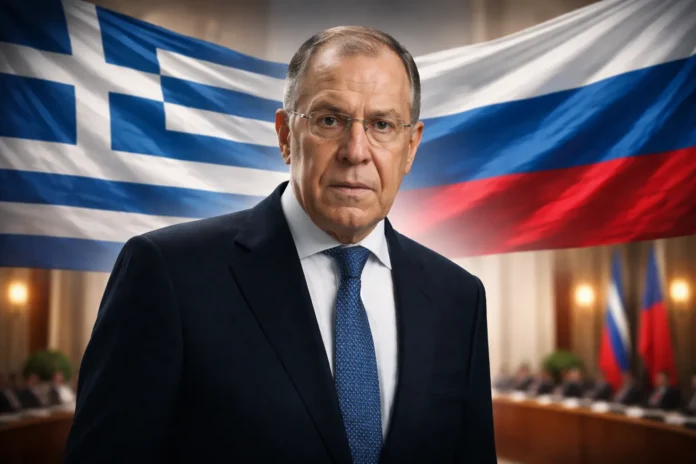
Lavrov’s remarks on Greece: what he said, why the tone matters, and what changes in practice
Russia’s Foreign Minister Sergey Lavrov publicly criticized Greece, arguing that Athens bears responsibility for the deterioration of bilateral ties after 2022.
The remarks matter because they function as diplomatic signaling: they show how Moscow frames Greece’s role inside the broader European response to the war in Ukraine. This explainer sets out what was said, the wider context, and what realistically changes—or doesn’t—for everyday life and business, without hype.
What Lavrov said about Greece
In Russia’s official framing and in international reporting, Lavrov’s message is that Greece has effectively “closed” long-standing channels of cooperation and aligned itself fully with the EU line on Ukraine. The core points are presented as:
-
Greece’s post-2022 choices led to a sharp downgrading of political and practical cooperation.
-
Athens is portrayed as part of a wider European posture against Russia.
-
The downturn is framed as Greece’s political decision rather than a purely bilateral dispute.
This is the key distinction: a statement of this kind is rhetorical pressure and narrative positioning, not a new legal regime or a new set of immediate restrictions.
Why the rhetoric is resurfacing now
Diplomatic rhetoric tends to intensify when two things happen at the same time: the conflict environment remains volatile, and the messaging battle becomes as important as the policy moves. In that sense, Lavrov’s remarks sit within a broader pattern of Kremlin signaling around escalation and pressure points, including what has been described as heightened risk messaging around Kyiv in recent coverage such as Kyiv under fire ahead of high-stakes talks: Moscow’s message.
The broader context: what actually changed after 2022
The practical EU-Russia relationship shifted sharply after 2022, and Greece’s posture is largely shaped inside the EU framework.
Diplomatic channels
High-level engagement has become more constrained, with fewer “normal” cooperation tracks and a higher political cost for re-opening them.
Compliance environment
The most tangible impacts are rarely created by statements. They come from compliance reality—how banks, insurers, carriers, and counterparties interpret sanctions risk and apply controls. That’s why the “real-world” consequences are often procedural: more checks, slower approvals, and higher friction.
For the official EU framework on restrictive measures against Russia, the authoritative reference point is the European Council’s sanctions page: European Council – EU restrictive measures against Russia
To understand how legal and political pressure can reshape the public debate around enforcement, it helps to look at how international actors frame accountability questions—such as in Would you arrest Putin? What Trump said, what Moscow signals, and why the arrest debate changes the game.
Public atmosphere
Harder language narrows the space for normalization. Even without new formal measures, it can keep relations in a low-trust mode for longer.
Practical takeaways for citizens and businesses
What this means in practice
For everyday life
-
A diplomatic statement does not automatically translate into immediate changes for citizens.
-
If anything changes, it typically comes through formal decisions and enforcement patterns, not headlines.
-
The most immediate effect is indirect: rhetoric reinforces uncertainty and keeps relations colder for longer.
For businesses and professionals
-
The key word is compliance. When geopolitical risk feels higher, institutions become more conservative.
-
Expect tighter documentation standards and longer processing times in sensitive cross-border contexts.
-
Most of the impact is operational rather than dramatic—delays and risk checks, not sudden “new rules” overnight.
For national security and institutional posture
Hardening rhetoric also tends to raise sensitivity around security narratives and risk assessment. Greece has seen domestic public attention intensify on security-related cases, and that atmosphere can shape how officials and institutions communicate. A relevant example in the Newsio archive is Military officer arrested for espionage: what is known and what is being examined.
How to read this without overreacting: three simple questions
-
Is it a statement or a decision? Decisions come with written measures, dates, and implementation.
-
Does anything change in the compliance environment? If not, impact is usually indirect and limited.
-
Is there a follow-up action? Formal steps—not rhetoric—signal a shift from messaging to policy.
For readers who want a disciplined way to separate narrative pressure from verified developments, Newsio’s media-literacy guide How to read the news without being manipulated offers a practical checklist approach.
What to watch next
Three outcomes are most realistic:
-
Rhetorical escalation without practical escalation: sharper language, but no immediate new measures.
-
More public exchanges: statements that keep the issue visible without changing the baseline.
-
A shift driven by wider EU-Russia developments: new enforcement moves or conflict developments that alter the policy environment.
Closing
Lavrov’s remarks are best understood as a diplomatic signal that reinforces Moscow’s narrative about the post-2022 rupture.
For Greece, the practical impact is determined less by rhetoric and more by formal decisions and institutional risk behavior. Until concrete measures appear, the immediate effect is mainly on the atmosphere—not on day-to-day rules.