
Table of Contents
The leader is absent, “victory” is everywhere: why Tehran’s propaganda is louder than reality
This is not peace
The cleanest way to begin is also the most important: the two-week U.S.-Iran pause does not read like peace. It reads like a fragile suspension inside an active crisis, with Washington holding military pressure in place and Tehran trying to turn a temporary halt into a political story of endurance and success.
Reuters reported that President Donald Trump said U.S. forces would remain around Iran until Tehran complies, which makes clear that Washington does not see this phase as a final settlement.
That changes the meaning of everything that followed. If one side keeps forces in place, keeps demanding compliance, and keeps Hormuz at the center of the dispute, then a pause is not the same thing as resolution. It is a political and strategic interval. That is why the stronger reading is still the most accurate one: this is a pause under pressure, not a peace agreement that closed the crisis.
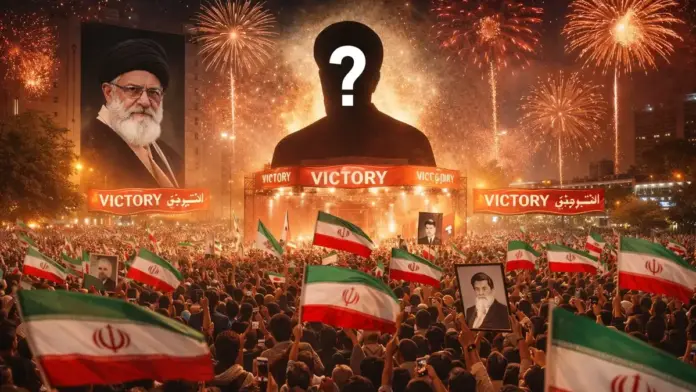
“Victory” is everywhere. The leader is absent.
This is where the propaganda question becomes impossible to avoid. Tehran’s regime machine and pro-regime circles are trying to present the two-week pause as proof of victory, or at least proof that Iran stood its ground against the United States and Israel. Reuters’ own photo coverage showed crowds gathering in Tehran after the pause was announced, with anti-American and anti-Israeli symbolism on display.
But the heaviest question remains standing: if this is truly such a great victory, where is the leader to stand in front of the nation and own it? That is not a theatrical question. It is the core analytical question. Because when victory slogans grow louder while visible leadership grows thinner, the celebration begins to look less like confidence and more like narrative maintenance. The message keeps speaking. The center of authority becomes harder to see.
There is credible reporting that the current supreme leader, Mojtaba Khamenei, has not projected the kind of stable, fully public command presence a regime would normally want in a moment it calls historic. El País reported that his whereabouts remained unclear while the regime tried to project continuity and deny any power vacuum. That does not prove collapse. It does show why the propaganda needs to work so hard.
Why regimes sell survival as triumph
Authoritarian systems do not only fight on the battlefield. They fight over meaning. A pause can be sold as victory if the system needs it badly enough. Survival can be reframed as strategic proof. A temporary escape from immediate escalation can be repackaged as proof that the enemy blinked first. That is how propaganda works when real conditions are too unstable to offer genuine certainty.
That is why the current victory narrative should be read with discipline. Reuters’ broader reporting has described Iran not as a clean strategic winner, but as bruised while still retaining leverage through the Strait of Hormuz. That is a very different picture from regime triumph. It means Tehran still has dangerous tools. It does not mean it reversed the balance of power.
For readers following Newsio’s wider English coverage, this article naturally connects with Trump did not buy peace — he bought time from a position of strength, The U.S. strategy toward Iran: the pressure points that could shape the next phase, and Iran: Pezeshkian’s Letter and the Regime’s Double Language. Those articles matter here because they help separate battlefield optics, regime messaging, and strategic reality.
The military stayed. That matters more than the slogans.
One reason the victory narrative rings hollow is that the visible U.S. posture does not look like retreat. Reuters reported that Trump said American military assets would remain around Iran until compliance is achieved.
That is not how a government speaks when it believes a war is over on negotiated terms acceptable to both sides. It is how a government speaks when it believes the current pause still serves coercive leverage.
This does not require inflated claims about secret plans or unseen redeployments. The public posture is already strong enough. A side that keeps forces in place, keeps the threat of renewed action alive, and keeps Hormuz at the center of its demands is not behaving as though the crisis is behind it. It is behaving as though time itself is now part of the strategy.
That is why “the military stays there” is not just a line. It is one of the central facts of the moment. The pause did not erase the pressure. It only changed its tempo. This article also fits into the same internal Newsio logic as Trump–Iran: The 10–15 Day Window and Strike Claims Explained, because both pieces are ultimately about how time, force, and narrative interact under pressure.
The people of Iran are not the regime
This distinction is not optional. It is the moral and analytical center of the story. The people of Iran are not the regime ruling them. They are not the same thing politically, morally, or informationally. A serious publication cannot confuse state-managed messaging with the free judgment of an entire society.
That matters even more in a moment like this because the public U.S. posture, as reported, is framed around compliance, maritime access, strategic leverage, and regional security. There is no comparable public evidence in the reporting here that Washington is framing the Iranian population itself as the target. The visible confrontation is about regime conduct, not about reducing an entire nation to its rulers.
For readers who want this line kept morally clear, Newsio’s The Regime in Tehran, the Billions It Reached, and the People It Never Chose to Build and Iran: no new mass uprising confirmed this week remain important internal reference points. One crisis should not erase the distinction between a controlled regime and the people forced to live under it.
Information control is part of the story
There is another reason the victory narrative should be treated with caution: information inside Iran does not move under normal free conditions. The Guardian reported that Iran has been living through one of the longest national internet shutdowns since the Arab Spring era, sharply limiting open access to information and public visibility. That does not make outside information impossible. It does mean the internal information environment is heavily distorted.
This matters because propaganda works best when reality cannot circulate freely. A population with limited digital visibility is easier to flood with curated symbols of success, selective footage, and emotionally loaded claims of resilience. That does not mean all Iranians believe the same story. It means the regime has a structural advantage in shaping what many people can see first and question later.
This is one reason communication itself becomes part of the deeper moral issue. In freer societies, information can travel with relative ease. In authoritarian systems, truth often has to squeeze through filters, risks, and deliberate blockage. That difference is not abstract. It changes how victory, fear, and reality are experienced by entire populations.
Hormuz is still the real test
If there is one place where the truth of the pause becomes visible, it is the Strait of Hormuz. Reuters reported that Iran would allow no more than 15 vessels per day through the strait, far below normal commercial conditions. That alone is enough to show that this crisis has not returned to normality. It has only shifted form.
That is why Hormuz matters more than victory slogans. As long as shipping remains restricted, politically managed, or exposed to sudden risk, the crisis is still alive at its core. Reuters also reported that Trump warned Tehran against charging tolls in the strait, while the U.N.’s maritime agency said any such move would set a dangerous precedent. This is not symbolic politics. It is direct pressure on one of the world’s most important energy chokepoints.
The strongest external authority link in this article belongs naturally here: the International Energy Agency’s analysis of the Middle East and global energy markets helps explain why disruption in Hormuz affects energy security, shipping stability, and the wider global economy. On the Newsio side, this article also links naturally to Strikes on energy infrastructure and a ship hit in the Strait of Hormuz and Fuel Prices Surge: How wars move oil markets and what the public should actually watch. One crisis. Multiple connected angles. One coherent explanation.
What is really at stake now
Three things are at stake at once.
First, Washington wants to know whether military and coercive leverage can produce a clearer political result. The pause only serves the White House if it yields something tangible: freer passage, clearer compliance, or proof that pressure worked. Reuters’ reporting on U.S. demands and posture makes that test obvious.
Second, the credibility of U.S. power is on the line. This is not just about one bilateral confrontation. It is about whether a superpower that claims to defend maritime order can actually restore confidence in one of the world’s most important shipping corridors. Reuters reported diplomatic pressure around Hormuz commitments from allies, which shows how quickly the issue scales beyond the immediate fight.
Third, the global economy remains exposed. Market relief after the pause may have reduced immediate panic, but it did not restore normal conditions. Shipping restrictions, uncertainty in Hormuz, and energy sensitivity all show that the system has taken a breath, not found stability.
The clean conclusion
The sharpest conclusion is also the clearest one:
The leader is absent. “Victory” is everywhere. Reality is harder than the slogans.
Tehran’s propaganda is trying to outrun the facts. But the public facts still point to a fragile pause, continued U.S. pressure, restricted Hormuz traffic, and a regime that needs to speak louder precisely because the underlying reality is less secure than its messaging suggests. That is the real shape of this moment.